A new report commissioned by the Transatlantic Consumer Dialogue (TACD), and supported by the Heinrich-Böll-Stiftung's EU | Global Dialogue and Washington, DC USA | Canada | Global Dialogue offices, highlights mounting concerns that international trade agreements are creating barriers to consumers’ right to repair the products they own. As everyday devices from smartphones to tractors become ever more reliant on software, restrictive clauses in free trade agreements are making it harder for consumers and independent repairers to access the tools and information they need for effective repairs.
The Digital Services Act (DSA) is now in force, but climate disinformation is not explicitly recognised as a “systemic risk”. With this regulatory gap in mind, we set out to examine how platform responses to climate disinformation evolved or failed to evolve between 2023 and 2025, and what their policies look like in practice.
Northern EU accession is becoming a political possibility that requires attention. Bundling enlargement could help build momentum. A carefully sequenced enlargement round that includes both Nordic and southeastern and eastern candidates could reinvigorate a fatigued debate. However, the EU needs to be careful to only incentivise, rather than push, EU accession.
A majority of citizens in Germany have a positive view of the new federal government‘s pledge for a stronger leadership role in the EU, but clearly advocate for doing so in a cooperative manner. These findings come from the latest edition of our long-term study 'Actually European!?' on Germany’s role in the EU.
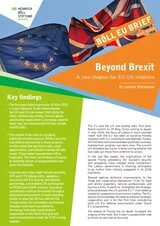
The EU and the UK are holding their first post-Brexit summit on 19 May. Since coming to power in July 2024, the focus of Labour’s much-vaunted ‘reset’ with the EU has been on building friendly relations with EU institutions and Member States. Whilst these overtures have been positively received, (substantive) progress has been slow. The summit will therefore be crucial in determining whether the two sides can move from ambition to action.
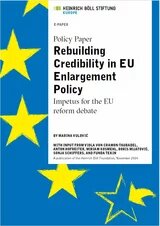
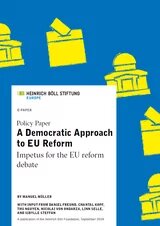
The European Union has many candidates for membership. It is currently conducting negotiations with Albania, North Macedonia, Ukraine, Moldova and Bosnia and Herzegovina. However, the accession processes are complicated. The current policy paper on the reform debate analyses the arguments for and against a rapid enlargement of the EU and provides recommendations for policy-makers.
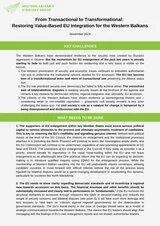
The Western Balkans have demonstrated resilience to the security risks created by Russia’s aggression in Ukraine. But the momentum for EU enlargement of the past two years is already starting to fade as both pull and push factors are weakening and a new stasis is visible on the horizon.
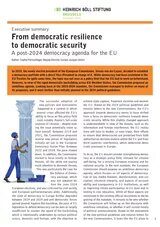
Based on the 2024 political guidelines and mission letters to the new European Commissioners, the EU’s approach towards democracy seems to have shifted from a focus on democratic resilience towards democratic security. After a thorough examination of the EU’s 2019-2024 democracy agenda, this study presents recommendations for the next legislative cycle.
This policy paper makes some suggestions as to how reforms could be possible with and without treaty changes and how the EU can preserve its future viability.
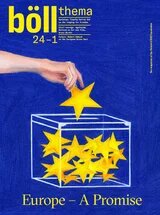
War in Europe, the worsening climate crisis, Europe's position in the global power structure: the EU is facing historic challenges. The European elections in June 2024 will decide what happens next. Current surveys see right-wing populist parties on the rise. They stir up fears about the future and stir up sentiment against Brussels without themselves having answers to the problems of our time. But we need positive and courageous ideas for Europe.
The EP 2024 elections could either invigorate the EU enlargement process or introduce new challenges, making it imperative to explore the possible impacts and strategic responses for the Western Balkans in this evolving context.
The 2024 presidential and parliamentary elections in North Macedonia occurred amidst increased Euroscepticism due to unmet high expectations for progress towards EU membership and failed promises to deliver justice and the rule of law in the country.
Heinrich Böll, a renowned German author, achieved bestselling status with his poignant works. In 1972, he made history by becoming the first German writer to receive the Nobel Prize for Literature after World War II. His novels and stories, still widely studied in schools today, have earned him a place among the literary classics. However, the personal experiences and motivations that shaped Böll's writing remain lesser known. This concise introduction aims to shed light on the life and driving forces behind one of Germany's most influential post-war voices.
The sixth edition of the long-term study Actually European!? examines how the German population views the European elections and what they expect from their government at the EU level, ahead of the 6-9 June 2024 European elections.
This study aims to take stock of the progress of the last decade, as well as identify remaining barriers and new opportunities for women CSO leaders in achieving systemic change in Europe. The key findings indicate a concerning trend of burnout among women leaders in the CSO sector, hindering their efforts to drive systemic change.
Political Capital Institute’s latest study, in cooperation with the Heinrich-Böll-Stiftung Prague, aimed to give a snapshot of the state of populist radical parties and their cooperation and the Hungarian government’s role in it, before the campaign starts for the 2024 European Parliament elections.
The core of the EU’s relationship with the WB lies in the promise of full accession with equal rights and responsibilities. As the EU enters a period of reflection and potential reform, it must reintroduce clarity, determination, and honesty into its interaction with WB6.
The EU is going through a critical moment in its history, expected to deliver on many fronts at once, from long-term transitions to crisis after crisis that has threatened to seriously upset its stability. It would be wrong, however, to assume that the EU can afford to ignore its deepest perennial challenge, namely its own democratic credentials. To offer ideas for the debates that will necessarily unfold, especially as we move towards the 2024 European Parliament elections, SWP and CEPS set up a High-Level Group on bolstering EU democracy.
This factsheet delves into platforms’ policies on climate change misinformation, focusing on Facebook, Instagram, TikTok, X/Twitter and YouTube and their actions are currently in place to limit the impact of such content.