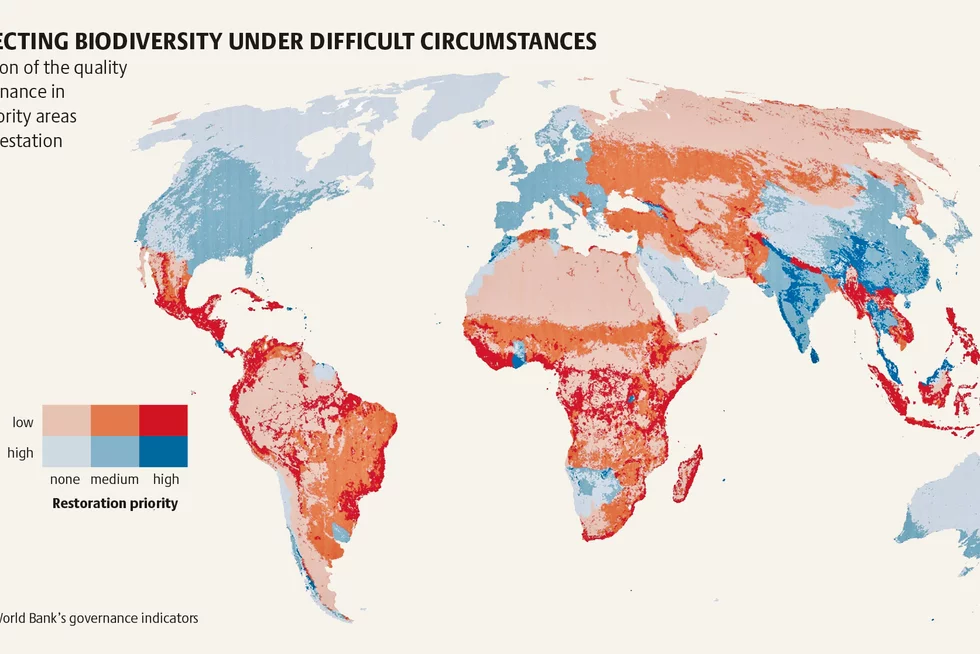
Climate policy: conflicts between demand for land and people's rights Published: 12 November 2024 Soil Atlas 2024 Soil plays a major role in protecting the environment. It serves as carbon reservoirs, the plots into which trees are planted, and a steward for producing climate-neutral fuels. But land-intensive climate action can give rise to conflicts and erode people’s rights. Even so, there is yet to be a resolution for this mounting global challenge in sight. David Betge, Frederike Klümper, Dr. Jes Weigelt
Soil carbon credits: blessing or curse? Published: 12 November 2024 Soil Atlas 2024 The world’s soils store more carbon than its forests, and this storage capacity is increasingly discussed as a contributor to climate protection. Tradable carbon credits were designed to incentivise the build-up or retention of carbon in the soil. However, they may in fact undermine efforts to reduce emissions. Sophie Scherger, Larissa Stiem-Bhatia
Human rights: rights versus reality Published: 12 November 2024 Soil Atlas 2024 Equitable access to land and fertile soil is fundamental to realising human rights, such as the right to food. Although numerous United Nations declarations on land rights have been ratified by national governments, deadly land conflicts persist throughout the world. Dr. Jes Weigelt, Frederike Klümper
Women and land: protecting rights, protecting soils Published: 12 November 2024 Soil Atlas 2024 Secure land access is essential for long-term soil protection because it enables land users to implement practices that enhance soil health and maintain its productivity over time. However, in many African countries, women’s land rights remain precarious, creating significant barriers to investing in sustainable soil management. Larissa Stiem-Bhatia, Kader Baba, Serah Kiragu-Wissler, William Onura
European Union: Soil protection? Wanted! Published: 12 November 2024 Soil Atlas 2024 Protection measures for climate, water, and biodiversity have been enshrined in EU law – in some cases, for decades. But a comprehensive legal framework for soil protection is still lacking. Previous attempts to create one have been torpedoed, while most existing policies are toothless. André Prescher-Spiridon
Agroecology: policies that keep soil alive Published: 12 November 2024 Soil Atlas 2024 Agroecology is a response to an industrial model of agriculture that exploits people and damages soils. In Brazil, agroecology is making significant breakthroughs in social and environmental terms. But one thing is already clear: government policy is needed to promote agroecology and confront the agroindustrial model. Júlia Dolce, Lucas Gattai
True costs: hidden effects Published: 12 November 2024 Soil Atlas 2024 Land degradation has numerous invisible costs – environmental, health, social, and economic. True Cost Accounting renders these costs visible, offering a clearer picture of the impact of land degradation. Olivia Riemer, Marlene Ohlau, Jenny Lay-Kumar, Mark Schauer
Sustainable soil restoration: reviving India's soils for a better future Published: 12 November 2024 Soil Atlas 2024 Modern farming techniques were introduced to India during the Green Revolution of the 1960s to meet the needs of a rapidly growing population. However, the overuse of chemical fertilisers and pesticides, alongside the cultivation in monocultures, severely damaged soil health. In response, many farmers are moving back to alternative soil management practices. Political support for this transition is growing, but requires more flame to ignite change. Pratik Ramteke , Ashok Patra
Regreening the desert: land and soil restoration in the Sahara and Sahel Published: 12 November 2024 Soil Atlas 2024 The Sahara Desert is expanding, thereby threatening millions of people’s lives and livelihoods. While many large-scale initiatives have been launched to combat desertification, most lack secure funding. Bottom-up techniques, implemented by local farmers, show how Indigenous knowledge can drive restoration. Mawa Karambiri
Soilless agriculture: revolution or illusion? Published: 12 November 2024 Soil Atlas 2024 Vertical indoor farming enables crops to grow all year round. It requires less space and promises to reduce water, fertiliser, and pesticide use, thus protecting both climate and soil. But this must be part of a larger transformation of food systems. Lena Luig, Christian Sonntag