

Böll EU Brief
Cable diplomacy: Securing influence, data and global rules
Böll EU Brief 03/2025
Key findings:
-
The EU should use cable diplomacy to strengthen global infrastructure resilience and become a security enhancer. Despite growing concerns over security and espionage, international cooperation on subsea cables is both possible and strategically smart. The EU can lead by tailored engagement in repair coordination, incident reporting, regulatory alignment, and infrastructure development.
-
The EU should focus on three geographic pillars: Black Sea, underserved African coastal states and Indo-Pacific alliances.
-
Subsea cables should be anchored in multilateral legal frameworks. Beyond geographic priorities, the EU must strengthen global governance. Engagement in bodies like the International Telecommunication Union, International Cable Protection Committee, and UNCLOS is crucial in advancing shared standards, improving incident data exchange, and integrating subsea infrastructure into development and legal cooperation frameworks.
More than 600 subsea data cables connect nearly every coastal country of the world, amounting to a cumulative length of more than 1.5 million km. These fibre optic cables are responsible for over 99% of intercontinental data traffic. They are the digital lifelines of our modern world. Yet, external factors frequently expose vulnerabilities in the network and its supporting infrastructure. While around 150 cable faults occur globally each year, states suspect a growing number of cable faults to be linked to hybrid or malicious activity. In this context, and following recent cable disruptions in the Baltic Sea, the European Union has put forth an EU Action Plan on Cable Security.¹
Recognising that many states around the world face similar risks, the Action Plan proposes to establish “an advanced cable diplomacy”.² But cable diplomacy is not a one-size-fits-all strategy. Technological sensitivities, dual-use aspects and geopolitical considerations demand a tailored approach.
This Böll EU Brief therefore addresses a key question: Where and how should the EU build effective cable diplomacy partnerships?
To address this, the EU’s cable diplomacy should be structured around three geographic pillars, reflecting regional contexts and strategic opportunities. Alongside these regional priorities, the EU must also reinforce its role in shaping global governance for undersea infrastructure, working through multilateral institutions and international standard- setting bodies. By doing so, the European Union can strengthen global resilience of subsea infrastructure and position itself as a security enhancer in the field of critical infrastructure.
Three geographic pillars of cable diplomacy
Black Sea
The immediate priority lies in the EU’s neighbourhood, the Black Sea. Black Sea littoral states show varying levels of dependence on communication networks controlled by authoritarian regimes. Much of Georgia’s and Armenia’s data traffic, for instance, is routed through Russian terrestrial networks – creating vulnerabilities in both data security and infrastructure resilience. An additional Black Sea crossing cable would offer much-needed diversification for the wider Caucasus region. A planned hybrid (energy and data) cable between Romania and Georgia could also deliver green energy from the Caspian region, primarily Azerbaijan, making it a mutually beneficial project.
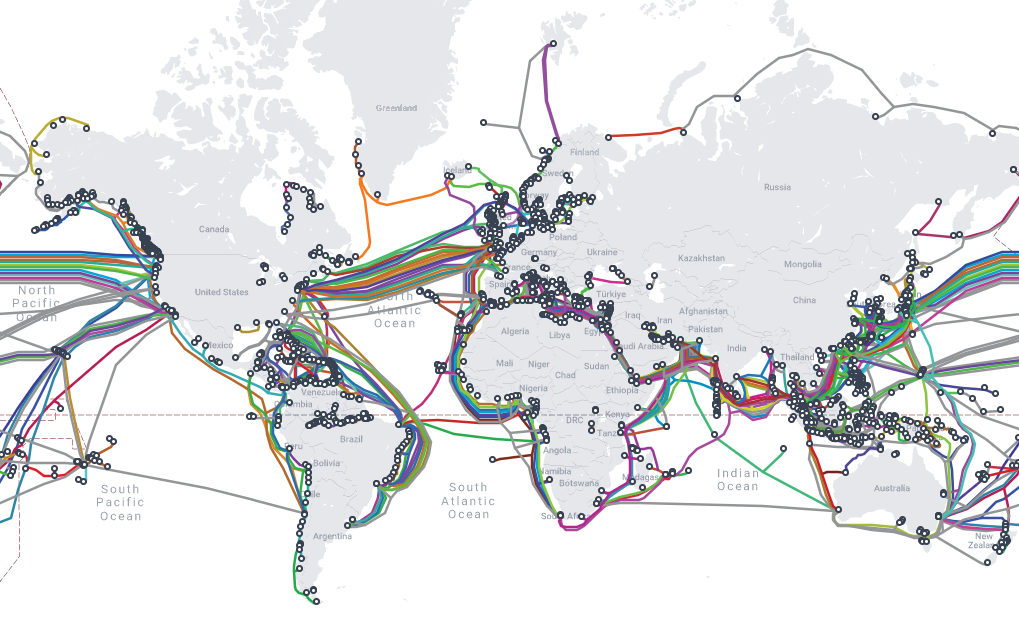
Submarine Cable Map by TeleGeography’s Transport Networks Research Service, CC BY-SA 4.0.
For Ukraine, connecting to the EU through land- and sea-based cables should be a key element of post-war reconstruction and deeper infrastructure integration. Preparatory steps like route planning can begin now, supported by the Connecting Europe Facility.
EU naval assets – including those of Bulgaria and Romania – could assist with mine clearance, while in the long run integrating Ukraine into IRIS² connectivity would reduce reliance on Starlink once the satellite system becomes operational.
A Black Sea-focused cable strategy allows the EU to break digital dependencies on Russia, bolster regional resilience and position the EU as a security enhancer in Eastern Europe and the South Caucasus. In this context, cable diplomacy should be an essential element of the EU’s upcoming Black Sea Strategy to be released end of May 2025.
Underserved African coastal states
As a second pillar, various African countries should be prioritised in cable diplomacy efforts. Africa is both a vulnerable link and a critical transit hub in the global cable network. The West African coast remains alarmingly exposed, with countries like Sierra Leone, Liberia, and Guinea suffering from critically low international redundancy. A 2024 landslide off Ivory Coast that severed four subsea cables starkly illustrated the economic and strategic risks. The EU’s co-funded AFR-IX MEDUSA cable will soon connect Mediterranean littorals, an important step in strengthening connectivity with the African continent.
Likewise, on the East African Coast, countries such as Eritrea (the largest coastal state without subsea cable access), Mozambique, and Somalia face similar vulnerabilities. Recent internet outages in the region, enabled by earlier anchor damages from the Houthi- targeted freighter Rubymar, highlight the risks of low redundancy and alternative subsea connections.
Co-funding commercial cable projects through the European Investment Bank, World Bank, or other development banks would significantly improve resilience and reduce the likelihood of future outages.
By investing in countries on both coasts of Africa, the EU enhances global network resilience, strengthens ties with African states enabling them to become important data hubs, and positions itself as a development partner and infrastructure enabler on a continent of rising geopolitical significance.
Indo-Pacific alliances
The Indo-Pacific is emerging as the most geopolitically contested digital theatre, where cable diplomacy intersects with great-power competition and hybrid threats. As such, the third pillar of the EU’s cable diplomacy should extend to partnerships with well- connected, like-minded countries in this region.
Countries such as India, Japan, and the Philippines face similar challenges as the EU. They also bring valuable technical experience and policy experience to the table. To be effective, such cooperation must be tailored: Japan and India should be treated as strategic priorities. Japan’s experience with pNaumrbaerl1l0e|l icckar ble disruptions due to large-scale seismic events (2006, 2011) positions it as a key partner for structured knowledge exchange on early-warning mechanisms, incident reporting frameworks and emergency response.
India, meanwhile, is actively debating the attraction and expansion of state-supported cable repair capacities, quite similar to the EU Action Plan. This offers the EU an opportunity to engage on state- supported repair assets, which should include far more than repair vessels, but also consider medium- term facilitation of the maintenance sector such as protected spare part depots, education of the skilled workforce and the design of time-efficient solutions for permitting and licensing of cable repairs. While improving incident recovery is essential, both the EU and India should ensure that any state-supported measures complement rather than crowd out the existing commercial repair sector, which operates on relatively narrow profit margins.
In the Philippines and Indonesia, where repair commencement is often delayed by complex regulatory frameworks, EU support could focus on technical assistance and regulatory dialogue to accelerate permitting processes – a need recognised by the European Commission.
EU Member States like Denmark and France offer best practices: Denmark is known for its coherent and timely permitting procedures, even under heightened security scrutiny, while France has streamlined approval processes in 2019. These models could inform targeted cooperation with Southeast Asian partners to support faster and more predictable repair operations.
One of the emerging challenges lies in balancing the principle of freedom of navigation with the need to secure subsea cables, potentially through the interception of vessels. Freedom of navigation grants all states the right to operate freely on the high seas and in Exclusive Economic Zones (EEZs), although coastal states retain certain rights in the latter. As incidents involving suspicious activity increase, states are re-evaluating how to respond effectively without breaching maritime law.³ These cases also present legal and operational challenges when harmful actions cross jurisdictions – for example, when an incident occurs in one state’s EEZ but the vessel involved is located in another’s. To address this, the EU should work with partners to develop shared legal frameworks and operational protocols that enable coordinated enforcement, including the possibility of intercepting vessels in international waters.⁴
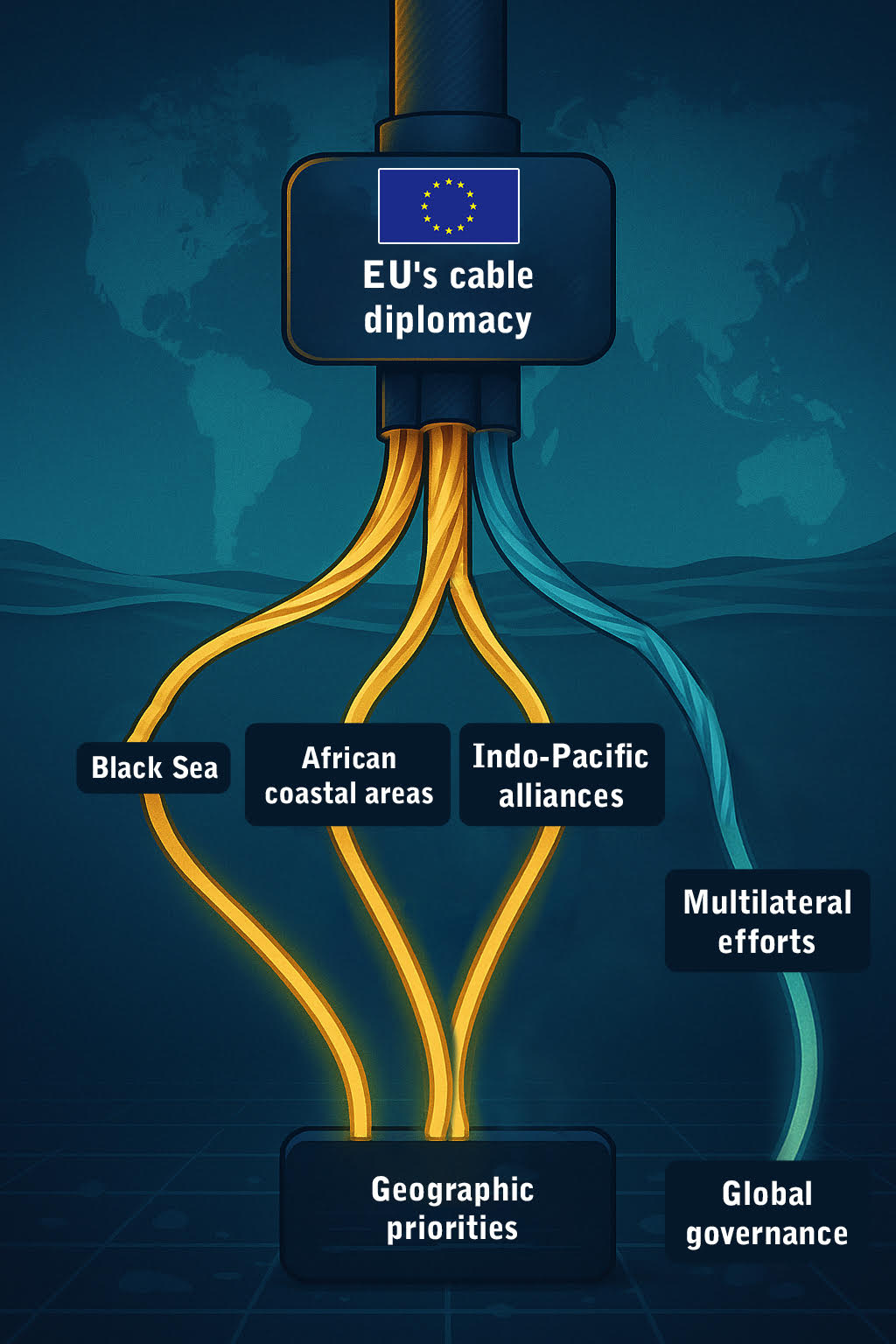
Design: Laurent Nyssen.
Global governance as a transversal element
Alongside regional action, the EU must assert itself in international organisations and the global governance of undersea infrastructure. Cables are strategic assets, and the absence of clear international rules leaves room for ambiguity and coercion.
The EU should engage in multilateral institutions, standard- setting bodies, and maritime legal forums to promote transparency, resilience, and collective responsibility.
The EU should advocate for stronger recognition of subsea cables as critical infrastructure in UN forums such as the General Assembly and the Open-ended Working Group on ICTs.⁵ While the International Telecommunication Union (ITU) has also taken up a new initiative for cable policy, its impact is limited by consensus rules. However, the ITU-ICPC Advisory Body on Submarine Cable Resilience, co-chaired by Portugal and Nigeria, provides a valuable platform for technical cooperation, standardization, and agenda-setting.
The EU can play a meaningful role in advancing the international legal dialogue on subsea cables, particularly in relation to the United Nations Convention on the Law of the Sea (UNCLOS). The 2024 New York Joint Statement⁶, endorsed inter alia by Canada, Japan, the United States, the UK, and the EU, signals a coalition of like-minded partners aligned with EU cable diplomacy goals and offers a strong basis for advancing global governance efforts. As party to UNCLOS, the EU can support coordinated positions among its Member States, encourage active engagement in relevant UN and maritime law-related forums, and promote the findings of expert bodies such as the International Law Association.⁷
By supporting legal capacity building in partner countries and facilitating multi-stakeholder dialogue on gaps in the current legal framework, the EU can contribute to a more modern, resilient, and enforceable legal regime for cable protection. Leading by example, the EU and its Member States can also review and update their own national legislation to shape evolving international norms.
As the EU steps up its multilateral engagement, it should promote structured exchanges on permitting, incident classification, and crisis response. At the same time, it should encourage the World Bank and other development institutions to adopt a broader view of cable infrastructure – supporting not just new deployments, but also regulation, repair, preparedness, and response capabilities. Of course, cable projects can only be effective if matched by adequate terrestrial infrastructure, including land networks, data centres, and functioning telecom markets.
Last but not least, EU-NATO cooperation should play a central role in addressing the more sensitive aspects of subsea cable resilience – especially where cables as military assets, maritime domain awareness, or hybrid threat deterrence are concerned.
NATO’s recent initiatives, such as the Critical Undersea Infrastructure Coordination Cell and the operation Baltic Sentry, offer great opportunities for cooperation, be it through joint exercises, maritime situational picture sharing, as well as coordinated physical protection or incident response.
However, cooperation remains constrained by longstanding challenges, particularly the limited mechanisms for exchanging classified information between the EU and NATO. To be effective, future efforts should focus on building trusted frameworks for operational coordination, while respecting institutional boundaries and security constraints.
Conclusions and recommendations
Across the three geographic focal points and the transversal element of global governance, the EU should pursue three types of action: enhance redundancy and connectivity, share best practices and build shared resilience, and cooperate on sensitive aspects, legal frameworks, as well as global standard setting.
Black Sea: enhance redundancy and connectivity
The EU should actively support new subsea data cables in its immediate neighbourhood. With funding mechanisms like the Connecting Europe Facility already in place, implementation should be prioritised – especially in vulnerable regions such as the Black Sea and the Caucasus. Cables crossing unconventional routes, such as the Black Sea, can significantly boost network resilience by avoiding chokepoints and diversifying data flows.
Underserved African coastal states: diversify transit hubs via connectivity
In Africa, EU-backed investments via the European Investment Bank, the World Bank, and regional or national development banks should extend beyond cable deployment to include terrestrial networks and local digital ecosystems. Connectivity is not a zero-sum game – the more routes and nodes exist, the higher the collective resilience of the global network. By investing in African littoral states, the EU can diversify international data access points that strengthen the continent’s connectivity and position the EU as a development partner.
Indo-Pacific alliances: share best practices, experiences and capacities
In the Indo-Pacific, cooperation with partners such as Japan and India should prioritise capacity building, incident response coordination, and knowledge exchange on repair and redundancy infrastructure. Specific areas should include permitting and licensing, shared repair assets, and education plans for a future skilled workforce. With other partners like the Philippines and Indonesia the EU should promote regulatory streamlining, sabotage prevention, and structured dialogue on resilience planning, tailored to their institutional readiness and political will. Best practice models from within the EU, e.g. Denmark and France, offer blueprints for effective regulatory regimes and should be made accessible through technical assistance or policy exchanges.
With regards to multilateral cooperation and global governance, the EU should strengthen cooperation with NATO in areas increasingly requiring coordination – such as maritime surveillance, hybrid threat detection, and physical protection of cable infrastructure. At the multilateral level, the EU and its Member States should support further legal discussions within UNCLOS forums. The EU can also encourage greater participation in the ITU- ICPC International Advisory Body on Submarine Cable Resilience. Supporting standardisation, data- sharing regimes, and soft law instruments can help reduce ambiguity and promote shared norms. At the same time, the EU should advocate for multilateral development institutions to adopt a broader definition of digital infrastructure resilience – extending funding to include redundancy, repair logistics, incident response, and terrestrial infrastructure integration.
Taken together, these actions can offer a forward- looking framework for the EU’s external cable diplomacy – combining technical, political, and legal tools to ensure resilient, secure, and inclusive global digital connectivity.
________________________________________________
1 European Commission, 2025. “EU Action Plan.” Brussels, 21.2.2025, JOIN(2025) 9 final: https://digital-strategy.ec.europa.eu/en/library/joint-communication-strengthen-security-and-resilience-submarine-cables
2 Ibid., p. 16.
3 In the Baltic Sea region, Finland, Sweden, and the Baltic states have responded to suspected acts of sabotage targeting cables. Their experiences make them valuable in developing protection and response strategies with partner countries. A more recent example is the decision of Taiwanese prosecutors to charge the captain of a Chinese vessel accused of damaging undersea cables in the Taiwan Strait.
4 Sari, Aurel. 2025. “Protecting Maritime Infrastructure from Hybrid Threats: Legal Options”. Helsinki, Finland: European Centre of Excellence for Countering Hybrid Threats: https://www.hybridcoe.fi/publications/hybrid-coe-research-report-14-protecting-maritime-infrastructure-from-hybrid-threats-legal-options/
5 C. Kavanagh, J. Franken, and W. He. 2025. “Achieving Depth: Subsea Telecommunications Cables as Critical Infrastructure”. Geneva, Switzerland, UNIDIR: https://unidir.org/publication/achieving-depth-subsea-telecommunications-cables-as-critical-infrastructure/
6 European Commission. 2024. “The New York Joint Statement on the Security and Resilience of Undersea Cables in a Globally Digitalized World”, September 26, 2024: https://digital-strategy.ec.europa.eu/en/library/new-york-joint-state-ment-security-and-resilience-undersea-cables-globally-digitalized-world
7 International Law Association. 2024. “Submarine Cables and Pipelines under International Law.” Third Interim Report 2024. International Law Association: https://www.ila-hq.org/en/documents/ilathi-1
The views and opinions in this brief do not necessarily reflect those of the Heinrich-Böll-Stiftung European Union.
Special thanks to Hannah Goerlich for supporting the work of this Böll EU Brief.


