Böll EU Brief
German Rearmament: Handle with Care - Public Attitudes in Six EU Member States
Böll EU Brief 04/2026
In the media: Süddeutsche Zeitung

Key findings:
-
There is broad but uneven support for German rearmament. 67% of respondents support German rearmament. Support is strongest in Lithuania (87%) and France (79%), but considerably weaker in Italy (52%) and Greece (48%). Yet support does not equate to trust or confidence that Germany would come to an ally’s defence. In Greece, for example, only 23% believe Germany would provide military assistance if their country were attacked.
-
Germany’s political future is cause for concern. The rise of extremist political forces in Germany emerges as respondents’ single most important concern (25%), ahead of historical memory (17%). Concerns about Germany’s future political direction and potential dominance in Europe also feature prominently.
-
Respondents want German military power firmly embedded in European and transatlantic structures. Institutional anchoring within the EU or NATO is the most frequently prioritised reassurance mechanism (42% combined). Meanwhile, 44% favour shared EU leadership without any single country taking the lead in European defence. Joint defence projects, democratic oversight and transparency are also important sources of reassurance.
Germany is rearming. Following Russia’s full-scale invasion of Ukraine in 2022, former Chancellor Scholz announced a Zeitenwende, backed by a one-off €100 billion special defence fund. Russia’s continued aggression, coupled with growing uncertainty over the reliability of the United States following Donald Trump’s re-election, added further urgency. In March 2025, the German Bundestag voted in favour of a constitutional reform of its debt brake exempting defence and security spending above 1% of GDP from borrowing restrictions.
This has paved the way for a structural and sustained increase in German military expenditure, transforming what began as an extraordinary response to Russia’s invasion into a long-term shift in Germany’s defence policy. By 2027, its annual defence expenditure is projected to approach the combined spending of the United Kingdom and France, potentially surpassing it by 2030.¹ In its first ever military strategy, the German government has made its ambitions clear: It wants to build Europe’s strongest conventional army by 2039.²
Russia’s war against Ukraine, its hybrid attacks across Europe, and Donald Trump’s questioning of America’s commitment to NATO and European security have shaken long-standing certainties. Germany’s historic military build-up is a response to these profound changes. But German rearmament is also a factor in its own right.
NATO was famously said to have been created to “keep the Americans in, the Russians out and the Germans down.” Today, the Americans appear to be moving out, the Russians are pushing in, and the Germans are moving up militarily. Against this backdrop, how do EU Member States view the prospect of a rearming Germany? Is it cause for concern among Europeans, particularly given Germany’s historic legacy? Could the old “German question”, the question of how to reconcile a powerful Germany with a stable and peaceful European order, return?
These issues have already been raised by experts, public intellectuals and politicians, such as Liana Fix, Timothy Garton Ash and Franziska Brantner. This Böll EU Brief aims to contribute to that debate by presenting the findings of a public opinion poll conducted on German rearmament in six different EU Member States. To our knowledge, this is the first public cross-country survey to examine how European citizens view Germany’s military build-up.³
Four key findings have emerged from the survey:
1. There is broad but uneven support for German rearmament
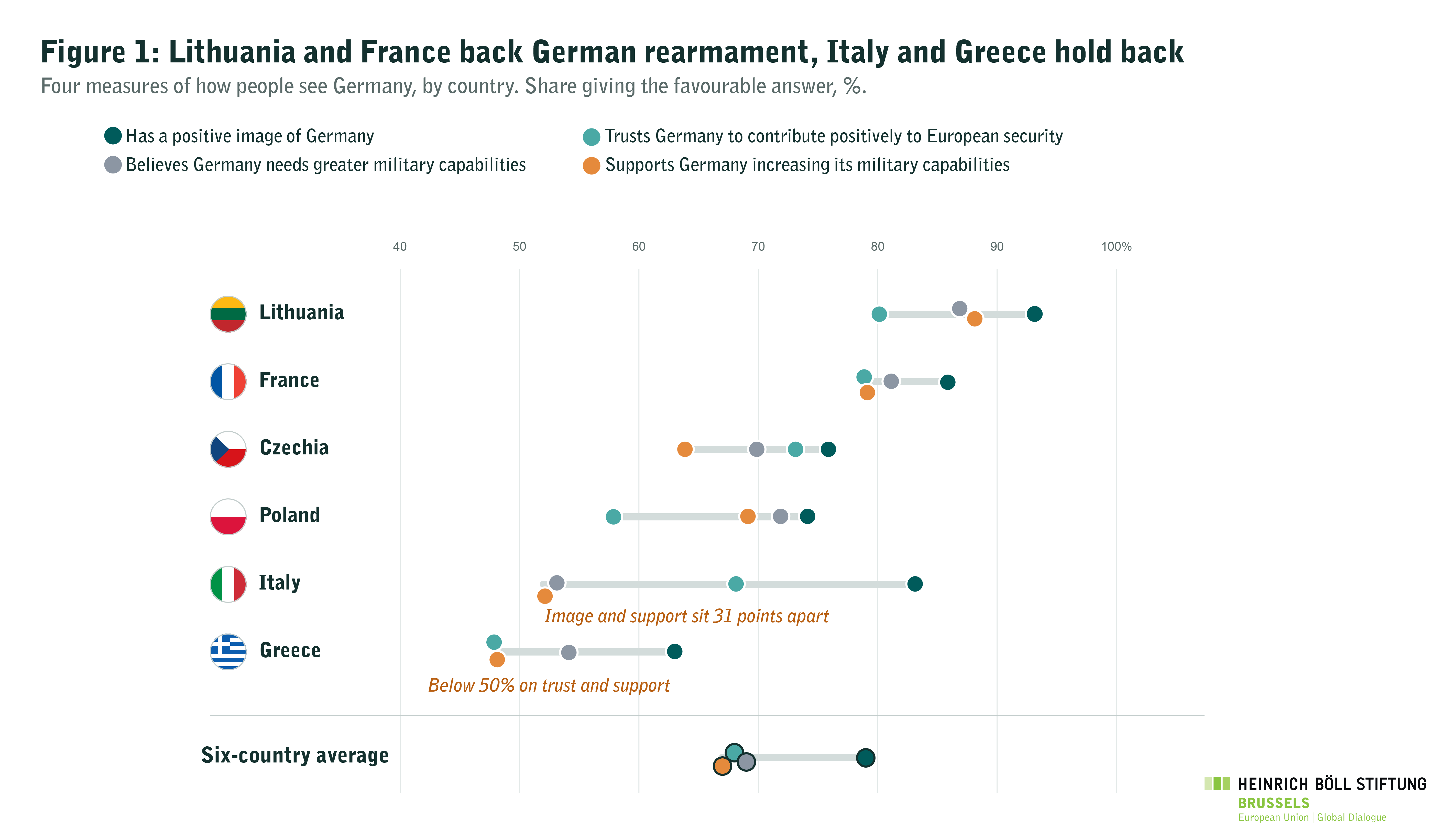
With 67% of all respondents in favour, the aggregated data shows broad overall support for German rearmament. However, this picture varies considerably among the six EU Member States surveyed (see Figure 1). Support is strongest in Lithuania (87%) and France (79%), followed by Poland (70%) and Czechia (64%). In Italy support is fragile with 52% in favour and 48% opposed, while in Greece, respondents narrowly oppose German rearmament with 51% against and 48% in favour.
The intensity of support also differs. Lithuania stands out as the only country where a substantial share of respondents strongly supports German rearmament (41%). Elsewhere, strong support is more muted with 17% in France and 16% in both Poland and Czechia, and just 9% in Italy and 8% in Greece.
2. Support for German rearmament does not directly translate into trust and confidence in German military support
The survey reveals important discrepancies between three distinct dimensions: support of German rearmament, trust in Germany as a positive contributor to European security, and confidence that Germany would provide military assistance if the respondent’s country were attacked.
In France, all three are closely aligned, with 79% supporting German rearmament, 79% trusting Germany to contribute positively to European security, and 77% confident that Germany would provide military support if France were attacked. Elsewhere, however, considerable differences emerge. In Lithuania, 87% support German rearmament and 79% trust Germany as a security actor, but only 70% are confident that Germany would provide military assistance (in spite of the presence of a German brigade in Lithuania).
A similar pattern appears in Poland, where 70% support rearmament, while just 58% and 57% respectively trust Germany as a security actor or expect German military support. Greece presents the starkest discrepancy: while 48% support German rearmament and an equal share trust Germany to contribute positively to European security, only 23% are confident that Germany would provide military assistance in the event of an attack.
The reverse pattern emerges in Italy, where trust in Germany as a security actor (68%) and confidence in its military assistance (63%) considerably exceed support for German rearmament (52%). In Czechia, too, trust in Germany’s positive contribution to European security (74%) exceeds both support for rearmament (64%) and confidence in military assistance (60%).
These findings suggest that support for German rearmament, trust in Germany’s contribution to European security and confidence in its military support are related but distinct attitudes. While they might coincide in some countries, they diverge considerably in others.
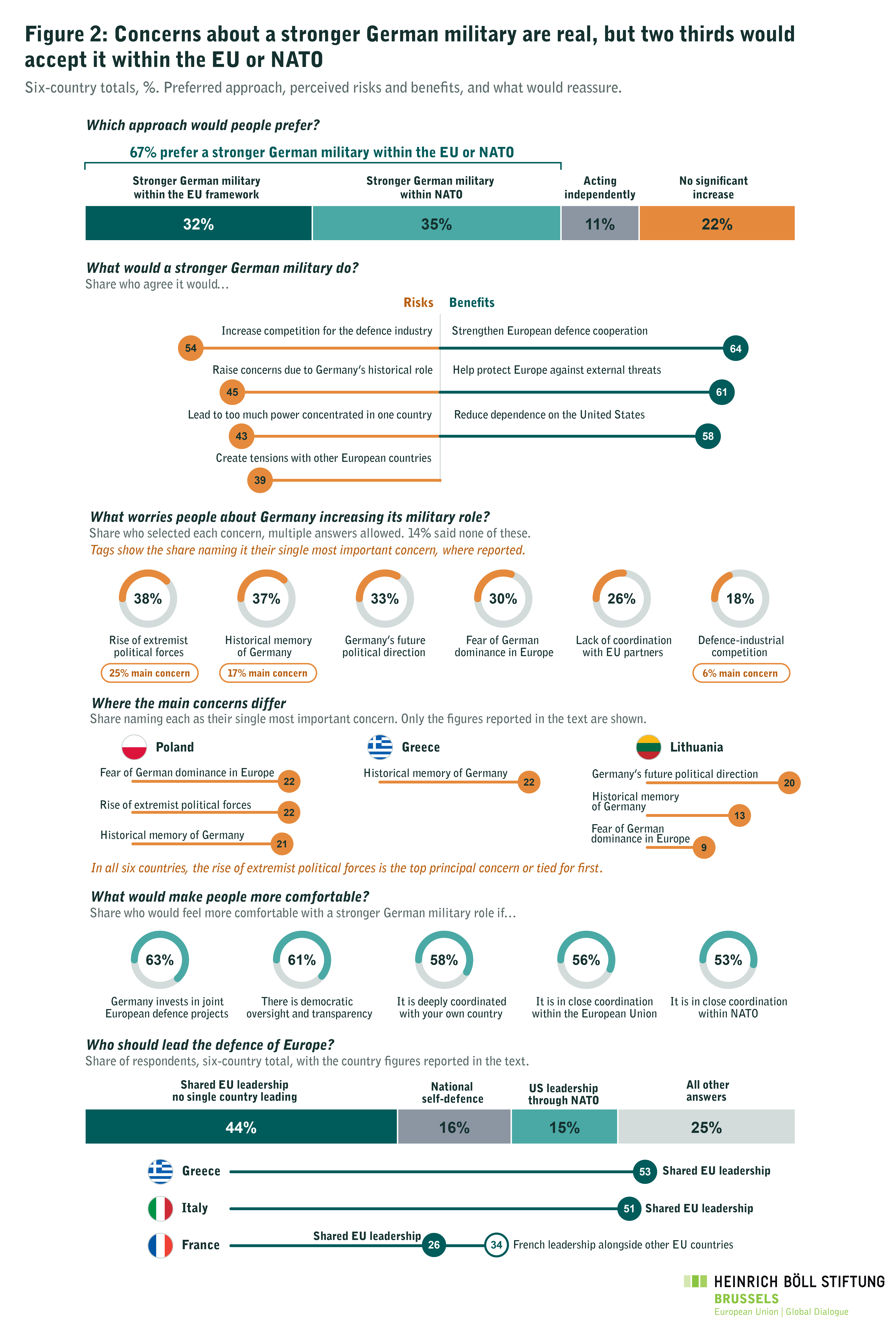
Particularly important: When asked who should play the leading role in defending Europe, the largest share of respondents (44%) favour shared EU leadership without any single country taking the lead, followed by national self-defence (16%) and US leadership through NATO (15%). Geographical differences are apparent. Shared EU leadership is the most frequently selected option in five of the six countries, commanding outright majorities in Greece (53%) and Italy (51%). France is the notable exception, with 34% favouring French leadership alongside other EU countries, compared with 26% preferring shared EU leadership.
3. There are concerns about German rearmament
Despite broad support for German rearmament, respondents do express concerns about Germany’s growing military power. The most frequently selected concerns are the rise of extremist political forces (38%), Germany’s historical memory (37%) and its future political direction (33%). However, when asked to identify their single most important concern, the rise of extremist political forces clearly emerges as the leading issue, selected by 25% of respondents, compared with 17% citing historical memory. (Figure 2)
The geographical differences are revealing. In Poland, the rise of extremist political forces and fear of German dominance in Europe are the joint leading concerns, each selected by 22% of respondents, closely followed by historical memory (21%). In Greece, historical memory and the rise of extremist political forces are equally prominent, both at 22%. In Lithuania, by contrast, the rise of extremist political forces is the leading concern (30%), followed by Germany’s future political direction (20%), while historical memory (13%) and fears of German dominance (9%) are considerably less prominent.
Across all six countries, the rise of extremist political forces in Germany is either the most frequently selected principal concern or tied for first place (Greece). Defence-industrial competition, meanwhile, appears to be a considerably less pressing concern. Although 54% of respondents believe that a stronger German military could increase competition in the European defence industry, only 6% consider it their most important concern.
These findings suggest that concerns surrounding German rearmament are not confined to the country’s historical legacy. Germany’s future political trajectory, particularly the rise of extremist political forces, such as the Alternative für Deutschland, plays an important role in shaping how its growing military power is perceived abroad. At the same time, concerns about German dominance in Europe remain pronounced in countries such as Poland.
4. Reassurance is essential, but expectations differ between countries
When it comes to reassurance mechanisms, the aggregate data shows that joint European defence projects are the most widely endorsed, with 63% of respondents indicating that such cooperation would make them more comfortable with a stronger German military. Democratic oversight and transparency follow closely at 61%.
However, when asked to identify the single most important factor determining their support for greater German military capabilities, institutional coordination takes precedence. Across the six countries surveyed, 22% prioritise coordination within the EU and 20% within NATO, followed by democratic oversight and transparency (18%). Joint European defence projects are selected by 14% as the single most important factor.
Here, too, there are geographical divergences. In France, Italy and Greece, coordination within the EU emerges as the most frequently selected factor, at around 23-25%. In Poland, by contrast, NATO coordination is the clear priority (31%), compared with 18% choosing the EU. Democratic oversight and transparency are particularly prominent in Italy and Greece, where 21% and 22% identify them as their most important consideration.
Conclusions and recommendations
The survey paints a broadly favourable but uneven picture of German rearmament across the six EU Member States. Trust in Germany and confidence in its military solidarity vary, while concerns about political extremism in Germany and its historical legacy are prominent.
Due to Germany’s history, Berlin’s military transformation can never be treated as a purely national undertaking; the data confirms this. Rearming Germany must consider the perspectives and concerns of European partners. Ultimately, Germany’s rearmament will be assessed not only by the military capabilities it develops, but also by the confidence and trust it inspires among its European partners.
Germany must rearm but also reassure.
Five general recommendations follow:
-
Europeanise German rearmament further. Germany’s growing military power must remain firmly anchored in the EU and NATO, as respondents clearly expect. Germany is not starting from scratch. Its leadership within NATO, its expanding bilateral and multilateral defence partnerships, and its historic decision to permanently station a combat brigade in Lithuania demonstrate its commitment to European security. These efforts provide an important foundation on which to build.
Yet, the scale of Germany’s rearmament calls for a further deepening of European integration. As Franziska Brantner, co-leader of the German Green Party, argued in a recent speech, Germany needs a new guiding principle: Nie wieder allein – never again alone.⁴ This means embedding German military capabilities in binding European frameworks.
Building on existing cooperation, Germany should champion deeper military integration through permanent multinational military formations, integrated command structures, and potentially new political coordination formats like a European Security Council. These arrangements could create lasting interdependence, making unilateral action by future German governments more constrained. This is particularly important given that the rise of extremist political forces in Germany is respondents’ leading concern, while the largest share (44%) favours shared EU leadership without any single country taking the lead in European defence. Today’s Germany must “constrain in advance the unknowable Germany of 2035”, as Brantner put it. -
Strengthen European procurement. This must also be backed by concrete cooperation via joint procurement, shared capabilities and cross-border defence-industrial projects. Germany’s rearmament can be further Europeanised. According to the Kiel Institute for the World Economy, between January 2020 and January 2026, just 3% of the value of German military orders with known supplier origin went to European companies outside Germany.⁵ Likewise, Germany is largely absent from multilateral procurement initiatives, such as the Multilateral Defence Mechanism (MDM) and the Defence, Security and Resilience Bank (DSRB). A Germany that is rearming, and failing to join European procurement initiatives, is a cause for concern. Germany should therefore expand joint procurement and purchase more equipment from other European countries where appropriate. European reassurance should become an explicit consideration in German defence procurement decisions.
-
Demonstrate credible military solidarity. Military capabilities alone do not establish confidence that Germany will stand by its partners. Joint exercises, multinational deployments, shared contingency planning and concrete security commitments can help demonstrate that German rearmament strengthens the security of its allies. Germany has already signed a multitude of security and defence partnerships, which is welcome and can be used in this regard.⁶
-
Communicate German rearmament beyond Germany’s borders. Germany needs a more proactive dialogue with European publics. The Federal Foreign Office, embassies, Members of the German Bundestag as well as the European Parliament, political foundations and civil society organisations could promote public debate on these issues.
-
Monitor public opinion with an EU-wide survey on German rearmament. This survey only provided a snapshot in six EU Member States at a given point in time. Public attitudes cannot be assumed to remain unchanged and are likely to differ in other EU Member States. An annual EU-wide survey tracking changes in support, trust, perceived risks and expectations could be valuable in this regard. It would provide Germany with an evidence base for understanding how perceptions evolve and where reassurance is particularly needed.
References
1. Brantner, Franziska. “The Lonelier Continent: Europe and the Burden of its Own Defence”, The Annual European Lecture, European Studies Centre, St Antony’s College, Oxford, 14.05.2026 - https://franziska-brantner.de/news/the-lonelier-continent-europe-and-the-burden-of-its-own-defence/
2. “Gesamtkonzeption für militärische Verteidigung aus einem Guss”, Bundesverteidigungsministerium, 22.04.2026 - https://www.bmvg.de/de/grundlagendokumente-strategische-ausrichtung/gesamtkonzeption-fuer-militaerische-verteidigung-aus-einem-guss-6092138
3. The online poll, conducted by Verian between 28 September and 18 October 2026, surveyed a representative sample of 1,500 respondents in each of six EU Member States: Czechia, France, Greece, Italy, Lithuania and Poland. The results were weighted at national level on gender, age, education, and region. In total, 9173 people were surveyed across more than one-fifth of EU Member States. These countries were selected to reflect the diversity of the EU, ranging from large to small Member States, from Western to Central and Southeastern Europe, and encompassing different historical experiences with Germany.
4. Brantner, Franziska, Ibid.
5. Wolff, Guntram; Binder, Johannes; Morgan, Thomas. “Leading in spending, lagging in innovation: German defence procurement compared to the UK and Poland” Kiel Institute for the World Economy, May 2026. See: https://www.kielinstitut.de/fileadmin/Dateiverwaltung/IfW-Publications/fis-import/b777dd5a-c97e-4550-b1c9-32e3a1503c75-Kiel_Report_Procurement-10.pdf
6. Kefferpütz, Roderick; Bruck, Anika. “Phalanx of Defence Pacts”, Böll EU Brief 05/2025, Heinrich-Böll-Stiftung EU | Global Dialogue. See: https://eu.boell.org/en/defence-partnerships-europe