Climate policy demands long-term vision, backed by action. The EU is at risk of under-delivering. Read our Böll EU Newsletter 9/2025 and check out our new content and upcoming events.

Ursula von der Leyen’s State of the Union revealed once again her instinct for political timing.
The speech came amid heavy crosswinds. She faced criticism over her handling of Gaza and Israel, criticism over the EU-US trade deal, frustration from Social Democrats over the lack of European social policy, and the prospect of new motion of censures.
So she used her speech to make concessions, offer proposals, rebut criticism, and shore up parliamentary support. She announced EU action against Israel. She defended the transatlantic trade compromise and offered new deals with Mexico and Mercosur. And she unveiled a social package with initiatives on affordable housing, quality jobs and fighting poverty.
Von der Leyen is known to be a deft tactician. She moved fast on Covid-19 vaccines, and led early on sanctions against Russia and support for Ukraine. She knows when to hold, when to fold, and when to go all-in.
It is less clear whether she has a long-term strategy or compass. Her message can oscillate depending on circumstances. One day she calls for de-risking from China, the next she stresses engagement. Pragmatic flexibility or absence of strategy?
To be fair, she doesn’t have an easy hand to play. She must navigate deeply divergent interests within the Parliament and especially the EU Member States.
In this regard, climate policy was largely absent from her State of the Union. This echoes the broader political mood where many actors, such as France, Poland and the new German government, are now advocating a slow-down, if not outright pause.
But climate policy demands long-term vision, backed by action. The EU is at risk of under-delivering:
- Member states have failed to agree a binding 2040 greenhouse-gas target, despite the EU Climate Law requiring it
- Debate over an interim 2035 milestone remains unresolved
- And the risk grows that the green transformation agenda literally falls under the “Omnibuses”
The EU still aims to be the first climate-neutral continent by 2050 and to cut emissions by 55% by 2030, but without credible and agreed 2035 and 2040 targets these ambitions risk drifting. At a time, where there is a vacuum in international climate politics, that is a missed opportunity.
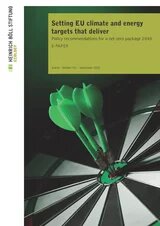
Our new publication “Setting EU climate and energy targets that deliver” proposes five key policies that could underpin a new “net-zero package”. I invite you to read this e-paper and join our webinar “Fit for 90? The battle over Europe’s next climate and energy targets” on 14 October.
Meanwhile, our New Delhi office is hosting an online discussion today on the EU-India Partnership on Climate Action. Look out for the recording in the coming days if you can’t join live.
And to understand how COP 30 is shaping up without the United States, and how Brazil is navigating these uncertain yet critical negotiations, you can read our latest analysis on the website.
Finally, we are proud to announce a new cohort of Climate Disinformation Fellows. Over the coming months these experts will (un)cover key stories of climate disinformation. So stay tuned!
Read more in our Böll EU 9/2025 Newsletter!
Warm regards,
Roderick Kefferpütz, Director, Heinrich-Böll-Stiftung European Union l Global Dialogue