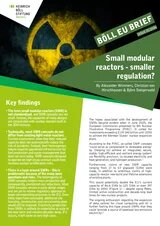
This Böll EU Brief critically assesses the prospects of small modular reactors (SMRs) in Europe. It finds that most SMR designs remain in early development, lack regulatory approval in the EU, and are unlikely to deliver electricity at scale before 2050. Technical, economic and political challenges – including high costs, unresolved waste management, proliferation risks and heterogeneous designs – undermine claims of rapid deployment and cost reductions. The authors conclude that prioritising renewables, storage and electrification is a more credible pathway for timely decarbonisation.
At the 2025 NATO Summit in The Hague, allies pledged to spend 5% of GDP on defence by 2035 – including 1.5% for resilience and security-related investment. Yet what counts towards this 1.5% remains unclear. As European governments face mounting fiscal pressure, funds must be spent wisely. Strategic investment in infrastructure, rail, clean energy, resilient supply chains and nature restoration could reinforce deterrence, strengthen economic competitiveness and address climate and biodiversity risks in tandem.
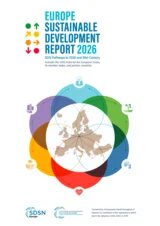
The Europe Sustainable Development Report 2026 (ESDR 2026) provides an independent quantitative assessment of the progress of the European Union, its member states and partner countries on the SDGs. The seventh edition of the ESDR shows that progress on SDGs has stalled in Europe, with declining political prioritization of the SDGs by EU leadership.
This policy brief explores how a focused agenda on clean mobility, renewable energy, circular economy, digital infrastructure, and climate adaptation could move the relationship beyond ambition to real-world action.
The new US shift on monetary and climate policy has created a rare opening for Europe. With strong green finance rules and the European Central Bank integrating climate risks, the EU can position the euro as the world’s leading green currency. This Böll EU Brief outlines how ‘green internationalisation’ could boost Europe’s strategic power.
The European Commission’s proposal for the 2028–2034 MFF opens a chance to raise ambition on climate, social, economic and security goals. This framing paper outlines key budget needs, priority areas and governance reforms to equip the EU with a stronger, more effective long-term financial framework.
The next MFF proposes centralised National and Regional Partnership Plans, shifting power to national governments and the European Commission. While promising coherence, this risks weaker regional involvement and oversight. Effective governance will depend on strong Member State accountability and safeguarding inclusive, transparent delivery.
The 2028–2034 MFF proposal acknowledges social pressures but risks diluting the EU’s social dimension. Social spending is consolidated in new National and Regional Partnership Plans Plans without a dedicated European Social Fund line, while guarantees are weakened. Major challenges include limited funding, weaker local roles and competing budget objectives.
The European Commission’s new MFF proposal introduces five new own resources to fund Next Generation EU debt and modernise EU revenues. This paper assesses the package and argues for a balanced basket of genuine new resources to support EU goals, reduce net-position politics and close major funding gaps.
The MFF proposal sidelines climate and the environment, inflates green spending claims, and weakens safeguards through flexibilisation and programme mergers. This paper assesses the spending target, the Do No Significant Harm principle, and climate and environmental provisions in the proposal’s two largest programmes.