Böll EU Brief
Reaching young men: How progressives can connect with them online
Böll EU Brief 03/2026

Key findings:
-
The far-right manosphere meets young men where they are. It starts with their everyday lives, interests and concerns rather than with politics, builds emotional connection and a sense of belonging, and then channels these experiences into far-right narratives that offer simple explanations and scapegoats.
-
Progressive influencers tend to start with politics, rather than young men’s everyday lives. Their content focuses largely on countering and debunking far-right narratives. Progressive digital ecosystems are also smaller and less closely connected to political actors.
-
Progressives need to move from countering to connecting. Start with young men’s interests and experiences, speak on a personal and emotional level, offer role models for progressive masculinity and build stronger networks between creators and progressive politicians.
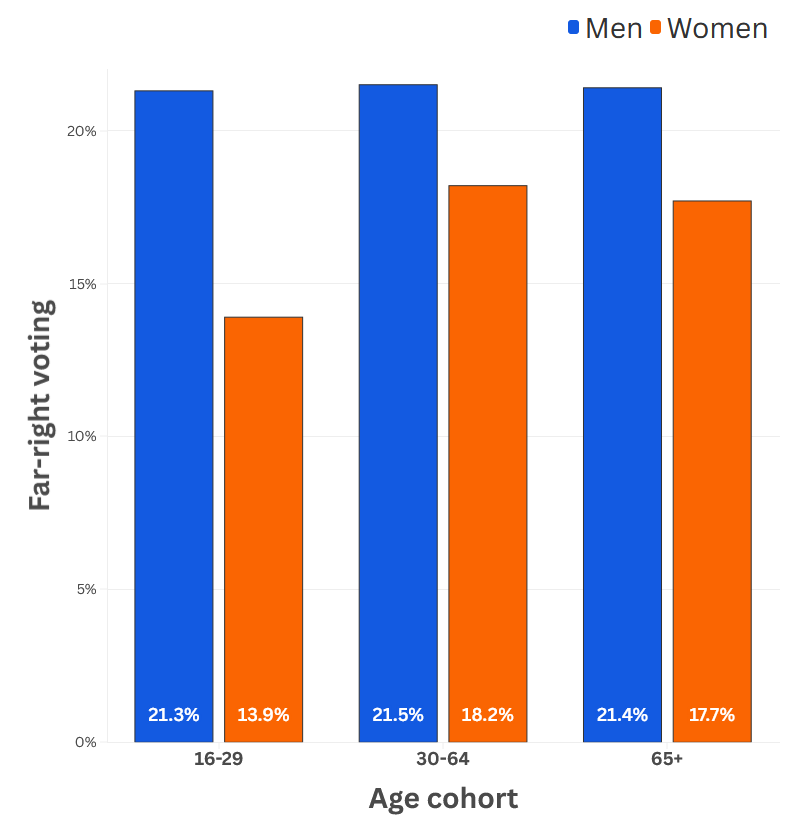
The 2024 European Parliament elections highlighted a trend in voting behaviour that could previously already be observed in some Western democracies. In these elections, young men voted for far-right parties in unprecedented numbers. What is remarkable here is the enormous difference in far-right support between young men and young women: 21% of male voters aged 16 to 29 voted for such parties, while only 14% of women in this age group voted far right. This so-called ‘gender vote gap’ is in no other age group as deep as among the youth (Figure 1). At the national level, too, this ‘gendered far-right wave among young voters’ can be observed in some Western European countries.¹
In six European countries, a long-term trend of young men moving to the right in their political positioning (while women are moving to the left) can be observed.² This development raises the question of why far-right parties have become more successful among young men, as well as how progressive parties can attract more young male voters. Due to the novelty of the phenomenon, research in this area is still scarce. Existing studies refer to:
- Economic factors, in particular the rise of women in education and careers, which young men interpret as a disadvantage for their career prospects.³
- Cultural factors, above all changing gender norms, which can cause uncertainty among young men about their status and role in society.
- The supply side of politics and social media communication, especially male content creators (‘manfluencers’) who spread far-right narratives, thereby increasing the electability of these parties among young men. Social media channels promoting this kind of content are discussed under the term ‘manosphere’.⁴ A progressive ecosystem targeting young men does not exist, or if it does, only in a much smaller dimension.
The aim of this Böll EU Brief is therefore to understand the gap between a far-right and a progressive digital ecosystem addressing young men. For that purpose, we have conducted a quantitative and qualitative study to compare both spheres and develop recommendations for progressive forces in order to better connect with young men.
Figure 1: Gender gap in voting for the far-right by age cohorts in 2024 EU elections
Appealing to young men: far-right vs progressive creators
With the support of narrative research and strategy firm Ripple Research we analysed actors, networks and content strategies of far-right and progressive influencers targeting young men. The study focuses on France, Germany and the United Kingdom. In all three countries, far-right parties – Rassemblement National (RN), Alternative für Deutschland (AfD), Reform UK – have performed well among young men in recent elections, although to varying degrees.⁵
While research and the public debate have so far focused mainly on the firepower of far-right digital content, the shortcomings of progressive actors in reaching a young male audience has not received much attention. That is why this paper puts a greater focus on the progressive ecosystem, after quickly summarising the results for the far-right counterpart.
The findings of the analysis of the manosphere (90 influencers) can be summarised in three points:
- Far-right creators meet young men emotionally where they are by starting with personal interests (e.g. fitness, gaming, dating) and real problems (e.g. finance, jobs, housing). Narratives are designed as radicalisation pathways offering simple causal stories and explanations for complex problems (You’re struggling because of feminism/migration/institutions).
- Manosphere content shapes a collective identity and offers a sense of belonging by using men like us language and scapegoats (e.g. wokeness, migrants, elites). These messages include solution-oriented endpoints, which are often connected to product placement of the manosphere industry, e.g. fee-based self-optimisation webinars or trading apps.⁶
- With intense interactions on social media, far-right politicians and manfluencers build strategic alliances to pull young men into a far-right worldview. By putting identity before ideology the manosphere recruits young men, sends them on a radicalisation journey and connects them to far-right politicians who aim to turn them into voters.
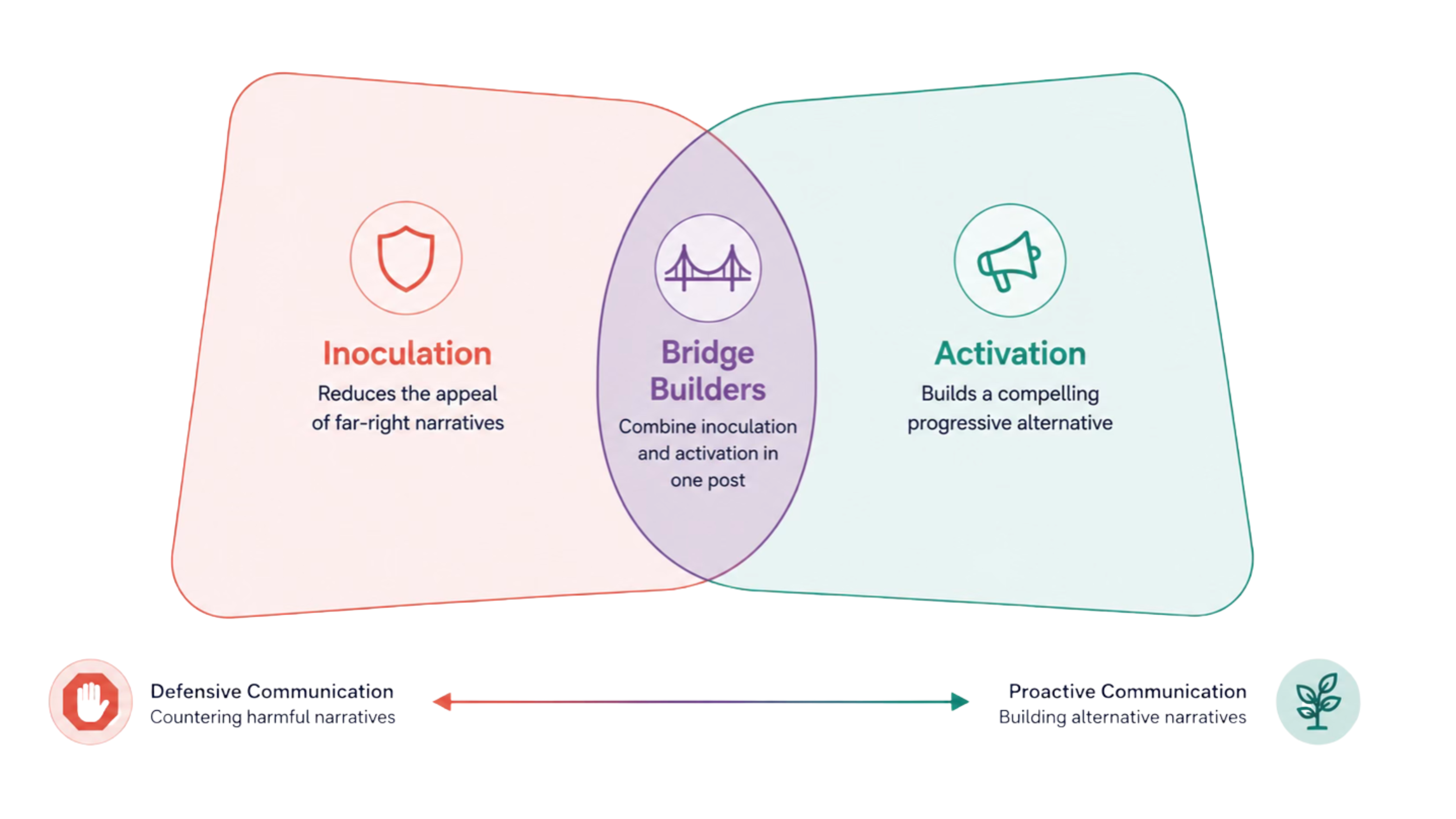
Let’s now turn to the progressive ecosystem. As with the manosphere, the study explored the content strategies of influencers (=60). After a pre-analysis of their content, a coding framework was established to analyse messages and narratives, including the tone and aesthetics of the whole sample. The framework mirrors the three main strategic approaches that were identified in the creators’ content (Figure 2): 1) Inoculation, a defensive strategy to counter far-right narratives and “reduce” their appeal. 2) Activation, a proactive approach to build a compelling progressive narrative as an alternative to far-right content. 3) Bridge-building as a combination of inoculation and activation, which aims to equip the audience with techniques to persuade others.
The results of this analysis, as presented in the next section, reveal the quantitative shares of the three approaches in the country samples and show thematic and story patterns within the three approaches for each country.
Figure 2: Main content strategies of progressive influencers
Progressive ecosystem: political from the outset, defensive in its narrativess
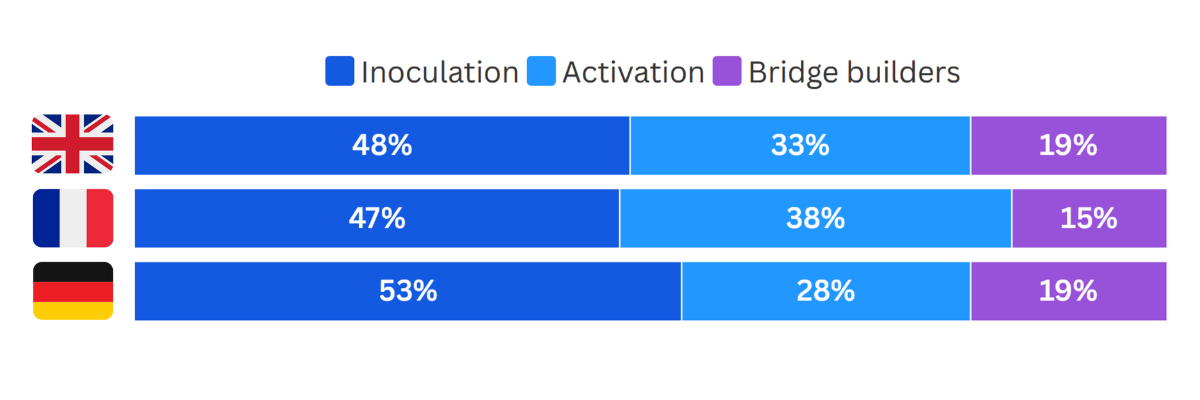
Comparing the three content strategies, the same priorities emerge in all three countries: the largest share of content is devoted to inoculation, followed – by a significant margin – by activation, and – by an even wider margin – by bridge-building. There are, however, differences between the countries in terms of the size of the respective shares: in Germany, the share of inoculation posts is the highest, at 53% of all progressive influencer content; in the United Kingdom and France, it is slightly lower, at 48% and 47% respectively. Activation posts account for a share of between 28% (Germany) and 38% (France). Bridge-building posts account for less than 20% of content in all three countries.
Germany
Content from the German progressive digital ecosystem reaching out to young men is explicitly political from the outset. Personal and lifestyle topics are widely neglected. Germany has the most defence-oriented progressive content of the three countries, with more than half of the analysed posts focused on inoculating audiences against far-right appeals. The inoculation target is mainly domestic: AfD debunking, TikTok radicalisation and far-right lifestyle as a youth trend. Inoculation content uses a wide range of narratives and styles, ranging from satirical mockery and street interviews to historical comparisons to the Nazi dictatorship. Activation content (28%) puts a focus on progressive economic narratives, including issues like income inequality, class, pensions, housing and corporate subsidies. German influencers offer the most structural and analytical economic content among the three countries. Also distinct from France and the UK is the anti-militarism/conscription focus of German influencers, which relates to plans by the federal government to recruit more young people for the Bundeswehr. With regards to the third content strategy, bridge-building, German creators are strong in teaching persuasion. Creators explicitly instruct audiences on how to have conversations with AfD-sympathetic family members and friends. Bridge-building comes to life when influencers explain, for instance, how to turn a conversation from far-right scapegoating rhetoric to individual social and economic anxieties and possible solutions for that.
The network analysis of the German progressive ecosystem shows only weak interactions on X between influencers and politicians; in fact, the weakest mutual connections in the cross-country analysis. The reason for this could be that many progressive accounts have left X after Elon Musk took over the platform and it turned into an amplification tool for far-right ideology.
Figure 3: Shares of progressive content strategies in the three countries
France
Similar to Germany, French progressive content is explicitly political from the outset. Content strategies of influencers are almost evenly split between inoculation and activation. The inoculation content is sophisticated and focuses on three areas: investigative stories exposing RN’s wrongdoings (e.g. unlawful financing of party activities), as well as billionaire-owned media promoting far-right narratives, deconstruction of RN rhetoric strategies and historical comparisons. Teaching media literacy is here a key component of inoculation content.
The French progressive ecosystem has the largest share of activation content (38%). Activation is shaped by France-specific issues, e.g. the defence of Muslim communities (on issues such as veil bans and mosque attacks) and demands for police accountability (systemic impunity).
Moreover, progressive economic narratives on tax justice, inequality and wealth distribution account for relevant parts of the activation content. Bridge-building (15%) is weaker than in Germany, reflecting a progressive ecosystem that fights hard on both attack and defence, but rarely fuses them into a single move.
The network analysis of France’s progressive ecosystem shows some connections on X between influencers and politicians, but most of them are not reciprocal. It seems that the French progressive camp has no strategic approach for building an active mutually reinforcing ecosystem.
United Kingdom
Like in France and Germany, British progressive creators address political issues right from the beginning and largely ignore more personal issues. Regarding the three content approaches, the UK ecosystem is more balanced than others.
However, still 48% of it is inoculation. British inoculation content uses three strategies: exposing wrong claims and wrongdoings (e.g. Nigel Farage’s school racism, Reform MPs’ fraud), satirical mockery and deconstruction of far-right narratives and their influence on the political discourse. Activation accounts for one third of the creators’ content. On the one hand these types of posts focus on electoral mobilisation for progressive forces. On the other, they promote economic narratives validating real frustration about living standards and redirecting its political roots from immigration to wealth inequality. Bridge-building content accounts for 19% of the posts. Most content of this type, however, deploys inoculation and activation sequentially, rather than fused.
The network analysis of the UK progressive ecosystem shows dense connections on X between influencers and politicians. Nearly two thirds of influencers generate all recorded interactions between the two actors. However, 71% of the analysed progressive politicians actively tag the influencers back.
How to close the progressive gap towards young men
Our study reveals significant quantitative (actors, networks, reach) and qualitative (messaging, resonance) differences between the far-right and progressive ecosystems targeting young men. This progressive gap may have contributed to young men shifting further to the right in recent elections. Based on the findings of the analysis, this study makes five recommendations. The aim is not to copy far-right strategies, but to develop better progressive alternatives:
- Meet them where they are and talk politics later: Most young people do not use social media to actively search for political content. However, most progressive content is political from the outset. It is the role of politicians to connect people’s personal lives with the political sphere, because politics should always aim to improve personal circumstances. On the one hand, progressive actors should make politics personal (e.g. don’t say ‘We need to help young people with their costs of living’, but ‘Do you know that feeling when you want to meet your good old friend at the weekend but cannot afford the train ticket?’). On the other hand, they should address personal interests such as sport, careers, diet or family planning, as a starter for conversations with young men.
- More activation, less inoculation: Whilst inoculation against the far right is important, forward-looking progressive narratives should be given much greater priority. Long-term connection is fostered through identification with a positive agenda, shared goals and a sense of community, not merely by warning people about others.
- Speak emotionally, not only rationally: Progressives must move beyond the notion that emotions and rationality are opposites. Emotional thinking is faster than rational thinking; it can therefore capture attention more effectively and act as a door opener to a deeper discourse. Emotions are evoked when personal values are implemented or violated in politics. Whilst progressive narratives should end with confidence and hope, the hook can also be anger or fear, because they are equally important and not mere far-right affects.⁷
- Role models for progressive masculinity: Progressives have failed to develop a positive and modern understanding of men’s role in society. This could involve emotional vulnerability, sharing care work equally, dismantling patriarchal structures and privileges, and seizing the opportunities a liberal society offers to fulfil one’s dreams while being part of an equal and caring society. The progressive ecosystem needs role models who exemplify this idea of masculinity in practice, rather than only describing it in theory.
- Build a progressive youthsphere: Interactions between influencers and politicians are much more developed in the far-right manosphere, leading to bigger reach and influence. Progressive creators and politicians should strengthen their connections and also include female creators to address young men. Altogether, this could contribute to a strong digital progressive youthsphere.
References
1. Abou-Chadi, T. (2024). A gendered far-right wave among young voters in Western Europe? European Journal of Politics and Gender.
2. Nennstiel, R. & Hudde, A. (2025). Is there a growing gender divide among young adults in regard to ideological left–right self-placement? Evidence from 32 European countries. European Sociological Review.
3. Milosav, Ð., Dickson, Z., Hobolt, S. B., Klüver, H., Kuhn, T., & Rodon, T. (2025). The youth gender gap in support for the far right. Journal of European Public Policy.
4. The term manosphere can be defined as an ecosystem of creators ‘that propagate misogynist ideology, reject gender equality and the liberal social order, and spread violent fantasies’; see also: Çağlar, G., Hammer, D., Drath, C., Matlach, P. & Schwarz, K. (2025). Mapping the Germanosphere. A Pilot Study. SCRIPTS Working Paper No. 57. Free University Berlin.
5. For this study, social media posts from actors who can be counted to far right and progressive (left and centre-left) of the respective country’s political spectrum were analysed. A total of 90 far-right and 60 progressive influencers and 90 far-right and 60 progressive politicians from Germany, UK and France were analysed. The quantitative difference between far-right and progressive sample reflects the different sizes of the ecosystems. Only influencers who clearly engage with young men, focus on masculinity, culture, and politics were selected. The sample included five high-performing posts from each influencer that were published on TikTok, Instagram, YouTube or X in 2024 and 2025. For both ecosystems, 750 influencers’ posts were analysed in total. For the platform X, interactions between influencers and politicians were analysed, too. For this purpose, politicians with the largest social media communities were identified for both ecosystems and each country, followed by an analysis of the interactions between them and the influencers. The results of the network analyses reveal the connections between politicians and influencers and the extent to which the two types of actors support each other.
6. Reset Tech/Equimundo (2026). The Grift Economy: How Young Men Are Being Sold Fake Belonging and Fake Wealth Online. https://www.equimundo.org/wp-content/uploads/2026/08/The-Grift-Economy.pdf
7. Hillje, J. (2024). Mehr Emotionen wagen – Wie wir Wut, Angst und Hoffnung nicht dem Populismus überlassen. Piper.