

Agribusiness Atlas 2026
Agrochemical corporations export pesticides that are banned in the European Union to countries where safeguards for health and the environment are weak. For BASF, Bayer, Syngenta and others, this is a lucrative business. For many people in the Global South, the consequences are severe.

Pesticides are traded across the globe. Regulation, however, often stops at national borders: rules on approval, sale, and use, as well as maximum residue limits, vary widely. Corporations repeatedly take advantage of different safety standards and legal loopholes to sustain a multi-billion-euro industry.
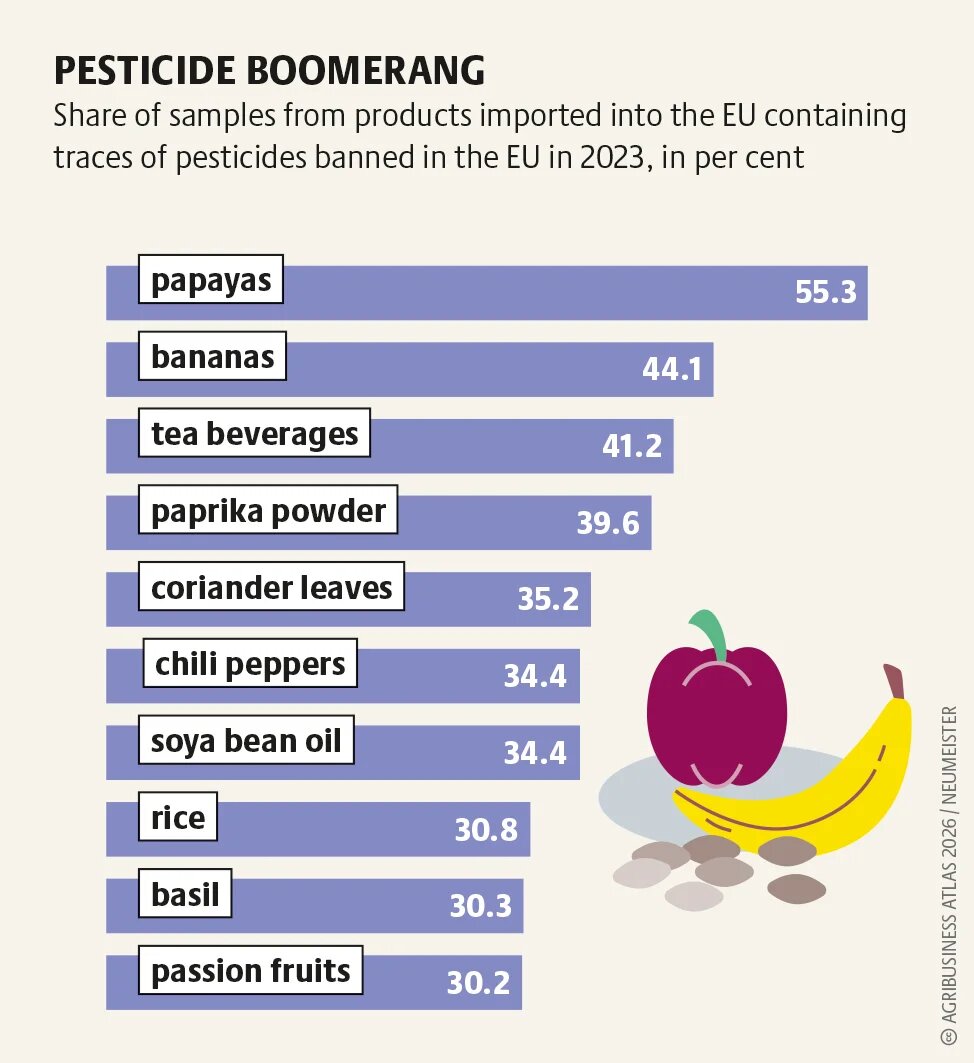
One loophole in EU pesticide law is that it regulates which pesticides can be sold and used within the EU, but not which pesticides can be produced or exported. Instead of closing gaps, the European Commission is currently trying to weaken EU pesticide regulation at the expense of existing safety standards. Since 2009, pesticides sold in the EU have undergone obligatory regular risk assessment. Certain substances that are particularly hazardous or proven to potentially harm foetuses, cause cancer or severely contaminate waterways are no longer permitted for use on EU farmland. But they do not disappear from circulation. Even when pesticides are not approved in the EU or withdrawn from its market, corporations may still manufacture them in Europe and sell them elsewhere. In 2024, the EU authorised the export of 122,000 tonnes of 75 different pesticide active ingredients deemed too harmful for use under EU law. Between 2018 and 2024, exports of EU-banned pesticides more than doubled. Like a boomerang, many of these highly hazardous chemicals return to European plates as residues on imported food.
The United Nations has warned that, in many countries of the Global South, pesticides can pose even greater risks to workers, consumers, and the environment than they would in the EU. In many cases, the legal framework governing pesticide use remains inadequate: maximum residue limits are weak, inconsistently enforced, or absent altogether. Public authorities often provide little reliable information about the risks posed by active ingredients. Farmers and workers receive little or no training and frequently even lack the protective equipment that regulations require. In some cases, hazardous substances are repackaged before sale, relabelled, or supplied with warnings only in a language that users barely understand.
The largest exporters in the EU are BASF, Teleos, Agria, Corteva, Syngenta, and Bayer. In 2024, BASF alone shipped more than 30,000 tonnes of banned substances abroad, followed by Teleos with around 11,000 tonnes. The shipments went, among other countries, to Ukraine, Russia, South Africa, Brazil, Colombia, Chile, the United States, Mexico, and Peru.
While France and Belgium have introduced national export bans for EU-banned pesticides, Germany and others remain inactive. Commitments by the European Commission to stop these exports remain unfulfilled. The largest share of banned pesticides from the EU exported globally originates from Germany, where major manufacturers are based. Bayer exports the insecticide cyfluthrin, acutely toxic even at low doses. BASF exports epoxiconazole, a fungicide linked to impaired fertility. Alzchem exports cyanamide, a growth regulator suspected of causing cancer. The EU withdrew approval for cyanamide as early as 2008, after users in Italy suffered poisoning. The EU authority s assessment left no room for doubt: even with full personal protective equipment, exposure levels for users exceeded the legally permitted limit by over 60 times. Since Alzchem is no longer allowed to sell cyanamide for plant protection purposes on the European market, sales have shifted to countries such as South Africa. There, in particular, women working in fruit and wine production are exposed to the pesticide without adequate protection.
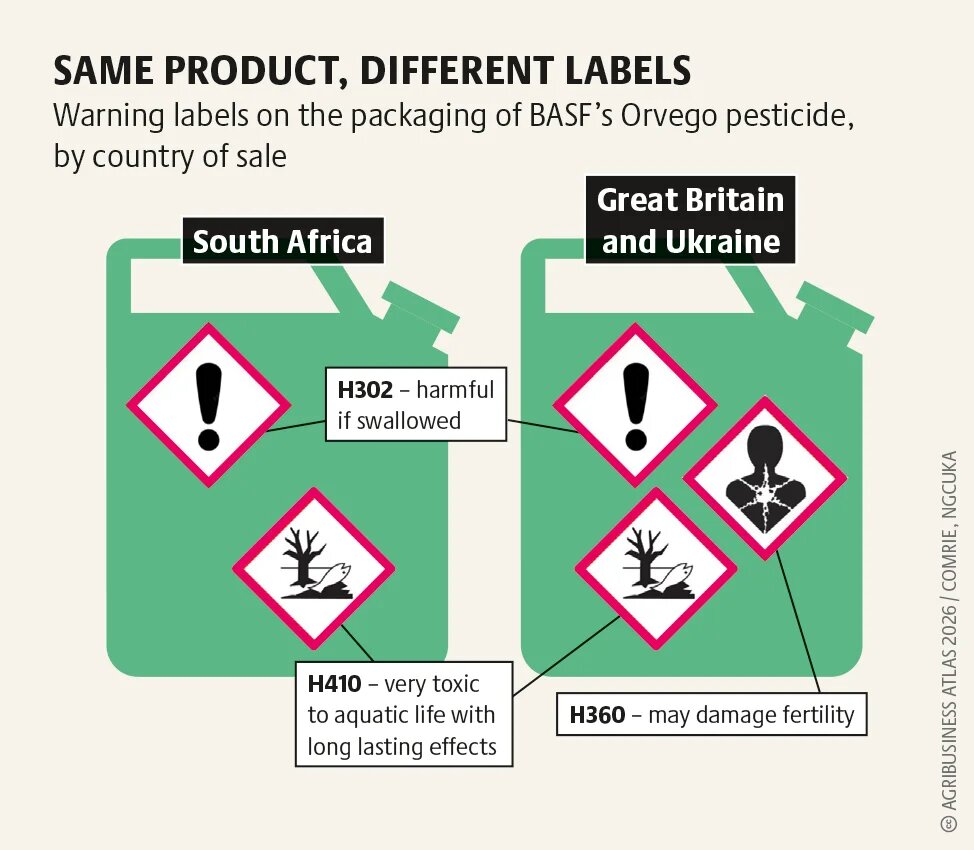
Alzchem is not only flouting basic ethical principles but is also acting in breach of the United Nations guiding principles on business and human rights, which require corporations to prevent or mitigate human rights violations that can be traced back to their products. Although Alzchem officially commits itself to these principles, the corporation continues to export cyanamide containing Dormex, unhindered, to countries with weak systems of protection.
For many years, civil society organisations around the world have been campaigning to ban highly hazardous pesticides. Their efforts drive a shift in thinking in many countries: Kenya, South Africa, and Nigeria have announced measures to tackle highly hazardous pesticides. In Kenya, for example, the government withdrew approval for a number of highly hazardous active ingredients in 2024. In June 2025, it announced plans to remove a further 77 pesticides from the market.
Many corporations respond by pushing back. They apply for exemptions, legally challenge planned bans, or seek to influence the hazard classification of their active ingredients. The industry has shown itself willing to systematically pursue its interests at the expense of health and environmental protection; especially in the Global South, where workers and ecosystems are particularly vulnerable. This makes an EU-wide ban on exporting substances already prohibited within the EU all the more urgent.
A handful of corporations dominate our food system, setting prices, profiting from crises, and driving relentless pressure on the environment, farmers, and consumers alike. The Agribusiness Atlas 2026 traces how this concentration of power took hold, and charts the political pathways toward a fairer food system built around the common good.
