

Commentary
The European Commission suggests a new electrification target, doubling the share of electrons in the EU final energy consumption by the year 2040. Can it energise a common EU energy policy again to prevent fossil fuel price hikes and combat the climate crisis?

In Ursula von der Leyen’s second term as President of the European Commission, competitiveness and resilience are the trending buzzwords. Making it easier for EU businesses to compete with affordable homegrown energy is one of the key objectives of her Clean Industrial Deal. Thanks to the accelerated growth of domestic renewable energy supply and coordinated action for energy savings, the EU sailed rather successfully through the stormy waters of the 2022/2023 energy price crisis. In 2026, the situation appears to be different. Amidst the geopolitical stress and rising national egoisms, the appetite for setting ambitious common energy objectives is much weaker.
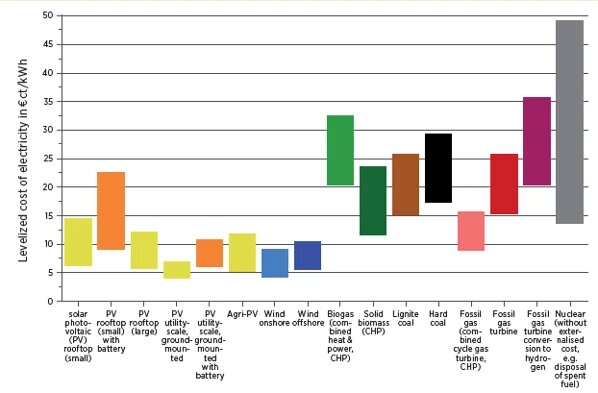
The package of legislative proposals launched on 17 July 2026 shows how the European Commission tries to navigate between on the one side the continuity of its long-term path towards a fossil-free continent, and the calls from laggards and sceptics to push the pause button. However, access to cheap and affordable electricity is the lowest common denominator almost everybody can agree on. The Commission now proposes a new benchmark of doubling the current share of electricity in final energy consumption from 23% to 46% by the year 2040. Is this realistic? Solar and wind power are the cheapest source of electricity in basically all EU regions.
Figure 1: Levelised cost of electricity generation of renewable energy technologies and conventional power plants at locations in Germany in 2024
Renewable electricity thus becomes more and more attractive, indeed driving a new wave of electrification:
- Electric heat pumps replace fossil gas boilers for heating homes and businesses.
- Electric vehicles replace cars and lorries with internal combustion engines.
- Electricity replaces fossil gas, oil and coal in industrial production processes, be it directly or indirectly through hydrogen from electrolysis.
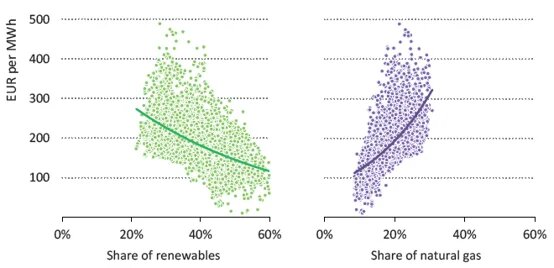
The growth of cheap renewable electricity already considerably buffers the wholesale electricity market prices in the EU.
Figure 2: EU hourly wholesale electricity prices, first half of 2022
Nevertheless, switching from fossil fuels to electricity is not a self-propelling item because electricity remains relatively expensive compared to fossil fuels. Normally, the ‘polluter pays principle’ applies in the EU: The more a certain energy carrier emits, the higher it should be taxed. But the taxes and levies on electricity in most EU Member States are still much higher compared to the same unit of fossil fuel energy carriers like fossil gas and oil. In some Member States, electricity is four times more expensive than gas while electrification becomes financially viable only if the electricity-to-gas price ratio is between 2 and 2.5. The European Commission suggested reducing taxes on clean electricity in its reform of the Energy Taxation Directive in July 2021. Since that time, Member States couldn’t agree because EU laws on taxation require unanimity amongst all national governments – and some preferred keeping the right to grant tax rebates for certain fossil fuels and their national consumers.
Will fossil fuels finally be taxed appropriately?
The trick that the Commission tries now to overcome this deadlock is an amendment to the Electricity Market Regulation. It leaves national governments the freedom to set the level of their energy taxes but prescribes that they must promote the use of electricity and always tax electricity at a lower level than fossil gas. By wrapping the taxation question into a broader improvement of market functioning, unanimity is not required any more. The change could be voted by qualified majority and would immediately enter into force across the EU. If progressive lawmakers in the European Parliament unite behind it and if Member States do not form a blocking minority, this could be a real game changer. After waiting five years in vain for a new Energy Taxation Directive, finally the switch to electric heat pumps, to electric vehicles and to electrified industrial processes would become economically much more interesting.
Going 100% renewables would be the most effective electrification target
The impact of the electrification target is questionable. It is more than just another technical key performance indicator but appears in the debate about the architecture for the EU climate and energy objectives for 2040. During the past two decades, Member States had to contribute to commonly agreed EU targets for increasing the share of renewables and for reducing energy consumption. This approach not only allowed for a broad market introduction of ever cheaper renewable energy sources. It also ensured a level playing field and prevented too large a disparity between Member States on the path towards EU climate neutrality. Not surprisingly, there are countries that are lagging behind in deploying their domestic renewables and reducing their overall consumption. Instead of trying to catch up, 15 national governments in June 2026 sent a letter to the European Commission, asking to simply abolish the renewable energy target. Instead, they suggest a new ‘clean energy target’ for the EU which would make nuclear power accountable in view of achieving the target.
While the electrification of heating, transport and industry is a normal process in Europe’s transition towards a renewable energy system, setting an electrification target alone does not necessarily contribute to more competitiveness, nor would it be a guarantee for getting rid of fossil fuel imports. The target is ‘technology neutral’, thus not prioritising any specific energy source. Without prescribing where the electricity comes from, it can also promote the continued use of fossil fuels, as well as nuclear power.
Looking at electrification alone can be counter-productive
The example of data centres shows that the electrification target can turn out to be counter-productive if no other safeguards and incentives are in place: Ireland hosts many data centres that make up more than a quarter of its electricity consumption. Like in other EU countries, their electricity demand is expected to further increase massively over the coming years. From the perspective of the EU’s electrification target, Ireland would be top of the class. From our exchanges with Irish energy experts and grid operators, we know, however, that the data centres cause quite a headache. The increase in electricity demand can partly be covered by the fast growth of solar and wind power, but in a situation of congested grids and limited cross-border electricity import capacities, the peak demand caused by higher electricity consumption can also incentivise expensive fossil gas-fired power production to fill the gaps. To prevent unguided electrification from becoming a boomerang, it is indispensable to ensure the constant growth of renewable energy supply while phasing out fossil fuels. Last but not least, rewarding energy savings, and promoting flexibility from storage technologies and grids will help prevent fossil fuels from staying in the game.
Will the EU’s Emissions Trading System (ETS) not kick out fossil fuels anyway? Yes, a strong ETS with ambitious emission reduction trajectories would be a safeguard, effectively complementing the new electrification target. But in parallel, the European Commission has also suggested to slacken the reins when it comes to its ETS. Prolonged free allocation of emission permits, introduction of international credits and carbon removals could undermine the price signal against fossil fuels.
The electrification target, a substitute for ambition on renewables and energy savings?
One elephant in the room remains: nuclear power. Even the most optimistic scenarios forecast only a limited growth of nuclear capacities in the EU. In an energy system with a massively growing electricity demand, nuclear reactors’ contribution to the electrification target would remain marginal. The costs of electricity generation from newly built reactors will stay several times higher than those of renewable energy sources. With roughly half of its nuclear fuels being sourced from Russia and its allies, the technology neither contributes to the EU's resilience nor to energy security. In the end, the electrification target might not lead to adding secure and affordable kilowatt-hours, but prepare channelling EU funds into lifetime extensions of reactors and small modular reactor (SMR) adventures – with the EU’s renewable energy target as collateral damage.


