

The world faces its fourth wave of global food price crises in just 20 years. This atlas not only documents the damaging impacts of corporate power within the food system but also highlights practical alternatives and successful efforts to curb corporate dominance and guarantee access to healthy, affordable food.

The world faces its fourth wave of global food price crises in just 20 years. We must confront one of the root causes of why our food systems are failing to feed the world sustainably and why they remain so vulnerable to geopolitical and economic shocks: the corporate power that shapes how our food is grown, processed, marketed, and consumed.
Since the early 20th century, the agrifood sector has undergone massive consolidation, creating vulnerabilities throughout the global food system. First, crop production has become concentrated around a handful of staples, with maize, rice, and wheat accounting for at least three-quarters of global cereal output. Second, geographic concentration has left the global food supply dependent on a small number of so-called breadbasket regions, such as Ukraine and the North China Plain. Third, international trade is routed through logistical chokepoints, the strategic vulnerability of which has most recently been illustrated by the blockade of the Strait of Hormuz. Finally, corporate concentration has reached unprecedented levels. Just four corporations control 61 per cent of the global pesticide market, 56 per cent of the commercial seed sector, 43 per cent of farm machinery production, and 24 per cent of the global fertiliser market, respectively.
Policymakers should be alarmed by the widening gulf between record corporate profits and rising global hunger during periods of crisis. Following Russia's full-scale invasion of Ukraine in 2022, global food exports fell by an estimated 7 million tons. Despite this marginal physical deficit amounting to less than one per cent of global crop production speculation drove wheat prices up by 50 per cent in the first month of the war, generating an estimated 1.9 billion US dollars in profits for hedge funds from wheat, maize, and soya bean trades. Financial investors were not the only beneficiaries of the war. In 2022, the world s five largest agricultural trading corporations tripled their profits compared with their 2016 2020 average, while the nine leading fertiliser firms increased their profit margins to an average of 36 per cent. As corporations and investors amassed unprecedented gains, the global population paid the price: food prices soared and the number of people facing acute food insecurity rose by 65 million in a single year.
Strikingly similar dynamics are now unfolding in the current global crisis triggered by the US-Israeli war against Iran. Roughly one-third of the global fertiliser trade normally passes through the Strait of Hormuz. The blockade has enabled major firms to reap windfall profits, while farmers struggle with soaring input costs. In March 2026, the chief executive of Nutrien, the world s largest fertiliser corporation, sold shares worth nearly 5 million US dollars, netting a profit of 1.8 million US dollars. Meanwhile, insiders at CF Industries, the world s largest ammonia producer, offloaded shares worth more than 50 million US dollars during the first two months of the Hormuz blockade. By March, the United Nations World Food Programme had warned that the conflict could push an additional 45 million people into acute hunger.
Yet the problems posed by concentrated corporate power in global food systems extend far beyond crisis profiteering and food price spikes. Most agrifood giants have transformed market dominance into political influence through lobbyists and industry groups such as CropLife, which represents the pesticide sector. At the same time, these corporations profit from the very crises they help create and exploit them to obstruct sustainability reforms even seeking to reverse decades of hard-won environmental and social progress. From Bras lia to Brussels and from Nairobi to Washington DC, these actors employ tactics long perfected by the tobacco and fossil fuel industries: downplaying the environmental and public health harm of their business models while blocking or weakening regulation.
The recent battle over pesticide regulation in the European Union (EU) serves as a stark example. When the European Commission announced a target in 2019 to cut pesticide use by 50 per cent, the agrochemical industry launched an unprecedented lobbying campaign. By commissioning a series of so-called impact studies portraying pesticide reduction as a threat to food security, an alliance of industry groups, the farming lobby Copa-Cogeca, and centre-right members of the European Parliament succeeded in derailing the proposal. Since then, the Commission has moved even closer to long-standing industry demands. In a 2025 proposal unveiled under the banner of simplification and competitiveness, the Commission set out plans to scrap mandatory safety reassessments for most pesticide active ingredients previously required every 10 to 15 years effectively paving the way for lifetime approvals. Experts view this as the culmination of years of industry efforts to cast doubt on evidence of harm and to entrench more industry-friendly assessment standards. This shift forms part of a broader agenda, both within the EU and beyond, aimed at weakening environmental and social protections across all sectors.
This atlas not only documents the damaging impacts of corporate power within the food system but also highlights practical alternatives and successful efforts to curb corporate dominance and guarantee access to healthy, affordable food. The solutions showcased range from stronger anti-trust policies designed to halt further consolidation and break up dominant firms, to regulations that strengthen farmers' bargaining power and secure fairer prices. Equally inspiring are examples from around the world showing how public procurement can reshape food systems while supporting family farming and agroecological production: from public buffer stocks to stabilise prices during crises to large-scale school meal programmes and even publicly owned grocery stores. The tools needed to curb corporate power already exist. What is missing is the collective power and political courage to deploy them.
We hope this atlas provides both insight and inspiration, and trust that you will find it as illuminating to read as it was to compile.
Dr. Imme Scholz
Heinrich-B ll-Stiftung
Lim Li Ching, Olivier De Schutter
IPES-Food
Matilda Flemming
Friends of the Earth Europe
Christian Russau
Association of ethical shareholders
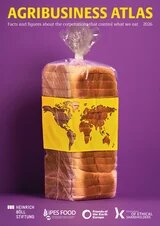
A handful of corporations dominate our food system, setting prices, profiting from crises, and driving relentless pressure on the environment, farmers, and consumers alike. The Agribusiness Atlas 2026 traces how this concentration of power took hold, and charts the political pathways toward a fairer food system built around the common good.
