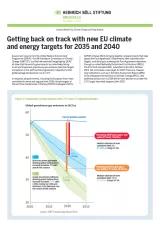
It is very clear that if the EU wants to make a fair contribution to the effort to limit temperature rise to 1.5°C, it will need to follow the recommendation of UN Secretary General Antonio Guterres and aim for achieving net-zero GHG emissions by 2040 rather than by 2050. This means the new EU 2040 target should become a net-zero target. It makes sense for the EU to set a very ambitious 2035 target of around 95% net GHG emission reductions at the same time.
The EU is going through a critical moment in its history, expected to deliver on many fronts at once, from long-term transitions to crisis after crisis that has threatened to seriously upset its stability. It would be wrong, however, to assume that the EU can afford to ignore its deepest perennial challenge, namely its own democratic credentials. To offer ideas for the debates that will necessarily unfold, especially as we move towards the 2024 European Parliament elections, SWP and CEPS set up a High-Level Group on bolstering EU democracy.
The upcoming European election in 2019 might bring about an unprecedented political earthquake, already foreshadowed four years ago, blowing away the political centre altogether. What is likely to happen in the end: the feared come-back of nationalism or is there hope for a pro-European revival?
Six months before the election to the European Parliament in May 2019, the prospects are bleak. If politicians can show that they are willing to respond to the real needs of the people and are able to connect local issues with the European level, there might still be hope for the European elections.
The recent European elections have clearly demonstrated that (too) many people have lost faith in Europe and its politicians. They do no longer trust their ability to make things better. But, is Europe’s decline really irreversible?
Is there still time to convince enough citizens, especially the young, to give their support to the European project, however bruised and battered it may look at the moment? What are the main challenges to be mastered if, at the end of the year, the European Union and its supporters will be able to look back with contentment, pride and relief and forward with confidence?
The study fleshes out a number of proposals to put the EU on a more stable and democratic footing and examines the futre of the European democracy as a whole.