Germany and Russia: as much cooperation as possible; as much conflict as necessary Published: 21 May 2014 The events happening in Ukraine are dividing the German public like hardly any other political event before. But this is not so much about Ukraine. The empathy or antipathy for the revolt against the Yanukovych regime is blanketed by a deeper difference: the view of Russia. Ralf Fücks
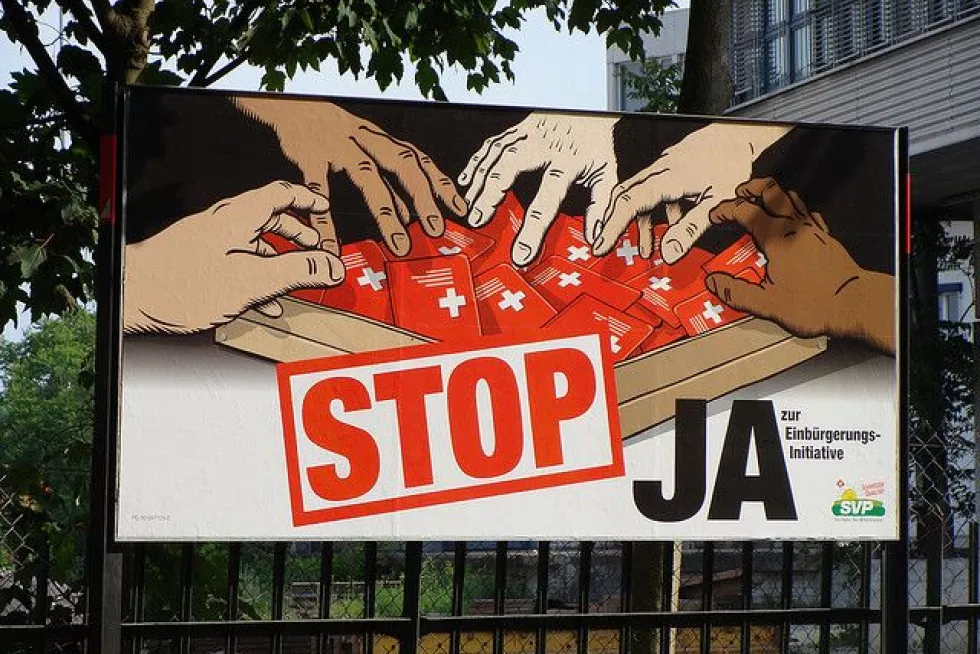
The Swiss Referendum: Stoking Fires Home and Away Published: 7 March 2014 The Swiss referendum on establishing immigration quotas seen throught the prisms of EU-Swiss relations, that of the debate on freedon of movement and that of the proliferation of referenda. Alex Lazarowicz
The Situation of Syrian Refugees in the Neighbouring Countries: What Role Should the European Union Play? Published: 5 February 2014 Do we expect that Lebanon, probably the most vulnerable of the host countries, will manage to deal with the refugee situation with international support? And, what is the situation in Turkey?
One Year after its First Democratic Change of Government: Georgia on the Road to Europe? Published: 5 February 2014 What are the biggest challenges for the Georgian government on its road to Europe and how can the reform approaches be consolidated?
New protest movements and social networks Published: 3 February 2014 Stephanie Reuter is one of our Young Voices of Europe. Stephanie Reuter
Belarus Between Round Table and Rapid Reaction Force - External Relations Published: 3 December 2013 A round table for Belarus? A wonderful idea. Who wouldn’t like to see the estate of an Eastern dictator be set in order at history’s most famous piece of furniture? But the rounds for hope are nonexistent when the suggestion comes from Alexander Lukashenko, the despot in power for the last 17 years. Werner Schulz
Eastern Promises: Supporting Civil Society in the Eastern Partnership Countries - External Relations Published: 3 December 2013 The experience of the post-Soviet countries shows that civil society (CS) plays an important role in democratisation and institutional (governance) reforms, which are central to the EU agenda in its relat ions with the Eastern Partnership countries. Howe ver, the effectiveness of EU sup port has been limited so far by factors such as the incoherence of EU policy which can be seen in the insufficient coordination of assistance activities carried out by EU institutions and the Member States as well as bureaucratic obstacles, making it difficult for social partners from the recipient countries to use the support. Elzbieta Kaca
Europe's New Diplomats - An initial appraisal of the creation of the European External Action Service - External Relations Published: 3 December 2013 After months of negotiations, the European Parliament and the EU Council finally gave the go-ahead in October for the creation of the European External Action Service. As a result, the new service can start work on 1 December 2010, drawing on around 3 700 staff and 135 embassies worldwide. The EEAS is one of the most important institutional reforms provided for by the Treaty of Lisbon. Existing but fragmented EU structures will be reformed, enhanced and brought together under the EEAS's umbrella. By Franziska Brantner
The EEAS is taking shape - External Relations Published: 3 December 2013 On 17 November 2010 the European Union Office of the Heinrich-Böll-Stiftung organised a lunch debate on The European External Action Service: Added Value or just a “28th Foreign Ministry”? Speakers were Poul-Skytte Christoffersen, Ambassador, Special Advisor to the High Representative of the European Union for Foreign Affairs and Security Policy, Franziska Brantner, MEP, Greens and Anne Schmidt, Researcher, Brussels Office of Stiftung Wissenschaft und Politik, German Institute for International and Security Affairs (SWP). Eberhard Rhein, former chef de cabinet to the Commission VP in charge of external relations and director responsible for the Mediterranean and Arab world, currently advisor to the European Policy Centre gives his own personal summary. Eberhard Rhein
American Culture and the Muslim World - External Relations Published: 3 December 2013 When Barack Obama was elected president in 2008, expectations were raised for a new political era. At home, many Americans hoped for an end to political polarization and the so-called culture wars. Abroad, millions more looked forward to America’s recommitment to engagement and consultation with the rest of the world. As the 2010 congressional elections approach and the midpoint of Obama’s four-year term looms, it is a good time to reassess such expectations. Are they on the way to being realized? And if not, why not? By Peter Skerry Peter Skerry