

Agribusiness Atlas 2026
Public food procurement is largely driven by cost minimisation, reinforcing corporate concentration and the spread of ultra-processed foods. Brazil offers a different model, using public purchasing to support smallholder farmers and improve diets.

The public sector buys food on a vast scale: from school meals and military rations to hospital cafeterias and prison kitchens. In the European Union (EU) alone, public procurement of food and catering services amounts to an estimated 50 billion euros annually. The United States federal government spends around 35 billion US dollars each year on school food programmes. This gives governments enormous market power, enough to set terms for entire agricultural sectors.
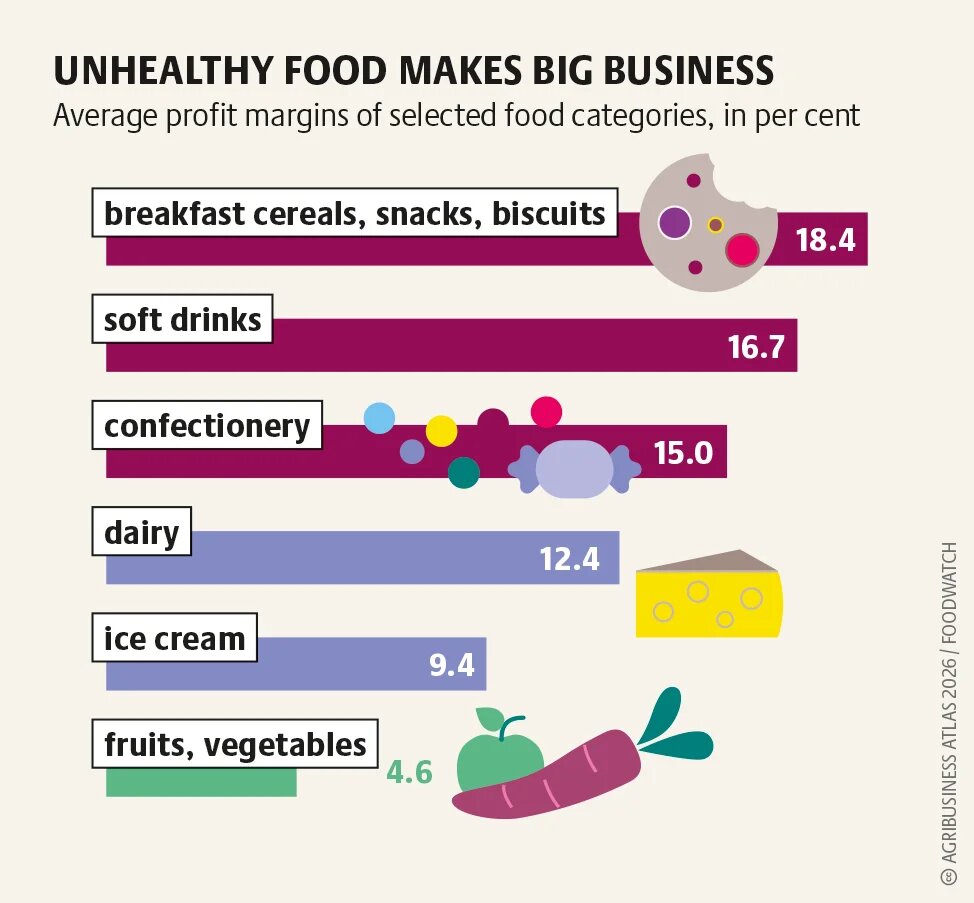
Yet in most countries, public food purchasing is driven by cost minimisation. Procurement contracts typically reward the lowest bidder, channelling public funds towards the largest food corporations able to supply bulk commodities at the cheapest price. The result is a system in which public money reinforces corporate concentration, driving down food quality, squeezing smallholder farmers, and externalising environmental and healthcare costs. A handful of transnational food service corporations such as Compass Group, Sodexo, and Aramark dominate institutional catering across the Global North, with combined annual revenues exceeding 85 billion US dollars.
A 2024 global review found that just 25 per cent of countries regulate the sale of unhealthy competitive foods on school grounds, and only 16 per cent restrict food marketing in schools. As a result, school food environments remain largely open to ultra-processed food manufacturers, which benefit from procurement systems designed around cost minimisation and shelf stability.
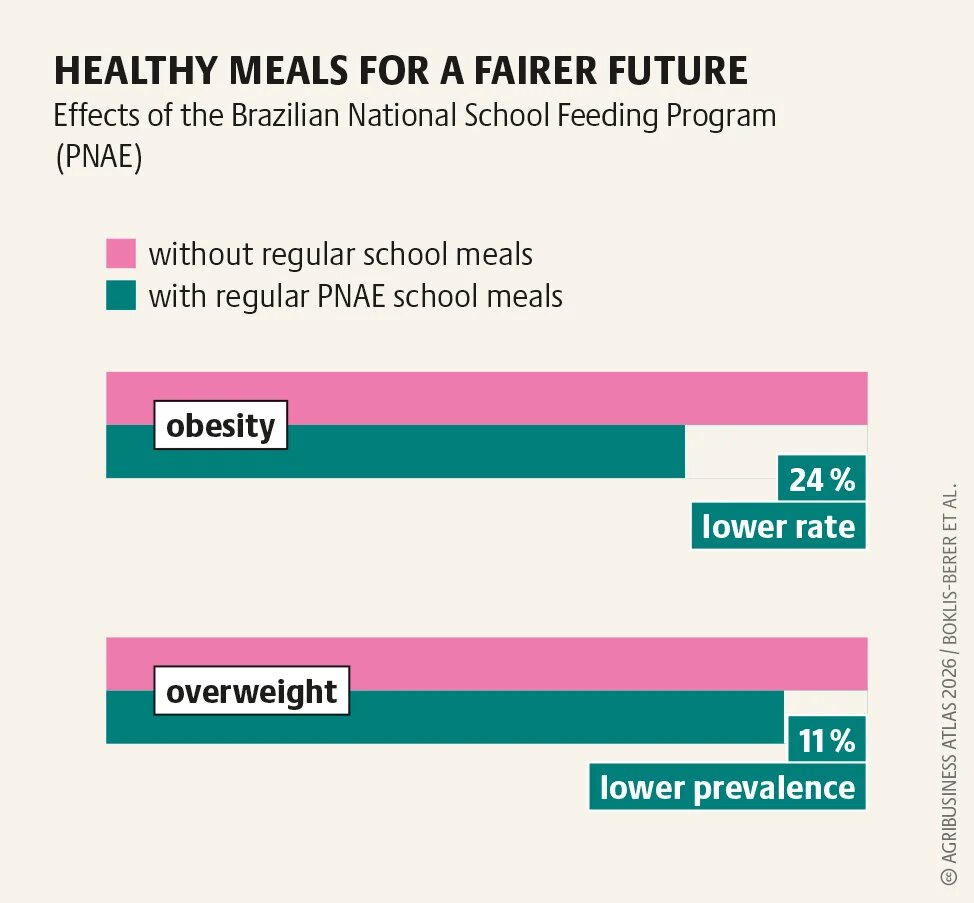
An alternative model can be seen in Brazil, where public procurement is redirected towards fresh food from smallholder farmers. The country's National School Feeding Programme, known by its Portuguese acronym PNAE, is one of the largest in the world and provides meals to more than 40 million students each day across 155,000 schools. A 2009 federal law requires that at least 30 per cent of PNAE funds be used to purchase food directly from family farmers, smallholders who rely primarily on household labour and manage limited landholdings. By 2024, the programme channelled roughly 284 million US dollars per year to smallholder producers. This created guaranteed markets that stabilise rural livelihoods and reward diversified, agroecological farming practices through price premiums and procurement priorities for organic and minimally processed foods. In 2026, a new law raised the minimum share for family farming to 45 per cent of funds, channelling more than an estimated additional 450 million US dollars per year to smallholder producers. It gives explicit priority to agrarian reform settlements, Indigenous and Quilombola communities, and women's cooperatives.
Brazil's complementary Food Acquisition Programme (PAA), established in 2003, extends this approach further. The PAA enables government agencies to purchase food directly from family farmers without competitive bidding, as long as purchases remain below annual per-farmer limits. The food is then distributed to food-insecure populations through food banks, community kitchens, and social assistance networks. At its peak, the PAA reached approximately five per cent of Brazil's four million family farmers each year. Between 2003 and 2011 alone, it purchased more than 3.5 million metric tonnes of food. In 2023, its first year of restoration after severe budget cuts, the programme generated income for over 81,000 family farming households. Of these, 61 per cent were headed by women.
The Brazilian example represents a deliberate inversion of conventional procurement logic. Rather than prioritising the lowest cost per calorie, Brazil's framework treats public food purchasing as an investment in multiple outcomes: nutrition, rural development, and food sovereignty. But the model has not been without difficulties. Between 2016 and 2022, PAA funding fell by more than 80 per cent from its 2012 peak, as successive administrations prioritised fiscal austerity and agribusiness interests. Restoration after 2023 introduced dedicated procurement streams for Indigenous and Quilombola communities. However, as of mid-2025, only one-third of Brazil's 5,570 municipalities were participating in the programme.
Despite these challenges, Brazil's model has influenced similar efforts elsewhere. In 2020, Colombia adopted legislation requiring that 30 per cent of public food procurement be sourced from smallholder and peasant farmers. India's midday meal scheme, which serves approximately 120 million children, has begun linking procurement to local producers, although centralised commodity distribution still dominates. In the United States, farm-to-school programmes have grown from a handful of pilot projects in the early 2000s into initiatives serving local food in more than 74,000 schools. In the 2022Ð2023 school year alone, they spent an estimated 1.8 billion US dollars on locally sourced products. However, these programmes lack the mandatory procurement thresholds that give Brazil's approach its force.
A handful of corporations dominate our food system, setting prices, profiting from crises, and driving relentless pressure on the environment, farmers, and consumers alike. The Agribusiness Atlas 2026 traces how this concentration of power took hold, and charts the political pathways toward a fairer food system built around the common good.
