

Agribusiness Atlas 2026
The world faces rising hunger and ecological breakdown, driven by industrialised food systems. Yet no institution effectively guides global policymaking. Responsibility is split among competing agencies with overlapping mandates, rival funding, and weak oversight. The fragmentation of United Nations (UN) food agencies is a political choice that corporations exploit to reshape institutions for commercial interests.

When the Food and Agriculture Organization (FAO) was founded in 1945, it held a sweeping mandate: directing global food security research, financing, emergency relief, and policy under a single roof. But the food and energy crises of the 1970s dismantled that authority. Agricultural finance was handed to the newly created International Fund for Agricultural Development (IFAD), while the World Food Programme (WFP), previously the FAO's emergency relief arm, became an independent agency heavily influenced by the United States. The Consultative Group for International Agricultural Research (CGIAR), the global agricultural research network, was set up outside the UN system, created by the World Bank and private foundations, with no mandate from Member States. Each new agency developed its own bureaucracy, complete with legal departments, communications teams, and fundraising operations.
In 1974, alarmed by the erosion of the FAO's mandate, the G-77 bloc of low- and middle-income countries pushed to establish an inter-agency coordination body: the Committee on World Food Security (CFS). Its purpose was to compel the growing constellation of agencies to convene regularly with Member States and mount coordinated responses to future hunger crises. Backed by FAO, IFAD, and the WFP, the CFS became the main intergovernmental forum for global food security policy.
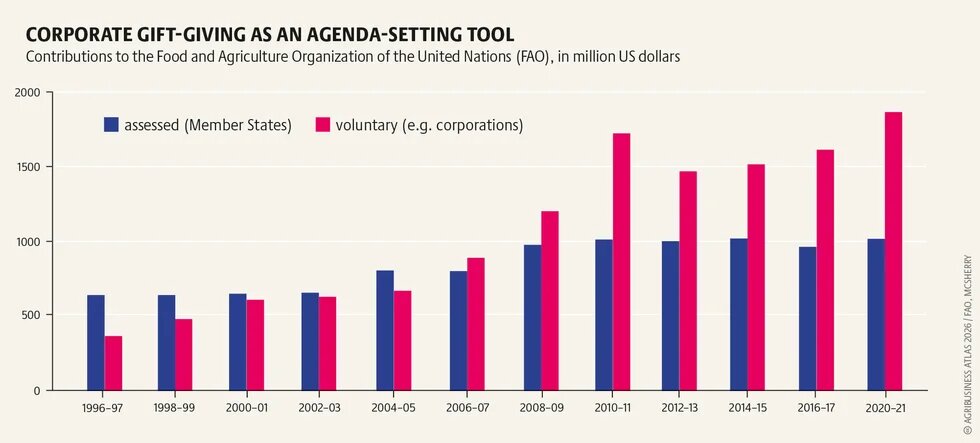
As austerity deepened, food agencies could no longer rely on stable Member-State contributions and became increasingly dependent on voluntary funding. This shift fundamentally transformed UN food governance and pulled corporate money deeper into institutional decision-making. Voluntary funding now accounts for two-thirds of the FAO's budget and for the WFP's entire funding.
This dependence on donor funding realigns institutional priorities and shifts UN agencies away from the public interest. To survive, agencies must satisfy private funders, who can then steer money towards projects that serve their own commercial or geopolitical interests. CGIAR illustrates this trend: its growing dependence on Gates Foundation and agribusiness donors has visibly reshaped its agenda. Research has increasingly focused on technological fixes, such as high-tech intensification and patented bio-digital systems favoured by major investors, rather than on agroecological or traditional farming models supported by Member States and communities. Fragmentation also allows corporations to circumvent unfavourable regulations by lobbying for their preferred policies through whichever institution proves most receptive, a practice known as forum shopping.
In 2009, Member States and civil society groups reformed the CFS in response to these failures. The revamped CFS became the first genuinely inclusive intergovernmental platform, giving civil society, small-scale food producers, and Indigenous Peoples a seat at the table alongside governments. This reform produced policy guidelines that have helped challenge corporate control, including frameworks on agroecology, land tenure, and responsible agricultural investment. However, in the 17 years since the CFS reform, high- and middle-income countries have steadily cut the CFS budget and weakened the role of social movements, leaving the institution struggling for relevance.
The 2021 UN Food Systems Summit (UNFSS) marked a shift towards opaque, corporate-led decision-making. Through a partnership with the World Economic Forum, the summit's organisers promoted investor-friendly technological solutions. Invoking the urgency of the COVID-19 pandemic, the summit bypassed the CFS and spawned a parallel entity: the UN Food Systems Coordination Hub. While the CFS scrapes by on a stagnant annual budget of approximately 2 million US dollars, the new Coordination Hub draws staff and funding from across the entire UN system, a clear sign that resources are shifting away from democratic control.
The current governance structure makes coordinated regulation of the global food chain nearly impossible. The result is a system that corporations can game at will, exploiting rivalries between agencies, competing for their ear, and evading any meaningful regulation.
The 2022 food price crisis exposed the consequences. Fertiliser prices tripled after Russia's invasion of Ukraine. The world's nine largest fertiliser corporations more than tripled their profits compared with pre-pandemic levels. Workers faced wage cuts and job losses, while consumers endured the highest food inflation in four decades. The fragmented governance system failed to deliver a coordinated response.
Now, amid a new food and energy price crises, the window for structural reform has reopened. The leadership of the major UN food agencies is up for renewal, as are the budgets, but it remains unclear who will seize the opportunity. Until food governance is re-anchored in the CFS, with genuinely democratic, accountable structures, corporate power will continue to exploit the gaps.
A handful of corporations dominate our food system, setting prices, profiting from crises, and driving relentless pressure on the environment, farmers, and consumers alike. The Agribusiness Atlas 2026 traces how this concentration of power took hold, and charts the political pathways toward a fairer food system built around the common good.
