

Agribusiness Atlas 2026
Access to clean water is a human right since 2010. Yet this vital resource is increasingly coming under corporate control. Across the world, corporations extract groundwater and spring water, selling it in branded bottles at prices that are often many times higher than those of tap water.

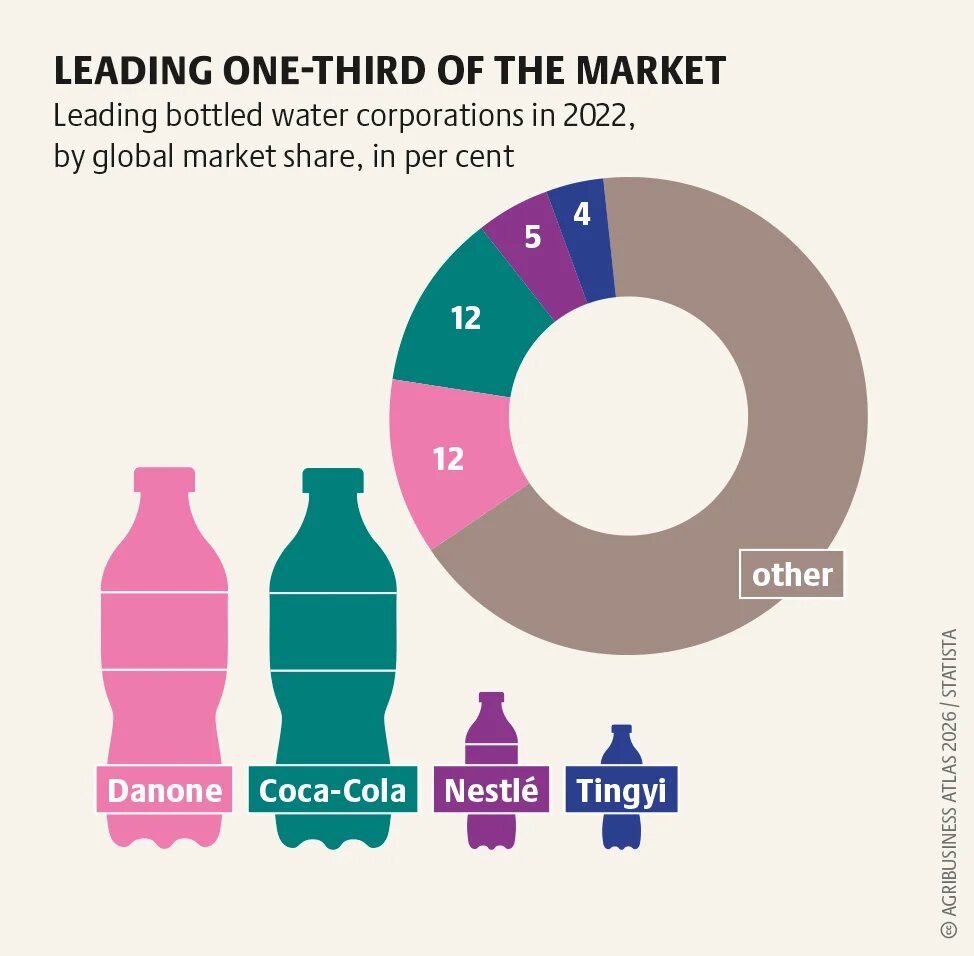
Since 2010, the global bottled water market has grown by more than 70 per cent. Annual revenues now surpass 300 billion euros. The global market is dominated by Coca-Cola, Danone, Nestlé, and PepsiCo. In the United States, their combined market share exceeds 70 per cent. Bottled water is significantly more expensive than tap water, which disproportionately affects low-income households. People who have no access to tap water, or only to water that is unsafe to drink, are forced to bear excessive costs. According to estimates, less than half of the amount spent globally on bottled water could provide hundreds of millions of people with long-term access to clean tap water.
Large corporations in sectors such as mining, energy, agribusiness, and beverage bottling often secure privileged access to water sources through long-term concessions, while local communities are denied the same. A recent United Nations report examining contracts across 34 African and 19 Asian countries finds that these agreements increasingly resemble private ownership rights. Although water is legally defined as a public good in many countries, these contracts significantly reduce public oversight and restrict local communities' access.
According to the United Nations, the privatisation of water is hindering the progress needed to achieve Sustainable Development Goal 6 (SDG 6), which aims to ensure universal access to safe drinking water. Each year, up to 3 billion people experience water scarcity for at least one month of the year.
The consequences of this system are evident worldwide. In San Cristóbal de las Casas, Mexico, a Coca-Cola bottling plant extracts more than one million litres of groundwater every day. At the same time, many residents receive running water for only a few hours per week. This situation is particularly striking given that the state of Chiapas is among the most water-rich regions in Mexico. Nevertheless, more than one-third of rural households there lack access to piped water, and only 7 per cent of residents consider tap water safe to drink. High industrial water consumption, weak regulation, and climate-related drought have intensified shortages, forcing low-income households to rely on bottled water produced from their own local resources.
A similar contradiction can be observed in the département of Puy-de-Dôme in France. After the region experienced drought in 2023, the authorities imposed restrictions on water use. These extraction bans did not apply to the mineral water corporation Volvic, a subsidiary of the food giant Danone, which was permitted to continue supplying its bottling plant with groundwater. In the same year, Danone reported profits of 881 million euros and paid out 1.2 billion euros in dividends.
In the driest region in the world, Chile's Atacama Desert, lithium and copper mining have become major drivers of groundwater depletion and pollution, and environmental stress. Corporations extract lithium by pumping mineral-rich brine from underground aquifers and evaporating it in large ponds, a process in which between 85 and 95 per cent of the water is lost. This intensive extraction has been linked to declining groundwater levels and damage to fragile wetland ecosystems on which Indigenous Atacameño communities depend. For thousands of years, these Lickanantay People have farmed and reared livestock, drawing on generations of deep ecological knowledge to grow food in a very dry and harsh climate. With less water available, the foundation of their traditional way of life is at high risk. In December 2024, the Environmental Court of Antofagasta imposed a record-fine of 47 million US dollars on Australian mining firm BHP, the US-based Albemarle, and Chilean firm Zaldívar for exceeding groundwater extraction limits, ruling that their activities lowered the water table, in some places between 25 centimetres and 2 metres. While several mining corporations are now investing in large-scale desalination plants to replace groundwater with seawater, critics argue that this shift neither fully reverses existing aquifer depletion and even creates new environmental pressures along the coast.
In Harare, Zimbabwe's capital, households already spend up to 20 per cent of their income on unsafe water that is delivered only every three to four days. Despite these conditions, the city is moving toward privatising its water system. In January 2025, the government invited private corporations to submit bids, even though the water supply comes from Lake Chivero, one of the most polluted lakes in the world. The city currently spends between 2.5 million US dollars and 3 million US dollars per month on water treatment, costs that are likely to be passed on to consumers.
These conflicts over water use illustrate a fundamental question for the future: how much water will remain available? And who will be entitled to use it, under what conditions, when it becomes scarce?
Around the world, initiatives such as Right2Water are campaigning for water to no longer be treated as a commodity. They call for its protection as a public good that must be available to all people in sufficient quantities and at an affordable price. A fair water policy in this sense requires clear political action. First, lawmakers must enshrine the right to water with the same weight as other fundamental freedoms anchored in the EU Charter of Fundamental Rights and in national constitutions. Second, governments must treat citizens as rights-holders, not consumers. That means banning and reversing the privatisation of water resources, returning water services to public control, and introducing social tariffs to ensure water remains affordable for every household. Third, regulators must hold corporations to account. Firms should be required to disclose their full water footprint: how much they extract, and the quality of the wastewater they discharge. They must bear the full cost of any damage they cause. Only robust, consistently enforced regulation will safeguard the natural water cycle over the long term.
A handful of corporations dominate our food system, setting prices, profiting from crises, and driving relentless pressure on the environment, farmers, and consumers alike. The Agribusiness Atlas 2026 traces how this concentration of power took hold, and charts the political pathways toward a fairer food system built around the common good.
