

Agribusiness Atlas 2026
The world's largest meat and dairy corporations emit as much greenhouse gas as entire countries and resist limits using fossil fuel lobby tactics. Data is key to accountability, but progress on reporting remains slow and under threat.

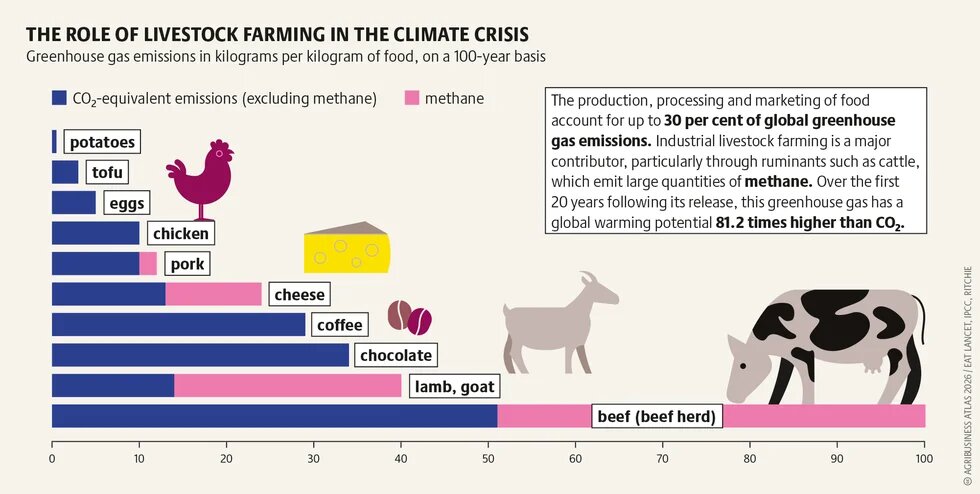
What we eat has a big impact on the climate. Food systems including how our food is produced, transported, stored, and distributed are responsible for about a third of global greenhouse gas (GHG) emissions. The footprint varies widely depending on the type of food and farm practices used. Meat, especially beef, and dairy contribute significantly more to the climate crisis than fruit, vegetables, or plant-based protein. When production is concentrated in industrial factory farms, the damage multiplies: rivers and soils are contaminated, biodiversity declines, rural communities lose out, and animal welfare suffers.
The largest meat and dairy corporations are a major source of GHG emissions. Yet they have largely avoided taking responsibility. Together, the top 5 meat and dairy producers emit as much as one fossil fuel giant like BP or Shell. And like Big Oil, Big Meat and Big Dairy exert influence over policymakers. Research shows major meat and dairy corporations spend millions on lobbying against climate legislation, downplaying the role of animal agriculture in a changing climate. In Europe, the industries lobby the right-wing conservative majority in the European Union (EU) Parliament, pushing narratives such as demands for less bureaucracy, while in reality seeking weaker environmental standards. Holistic European wide food system legislation has been abandoned.
Nearly 80 per cent of EU farm subsidies currently support livestock or feed production. Animal-based foods cause most of food-related greenhouse gas emissions in the EU. Environmental organisations and progressive farmers' groups are advocating for a redistribution of these subsidies to promote farming practices that benefit the climate and nature. Yet, in the next round of EU subsidies, starting in 2028, payments risk becoming even less tied to environmental obligations. Civil society groups are also calling for better EU regulations for cost-covering prices for producers. If dairies were legally obliged to pay fairer prices, as it is on the way in Spain, their business model of exporting cheap dairy products would be undermined. Agricultural lobbies label all of this a bureaucratic burden. They demand more subsidies without environmental conditions and oppose fairer trade regulations.
One of the big EU meat producers is Germany, where livestock farming is responsible for about 70 per cent of the agricultural sector's greenhouse gas emissions. In the 2000s, the meat industry began to grow significantly, after federal and state governments weakened environmental laws, reduced inspections, and channelled billions in subsidies into new factory farms. Research suggests that German meat corporations such as Tönnies, Westfleisch, and Rothkötter may be violating the Supply Chain Due Diligence Act. The allegation is that these companies use soya feed in their supply chains that may be linked to human rights violations and land conflicts in Brazil's Cerrado region. All three corporations were the subject of a written notice to the supervisory authority of the German Supply Chain Act filed by civil society organisations. The results of the official investigation into these allegations have not been made public.
Many climate-harming corporations exploit the lack of standardised reporting, which remains a major obstacle to accountability. Without consistent data, it is difficult to track corporate climate performance or assess the credibility of corporate commitments. Today, the limited information available is scattered across voluntary initiatives and corporation reports, which cover different companies and measure different things.
Meat corporations worldwide are constantly looking for ways to raise capital while sidestepping transparency rules. A prime example is the Brazilian meat giant JBS. For nearly ten years, its attempts to list on the New York Stock Exchange were blocked by the U.S. Securities and Exchange Commission, due to various bribery and corruption scandals, and labour law violations. Despite prison sentences for executives and several price-fixing settlements, JBS has maintained its political influence. Pilgrim's Pride, a U.S. subsidiary of JBS, donated 5 million US dollars to Donald Trump's 2025 inauguration committee. That is more than donations from several Big Tech firms combined. Soon after, JBS received regulatory approval to list on the NYSE and its shares began trading in mid-2025.
Some Governments and the European Commission have begun to close the transparency gap by proposing mandatory reporting rules. This is a step forward, but many rules exclude emissions from the supply chain known as Scope 3, meaning indirect emissions across a product's lifecycle, from feed production to transport. Yet these emissions represent by far the largest share. Further progress is at risk due to the US abandonment of its federal rules and the EU's reconsideration of its reporting requirements. Some meat and dairy corporations have started publishing more emission data ahead of or under these reporting requirements, but major gaps remain. Disclosing emissions from meat and dairy production continues to lag behind disclosures from other sources like electricity use or food processing, which represent a much smaller portion of a company's emissions. Some corporations still have not reported any emissions or have recently ceased further disclosures. Much remains to be done.
A handful of corporations dominate our food system, setting prices, profiting from crises, and driving relentless pressure on the environment, farmers, and consumers alike. The Agribusiness Atlas 2026 traces how this concentration of power took hold, and charts the political pathways toward a fairer food system built around the common good.
