

Agribusiness Atlas 2026
Today, just a handful of corporations determine what is grown in our fields, what ends up on supermarket shelves, and ultimately what we eat. This concentration of market power did not emerge overnight

As early as the 19th century, new machinery enabled the cultivation of ever larger areas of land with fewer workers. In the 20th century, the introduction of synthetic fertilisers and pesticides further accelerated this consolidation of power. Smaller farms came under increasing pressure, and so did the natural environment.
From a historical perspective, the fact that farmers buy their inputs on the market is a relatively recent development. Barely 200 years ago, farmers saved their own seeds, crafted tools by hand, and fertilised with organic waste and manure from their own farms. Hedgerows, tree lines, crop rotations, and wetlands provided vital habitats for beneficial species such as birds, spiders, and predatory insects that helped keep pests under control.
With industrialisation, all of this changed fundamentally. From the 1830s onward, groundbreaking innovations like the mechanical harvester and the steel-tipped plough enabled much larger areas to be cultivated. At the same time, trade in nitrogen-rich guano and mineral fertilisers such as potassium and phosphorus sourced from bone and rock began to expand. These nutrients promoted plant growth, and targeted fertilisation suddenly made it possible to achieve higher yields and cultivate ever larger tracts of land.
At the beginning of the 20th century, the industrial model of agriculture gained further momentum, with the introduction of petrol-powered tractors. A new development was the use of agrochemicals: synthetic nitrogen fertilisers, pesticides from the laboratory, and hybrid seeds designed to produce high-yielding crops began to be widely used in fields. Political measures, including the Agricultural Adjustment Act (AAA) introduced under the 1930s New Deal in the United States, also contributed to the advance of industrial agriculture which, in turn, benefited the dominant input firms in the sector. By the late 1930s, large-scale monocultures had become commonplace in many regions that were heavily reliant on machinery, agrochemicals, and purchased seeds.
As industrial farming methods spread, stable and profitable markets emerged. Early industry leaders rapidly grew into dominant forces first in North America and Europe, and later globally. The 19th century saw the founding of major agribusinesses such as Bayer and BASF in agrochemicals and Deere & Company in farm machinery all of which remain influential to this day. Over time, these corporations acquired numerous competitors, thereby securing ever greater market shares. The modern global player Corteva Agriscience, for instance, has roots that reach back into the 19th century and was formed through the spin-off of the merged agrochemical giants Dow and DuPont.
This concentration of power began in a handful of countries with vast expanses of grassland territories that were often taken by force and converted into industrial farmland. In other words: Indigenous and local communities were displaced to create space for settlers and agricultural expansion. Countries such as the United States, Canada, Ukraine, Australia, and Argentina were early adopters of industrial farming methods to produce large quantities of grain for export. The advent of steamships and the expansion of railway networks from the mid-19th century onward made it increasingly easy for them to export surpluses first to Europe and later worldwide. These nations remain key players in the global grain trade to this day.
Alongside the booming grain trade, commodity markets that became increasingly financialised began to emerge markets where agricultural products were not only traded but also treated as financial investment assets. These markets came under the control of a few major international trading houses. While the first agricultural futures exchanges had already appeared as early as the 17th century such as the Dojima rice market in Japan or the coffee and spice trade at the Amsterdam Stock Exchange these markets gained real traction from the mid-19th century, particularly after the repeal of Britain s Corn Laws in 1846. In this period, a few large and influential grain trading corporations emerged Bunge, Louis Dreyfus, Cargill, and Archer Daniels Midland (ADM) which continue to dominate the global grain trade today.
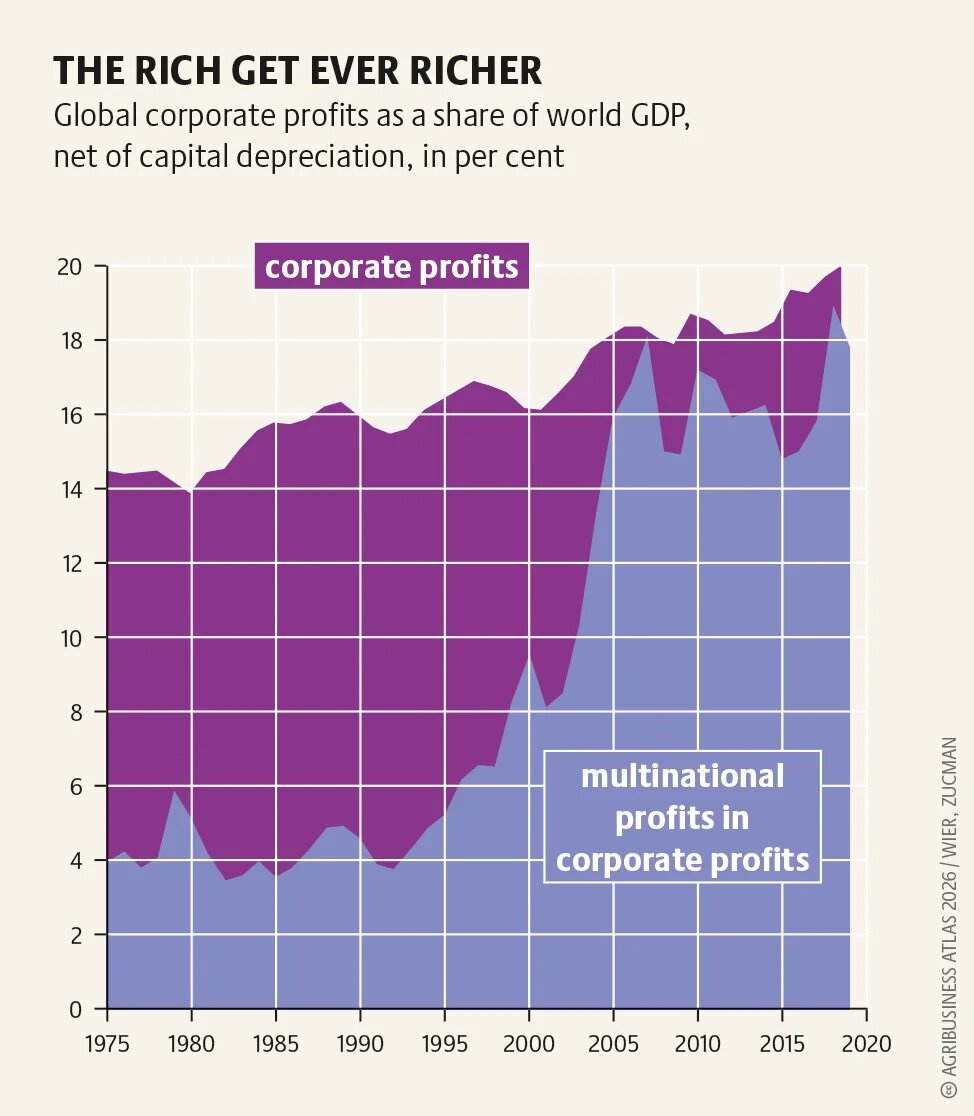
Civil society groups and some farming organisations criticise the fact that a small number of very large corporations now control the entire supply chain of the global industrial food system from agricultural production to food processing to grocery retail. This concentration of power entrenches a one-sided production model: it secures profits for a few global corporations while threatening food sovereignty, health, and diversity. Monocultures, intensive use of pesticides and fertilisers, and resource-intensive practices have serious ecological consequences, including soil erosion, biodiversity loss, and climate impacts. For consumers, food options are less healthy and less diverse. For small farms, economic pressure continues to mount. They become increasingly dependent on market-dominant suppliers and buyers and are left with little room to pursue sustainable farming practices.
A handful of corporations dominate our food system, setting prices, profiting from crises, and driving relentless pressure on the environment, farmers, and consumers alike. The Agribusiness Atlas 2026 traces how this concentration of power took hold, and charts the political pathways toward a fairer food system built around the common good.
