Water Atlas 2025
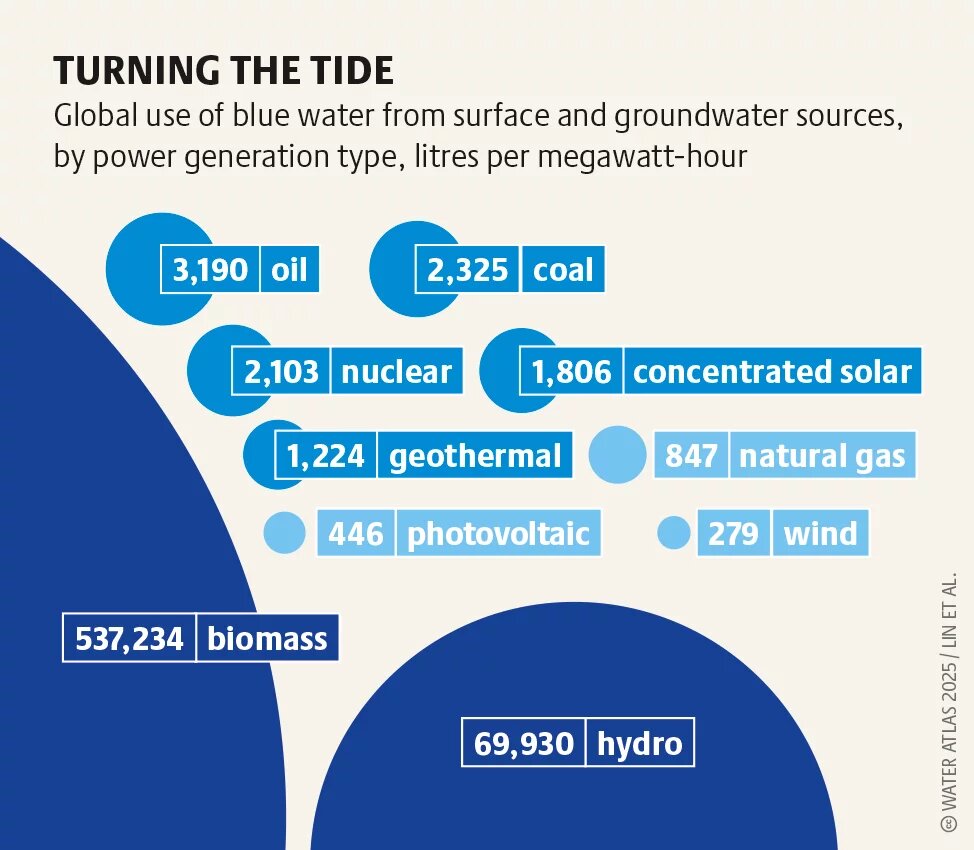
Water and energy are deeply interconnected: producing energy relies on water, while treating water consumes energy. Mining raw materials such as lithium and copper needs lots of water, also in arid regions. The solutions: recycling, water-saving technologies, and switching to renewable energy sources such as wind and solar.

Overcoming water-related challenges is inseparable from tackling energy-related issues. It takes lots of water to generate energy, for example to cool thermal power plants and nuclear reactors. Energy, in turn, is needed for water-related activities such as drilling, transportation, purification, desalination, and wastewater treatment.
Because the relationship between water and energy is so close and complex, problems such as access, scarcity, or mismanagement of one can significantly affect the other. If water is scarce, this can hamper energy production and hinder efforts to cut carbon emissions. And energy production that ignores water limitations can lead to pollution, as seen in Shell’s oil operations in Nigeria, which have caused severe local damage. Likewise, fossil-fuel power plants are major contributors to water pollution, releasing contaminants that threaten public health and ecosystems, including rivers, groundwater, and surrounding communities.
According to the International Energy Agency (IEA), global water withdrawals for electricity and fuel production reached around 370 billion cubic metres in 2021. Most was used for cooling in thermal and nuclear power plants. It is projected that water withdrawals for energy production could rise to 400 billion cubic metres by 2030.
In the energy sector, electricity generation accounts for the largest share of water withdrawals. In 2021, around 54 billion cubic metres of water were used to produce energy. Although in 2021 the global energy system used less water than in 2010, it still accounts for roughly 10 percent of total global freshwater withdrawals.
In 2023, the United Nations Climate Change Conference called for global renewable energy capacity to be tripled by 2030. Achieving this goal will require adding an average of 1,100 gigawatts of renewable capacity per year. This holds out the hope of reducing the exploitation of the world’s water resources. Renewable energy sources represent only a small fraction of total water consumption, much smaller than that of fossil fuel-based energy.
But significant challenges remain. The climate crisis is disrupting the global water cycle. The mining industry is failing to manage its waste and reduce its consumption of water. Social and environmental problems abound. Many critical minerals lie in water-scarce regions, including lithium, nickel, cobalt, and graphite for batteries, and rare earth elements for wind turbines and electric vehicles. Over 50 percent of the world’s lithium reserves are located in water-scarce regions. Chile, the world’s biggest copper producer, holds around 21 percent of global copper reserves. Mining poses significant environmental risks, particularly to fragile forest ecosystems, as it requires large amounts of water and pollutes both surface water and groundwater. Mineral extraction relies on chemicals that can be hazardous if not properly managed, posing serious threats to human health, biodiversity, and the environment.
So-called green hydrogen, or hydrogen produced by the electrolysis of water using renewable electricity, is often held up as a replacement for fossil fuels. But producing one kilogram of hydrogen consumes between 9 and 13 kilograms of water; actual consumption may be higher, depending on the electrolysis technology and amount of cooling water used. Desalination plants, which remove salt from saline water by filtering or heating, are expanding to meet demand. Most are in the Middle East. But desalination is expensive, takes a lot of energy, and has big environmental impacts. In many countries, only wealthier regions or social groups can afford access to desalinated water due to its high cost, while poorer areas often lack the infrastructure or funding – despite having equal or even greater water needs. It also generates vast amounts of brine waste – 141.5 million cubic metres per day – with 70 percent of that in the Middle East.
Another controversial water-intensive technology is Carbon Capture and Storage (CCS). This involves capturing greenhouse gas emissions from fossil-fuel power plants and storing them underground. This takes a lot of water. The large-scale development of such technologies could nearly double humanity’s water footprint.
Reducing energy demand in a coordinated manner is crucial for ensuring a fair, secure, and sustainable future in the face of the climate crisis and water scarcity. A strategy that integrates water-efficient energy technologies is essential for reducing pressure on vital water resources while providing equitable access to energy.