

Böll EU Brief
Europe’s Indo-Pacific security gap: A new dataset on the EU coordination deficit
Böll EU Brief 02/2026
In the media: Handelsblatt, Euractiv
Key findings:
-
European Indo-Pacific engagement has accelerated sharply but remains fragmented. A dataset of 1,077 co-operation entries spans three lanes: institutionalised frameworks (52%), defence-industrial co-operation (26%), and operational presence (20%), with the EU dominating the first and Member States delivering the rest. Europe’s aggregate engagement has never been presented as a coherent whole. The EEAS should maintain a live tracker across all three lanes.
-
Defence industry is the area where fragmentation is most costly. Around a quarter of all engagement involves defence industry and capability transfer, yet operates without EU-level governance. Member State competition persists, Türkiye competes as a pure arms exporter, and drone co-operation proceeds without Brussels oversight. A DG DEFIS-convened working group could provide some minimal governance architecture.
-
A de facto pattern of national specialisation exists but remains unorganised. France leads on maritime presence, Central Europe on industrial ties, the Baltics on cyber. An EEAS-maintained niche contributions catalogue would make this legible to partners without requiring new institutions.
Europe’s Indo-Pacific presence
European and Indo-Pacific security is more intertwined than ever. The region is vital to European prosperity, maritime security, and the rules-based order.
While Russia’s invasion of Ukraine has concentrated European strategic focus at home, it has simultaneously underscored the interconnectedness of the two areas, most notably through China’s support for Russia and North Korea’s deployment of troops on European soil.
Similarly, the unravelling of international norms under the current US administration has increased Europe’s security burden, but also created new common ground with middle powers in the Indo-Pacific that might wish to hedge against great power influence. For partners recalibrating their dependences, a fragmented European offer is weaker than a coordinated one. The case for European coordination in the Indo-Pacific is therefore a condition of European strategic relevance.
The new dataset presented in this brief¹ suggests that European actors have increasingly acted on this logic. Between the EU’s 2021 Indo-Pacific strategy and the fourth Indo-Pacific Ministerial Forum in November 2025, European security engagement in the region moved from aspiration to something more tangible.
Military deployments by France, Germany, Italy, and the Netherlands reached a post-Cold War peak in 2024–25, while the EU translated framework language into more concrete security arrangements: Security and Defence Partnerships (SDPs) were concluded with Japan and South Korea, followed by India and Australia in early 2026.
The database further shows that Indo-Pacific co-operation is increasingly relevant to Europe’s own rearmament, with a significant share of engagement running through defence procurement, capability transfer, and industrial co-operation. The dataset includes 1,077 cooperation entries, covering EU institutions, 27 EU Member States, five non-EU countries (Norway, Switzerland, Türkiye, Ukraine, and the United Kingdom) and 49 Indo-Pacific partners from 1947 to early 2026.
The data reveals three distinct lanes of cooperation: institutionalised cooperation (frameworks, treaties, and dialogues: 52% of entries), material cooperation (defence industry and capability transfer: 26%), and operational presence (exercises, deployments, and training: 20%).
Activity has accelerated sharply: nearly 60% of all recorded entries fall in the 2020s, with 2024–25 alone accounting for 39%. This partly reflects recency bias in data collection, but the scale of the post-2020 uptick – driven by the 2021 strategy, Russia’s invasion of Ukraine, and growing concern over rising tensions in the Indo-Pacific – is genuine.
The EU dominates the first lane, providing the scaffolding of dialogues, strategy documents, and partnership agreements, as well as EU-level capacity building and cooperation on cyber and hybrid threats.
Countries do the heavy lifting in material and operational terms, accounting for the overwhelming majority of defence-industry entries in the dataset and the majority of training and capacity-building entries. These are naturally Member State competencies, but the absence of EU-level coordination in these lanes often leaves duplication and competition unmanaged.
Fragmented specialisation
here is a steep hierarchy among European actors. France dominates with 153 entries, accounting for roughly a quarter of all maritime-themed cooperation. The United Kingdom, operating outside EU structures, contributes 90 entries through forward-deployed assets and institutional infrastructure including a permanent garrison in Brunei and the Five Power Defence Arrangements. A second tier of substantial engagers includes Italy (84), Germany (77), Poland (54), Czechia (54), and the Netherlands (43), each with distinctive profiles.
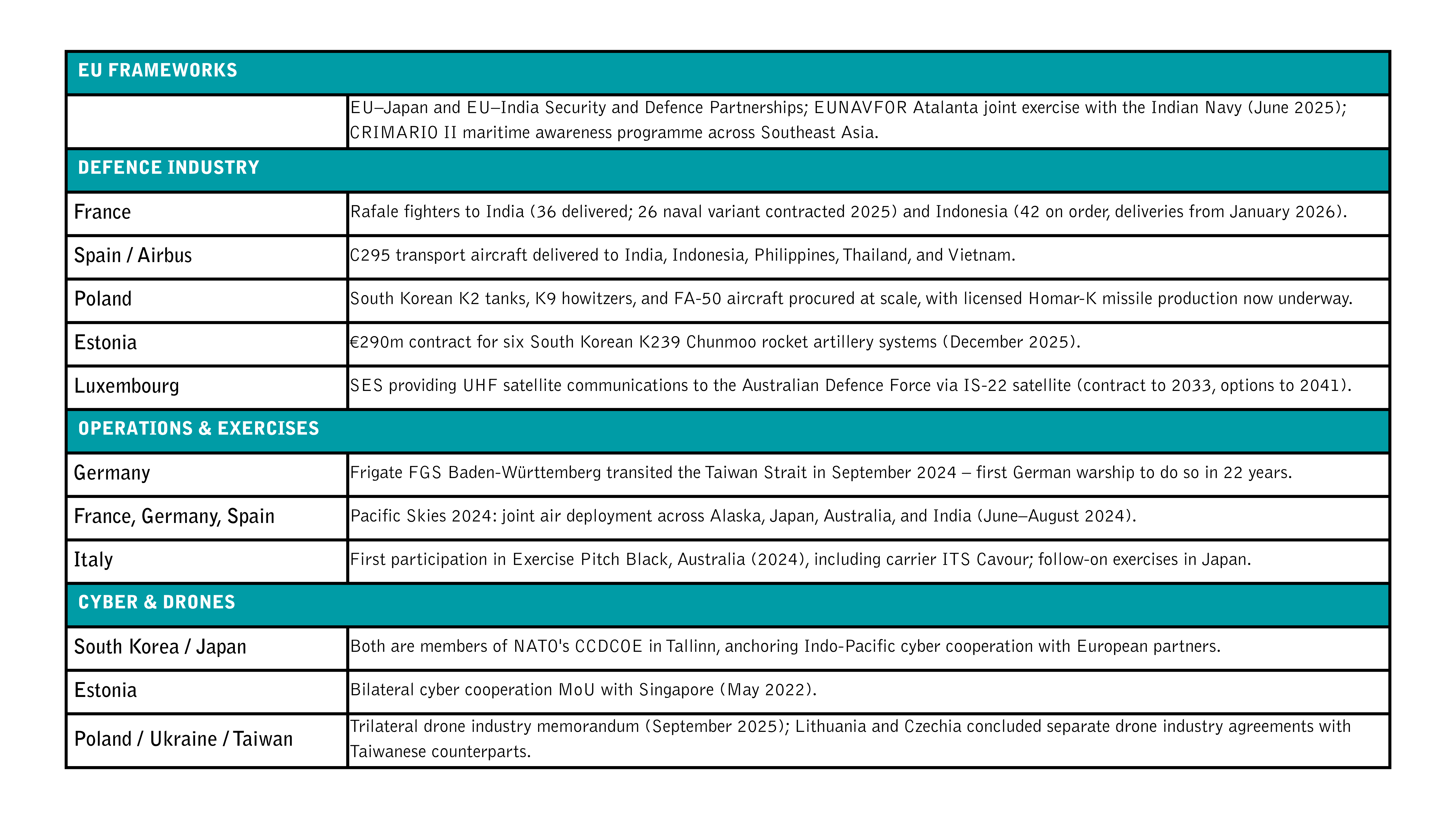
Several Central and Eastern European states stand out in the data. Poland and Czechia have strong defence-industry footprints in Asia, with growing links to South Korea, Taiwan, Vietnam, and Indonesia.
Figure 1: Priority Indo-Pacific partners - bilateral concentrations at a glance
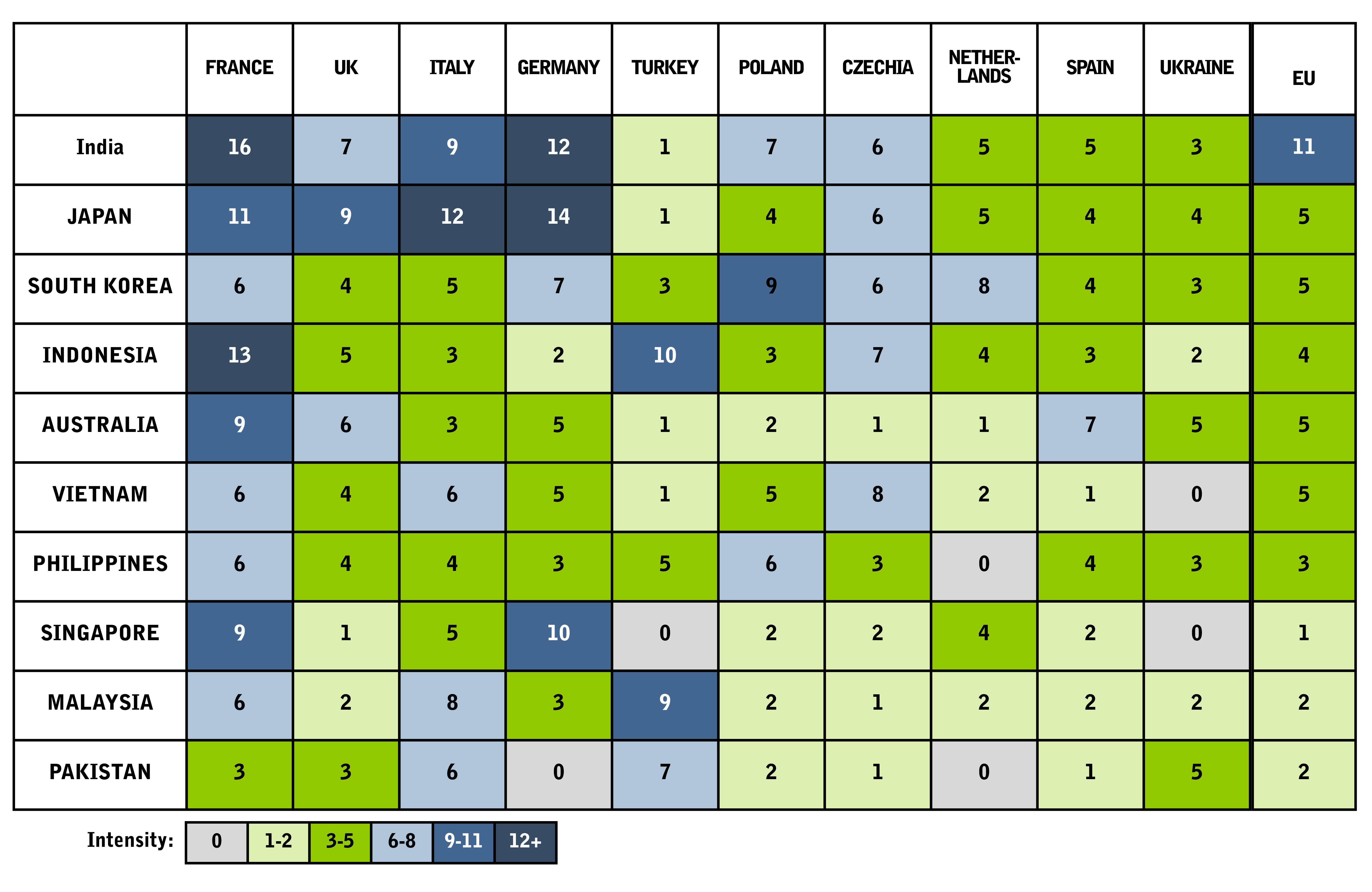
Estonia (29) leads Europe on cyber-security cooperation with Indo-Pacific partners. These are niche contributions, but they represent genuine capability that the EU could scale.
Below this second tier of engagement, a long tail of 21+ EU Member States accounts for 307 entries collectively. Much of it consists of niche but meaningful ties, from cyber and training links to defence-industrial contacts and legacy bilateral channels. Without an EU-level aggregating function, partners see these as scattered national fragments rather than as part of a broader European offer.
On the partner side, engagement is concentrated around a small club. India (134 entries), Japan (116), and South Korea (101) together absorb a third of all European cooperation. The next tier – Indonesia (75), Australia (69), Vietnam (57), the Philippines (54), and Singapore (50) – takes the total to 61%.
Australia presents a distinctive case. With 69 entries it sits in the second tier of Indo-Pacific partners, but that count obscures a specific structural disruption.
France’s bilateral engagement, historically the most substantive, was disrupted by the 2021 AUKUS announcement, which ended the submarine programme overnight and sits entirely outside EU coordination architecture.
The surprise AUKUS announcement also makes visible a wider reality: European Indo-Pacific engagement takes place within a regional order still structured by the United States.
The Pacific Islands receive negligible European security attention (France excepted), much of South Asia beyond India is thinly covered, and parts of the western Indian Ocean – where EU NAVFOR already operates – lack the bilateral density to sustain engagement between rotational deployments.
This concentration is not irrational: India, Japan, South Korea, and Australia are the partners most willing and able to invest in structured security cooperation with Europe.
But it leaves Europe vulnerable to the charge that its Indo-Pacific strategy is really a strategy for three or four countries. And there is potential in broadening the partner base.
A de facto division of labour already exists among Member States. France leads on the Indian Ocean and Pacific, Germany and Italy on Northeast Asian major economies, Central Europe on South Korea and Vietnam, Estonia and the Baltics on cyber.
The data also suggests implicit geographic specialisation: Poland’s growing links with South Korea and Taiwan, Czechia’s legacy ties with Vietnam and Indonesia, Denmark’s maritime-security partnership with Kenya.
These patterns have emerged organically. The question is whether Brussels formalises them or leaves them uncoordinated.
Figure 2: Europe in the Indo-Pacific - Selected examples
Closing the coordination gap
The 275 defence-industry entries in the dataset have no EU-level governance framework. This is not new – but it is newly consequential, as EDIP and the Strategic Compass create EU-level frameworks that Member State bilateral competition undermines. French, Italian, Polish, Czech, and Swedish firms bid for the same contracts in Indonesia, India, and South Korea.
While competition is intended, they sometimes undercut each other’s credibility. There is no mechanism to share market intelligence on procurement cycles, identify opportunities for consortium bids, or set basic ground rules against intra-EU competition.
Türkiye sharpens the problem. Türkiye is a competitor, running a pure arms-export strategy targeting Southeast Asia and Pakistan. It leverages cultural ties alongside competitive pricing to supply advanced offensive systems.
The contrast with EU engagement is not that Türkiye exports to these markets, as several other European states also do, too; it is that Türkiye does so without the broader partnership architecture that gives EU engagement its strategic rationale.
Meanwhile, Ukraine’s combat-proven drone technology is becoming attractive to Indo-Pacific partners: Kyiv is in active discussions with the Philippines on maritime-drone co-production, and Ukrainian, Taiwanese, and Polish firms signed a trilateral drone-industry memorandum in September 2025; Lithuania and Czechia have separately concluded drone industry agreements with Taiwanese industry bodies – part of a broader pattern of Central and Eastern European engagement with Taiwan’s drone ecosystem that Brussels has yet to map or coordinate.
The European Defence Industrial Strategy and associated instruments like the EDIP, adopted by the Council of the European Union in December 2025, are designed to strengthen Europe’s defence-industrial base – but they are predominantly inward-facing. There is no mechanism to coordinate outward-facing defence-industrial engagement with Indo-Pacific partners.
Member States currently apply EU Common Position arms export criteria to Indo-Pacific partners in isolation, with no visibility into what others are approving or on what basis. Competitive pressure to secure contracts can distort those national assessments resulting in a structural information asymmetry with both commercial and normative consequences.
Training and capacity building present a similar challenge. The dataset records 71 entries in this lane: 13 from the EU, 41 from EU Member States, often targeting the same countries through parallel bilateral channels.
Vietnam and Indonesia, where Member-State activity is densest, would be natural candidates for consolidated EU-branded programming. But no coordination cell exists within the European External Action Service (EEAS) to map, cluster, or sequence national contributions.
Lack of EU–UK coordination compounds the issue, the United Kingdom accounting for 90 database entries with forward-deployed assets and institutional infrastructure that no EU Member State replicates.
The consequences of this coordination deficit were most visible in September 2021, with the AUKUS announcement. Since then, the May 2025 EU–UK Security and Defence Partnership has been concluded. The SDP does mention the Indo-Pacific as one of several regions for consultations, but it does not contain a dedicated Indo-Pacific track.
Figure 3: European Indo-Pacific engagement has accelerated sharply but remains fragmented
Source: Author’s research; 1,077 entries covering EU institutions, 27 EU Member States, five non-EU European states (Norway, Switzerland, Türkiye, Ukraine, and the United Kingdom), and 49 Indo-Pacific partners (March 2026). Graphic design: Joan Lanfranco.
Policy recommendations
The annual Security and Defence Dialogues established under the Indo-Pacific SDPs do provide the EEAS with an opportunity to present a coherent account of European engagement in aggregate (bilateral and EU-level alike) rather than leaving Member State activity invisible at the EU level, but six further steps would help close the coordination gap without requiring new institutions.
1. Create an EU Indo-Pacific engagement tracker. Mapping is the precondition to coordination. The EEAS should maintain a live database of Member-State security activities in the Indo-Pacific (modelled on the dataset underpinning this analysis) to provide transparency, identify duplication, and spot gaps, covering all three lanes of cooperation. This function should be anchored in the Asia-Oceania Working Party (COASI), where Member State diplomats already coordinate weekly on Indo-Pacific policy, with the Indo-Pacific Special Envoy responsible for maintaining the tracker and presenting consolidated findings to Member States through the Political and Security Committee (PSC) and European Union Military Committee (EUMC).
2. Broaden the partner base. European engagement is heavily concentrated. Three gaps warrant specific attention. First, the Philippines: a US treaty ally under maritime pressure and an emerging partner for European drone technology, but without the structured EU-level engagement its strategic position warrants. Second, Malaysia: the dataset’s largest under-institutionalised relationship relative to defence-industrial footprint, and a primary market for Türkiye’s competing export strategy. Third, the Pacific Islands: almost entirely absent from European security engagement outside French territories, despite direct relevance to undersea cable and maritime domain security.
3. Designate thematic and geographic lead contributors. The EU already informally relies on France for maritime security and Estonia for cyber. Making this explicit, through an “Indo-Pacific niche contributions catalogue”, would allow the EU to present a coherent offer to partners while letting smaller Member States contribute meaningfully. Lead-nation responsibility should carry light reporting obligations to the EEAS.
4. Establish an Indo-Pacific defence-industry coordination mechanism. Convened by DG DEFIS in coordination with the EEAS and the European Defence Agency, a biannual working group could map Indo-Pacific procurement cycles, identify consortium opportunities, develop norms against intra-EU competition, and host structured industry dialogue through the EU’s economic security framework. Its remit should include Common Position coordination: sharing how Member States are applying arms-export criteria to Indo-Pacific partners to reduce the information asymmetries that allow competitive pressure to distort national assessments. This is a coordinative function; enforcement remains a national competence. Defence-industry coordination should also feature as a standing item at the EU Indo-Pacific Ministerial Forum, giving the mechanism political visibility above the working-group level.
5. Build a training coordination cell within the EEAS. CRIMARIO II and ESIWA+ already provide functioning architecture. A coordination cell should map Member-State bilateral activities, cluster contributions under EU programme branding where multiple Member States are active in the same partner country, and use EU instruments to fill gaps. Vietnam and Indonesia should be the pilot cases.
6. Operationalise the EU–UK Indo-Pacific track. The May 2025 Security and Defence Partnership establishes regular consultations covering the Indo-Pacific alongside other regions of joint interest. The existing Security and Defence Dialogue should build on this consultation mechanism to develop a dedicated strand: coordinating deployments, sequencing capacity-building programmes, and aligning messaging in countries where both the EU and UK are active. Without this, partner countries must engage Brussels and London separately, duplicating effort on both sides.
The October 2025 Council conclusions called for more EU “presence, visibility and actions” in the Indo-Pacific. The data shows that European activity is already extensive; the challenge is not whether Europe engages, but whether it does so as a coherent actor or as 27 separate ones.
References
1. Dataset compiled by the author: INDOPACIFIC_MASTER_MARCH_FINAL.xlsx, 1,077 entries covering EU institutions, 27 EU Member States, five non-EU European states (Norway, Switzerland, Türkiye, Ukraine, and the United Kingdom), and 49 Indo-Pacific partners (March 2026). Entries span 1947–2026 but are subject to recency bias in collection. Available here.
2. Council of the European Union, ‘EU Strategy for Cooperation in the Indo-Pacific: Council approves conclusions’, 20 October 2025.
3. European Defence Industry Programme (EDIP) regulation adopted by the Council of the European Union on 8 December 2025. EDIP provides €1.5 billion for 2025–2027 to strengthen the EU’s Defence Technological and Industrial Base.
4. EU–UK Security and Defence Partnership, signed 19 May 2025 at Lancaster House. The agreement references the Indo-Pacific as a region for consultation but contains no dedicated implementing structure for the region.
5. 4th EU–Indo-Pacific Ministerial Forum, Brussels, 20–21 November 2025. Chair’s statement highlights Security and Defence Partnerships with Japan and South Korea, the conclusion of EU–Indonesia CEPA negotiations, and a new initiative on critical maritime infrastructure protection.
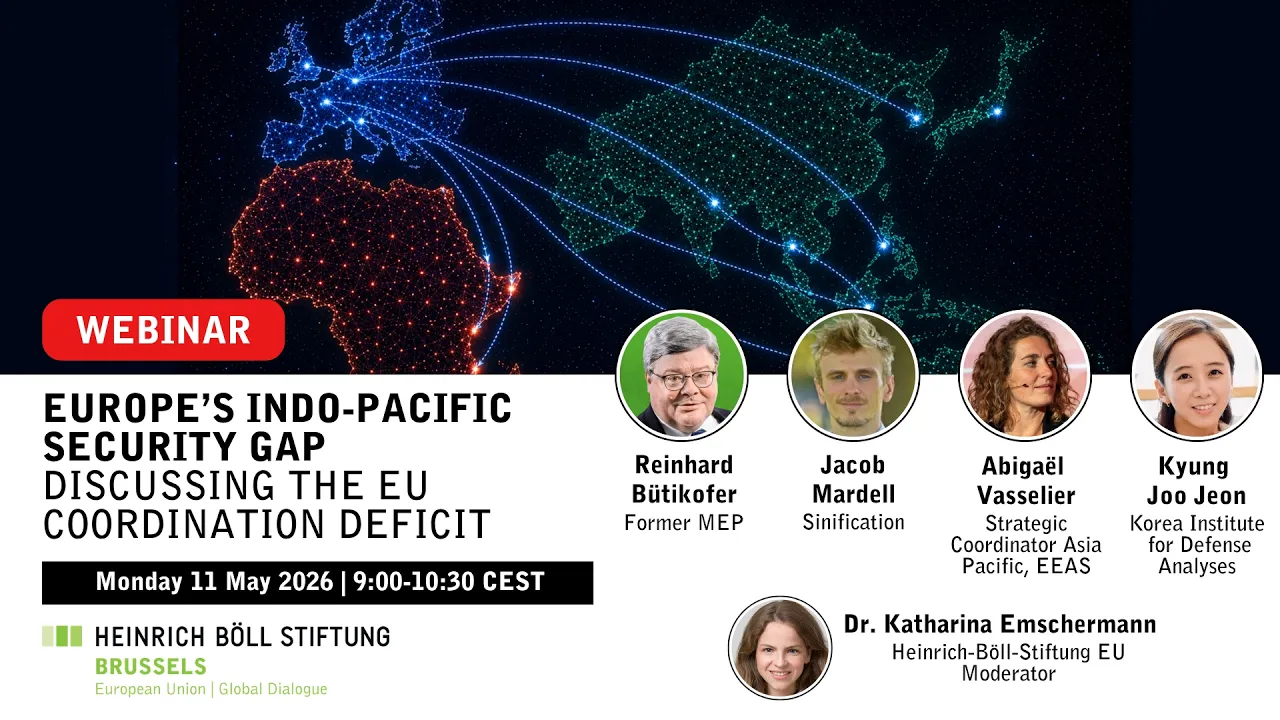
Webinar recording
Europe’s Indo-Pacific security gap: Discussing the EU coordination deficit in the Indo-Pacific - Heinrich-Böll-Stiftung EU | Global Dialogue
 Watch on YouTube


