The 2016 elections in Slovakia: a shock No parliamentary elections in Slovakia have ever caused so much surprise, consternation and dismay as those held on 5 March 2016. The results can be readily characterised as shocking. Grigorij Mesežnikov
Ending the crisis in Burundi: What to remember and keep in mind Following peaceful protests against a contested third term of the president, violence has once again escalated in Burundi. Efforts to end the crisis will continue to fail if they ignore the country’s history and its political landscape. Yolande Bouka
Doing Something Bad for Europe? The UK’s Referendum Deal The famous wit Mary McCarthy once remarked, ‘If someone tells you he is going to make a “realistic decision”, you immediately understand he has resolved to do something bad.’ Alex Brianson
Diverging Voices, Converging Policies: The Visegrad States’ Reactions to the Russia-Ukraine Conflict The annexation of Crimea in March 2014 and the launch of a hybrid war against Ukraine was Russia’s answer to the revolution triggered by Euromaidan. The conflict continues to pose fundamental challenges for the European Union, and raises the question of whether the EU will maintain its commitment to the political and economic consolidation of those of its Eastern neighbours which aim to make sovereign choices based on the rule of law and democracy. Jacek Kucharczyk, Grigorij Mesežnikov
War on Terror 2.0? Following the attacks in Paris, a global coalition in the fight against ISIL emerged. History seems to repeat itself. What have we learned from the events since 2001, and how did it come to the current escalation? Hans Joachim Giessmann
ENF: the New Right-Wing Force in the European Parliament and how to Deal with It On 15 June, Marine Le Pen, together with Geert Wilders and MEPs from five other parties, announced the creation of their new far-right political group. Jan-Philipp Heinisch
Can the European Union Help Ukraine to Succeed? Reforms, the Russian Factor and Implications for the Eastern Neighbourhood Ukraine presents a crucial challenge for the EU, as well as an opportunity to prove its ‘transformative power’ and its ability to protect its goals and interests in the neighbourhood. Henrik Hallgren, Iryna Solonenko
What the Paris Agreement means for Climate Policy in the US Commentary In his support of, in and for Paris, President Obama has emerged as the first real “Climate President” of the United States. Nevertheless, whether or not his country and predecessor will remain faithful to this legacy remains uncertain. Rebecca Bertram
[COP21] COP 21 and the Paris Agreement: A Force Awakened Globally, political leaders are lauding the acceptance of the global and legally binding Paris Agreement on Climate Change at COP 21 as a historical moment. It achieves a goal long believed unattainable. However, judged against the enormity of the challenge and the needs and pressure from people on the ground demanding a global deal anchored in climate justice (“system change, not climate change!”), the Paris Agreement can only be called a collective failure and disappointment. Read a critical assessment by hbs colleagues from around the world. Lili Fuhr, Liane Schalatek, Maureen Santos, Hans JH Verolme, Dr. Radostina Primova, Damjan Bogunović
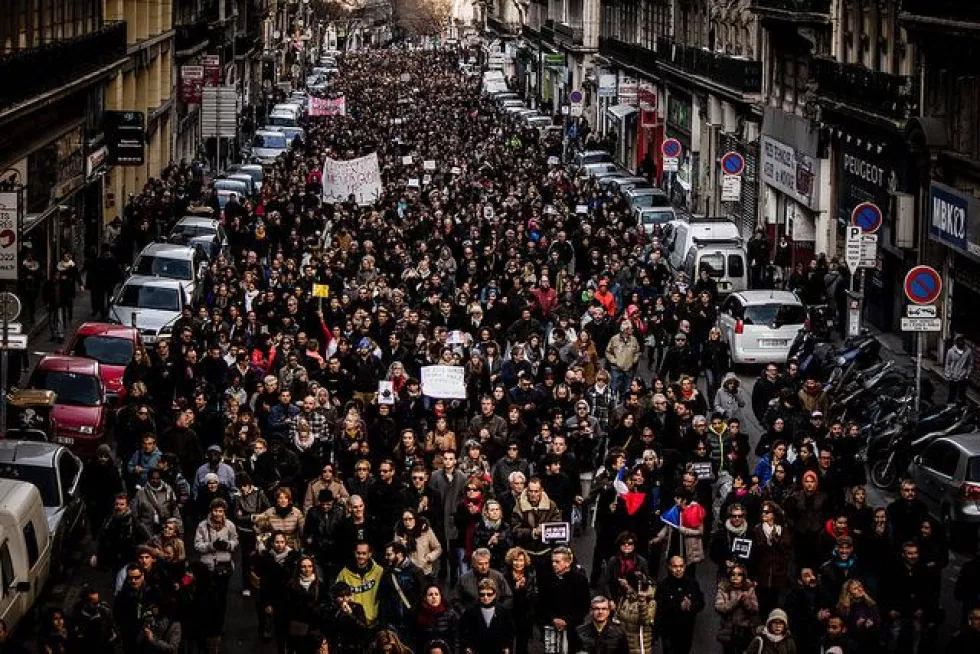
How to Defeat Terrorism and Defend Freedom ─ Europe after the Paris Attacks We are living in extremely turbulent times. Never in the past decades has the old adagio ‘the EU is now at the crossroads’ been so true. Nothing seems certain any longer, everything can happen: a suspension of Schengen, the fall of the euro, a major war conducted by a EU country, a terrorist lockdown at the heart of Europe. We are all understandably confused. Camino Mortera-Martinez