

Agribusiness Atlas 2026
Seeds form the foundation of our food supply. Yet they are increasingly controlled by a small number of multinational corporations. New genetic engineering techniques are accelerating this trend. Together, these developments are eroding biological diversity and pushing farmers around the world into ever greater dependence.

Seeds are both the origin of all agricultural crop production and its outcome. Some of the harvested grains are used for food – milled into flour and baked into bread – while others are kept for sowing the next season's harvest. Over countless generations, farmers and plant breeders have improved yields and crop quality through continuous selection, creating a diversity of plants adapted to specific climates and soils.
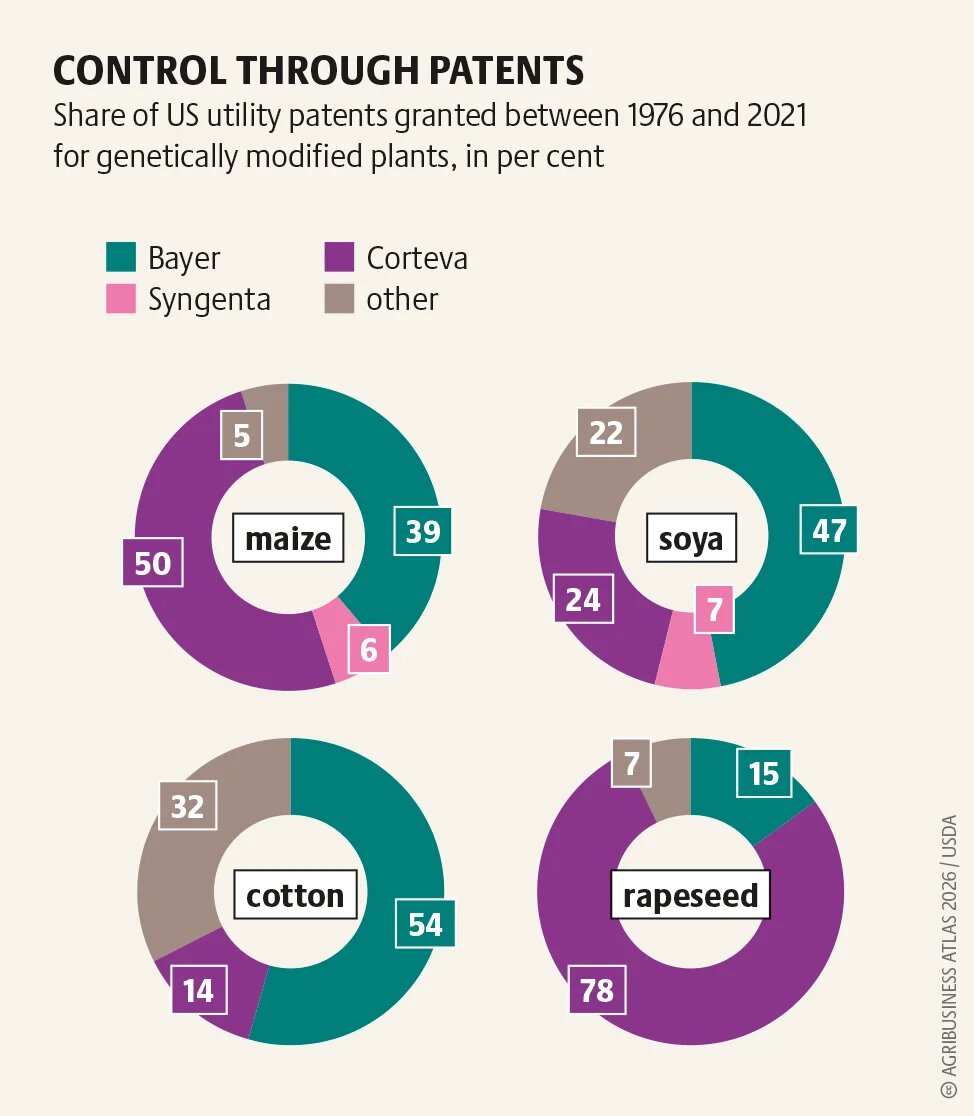
In theory, farmers would not need to buy seed at all, as it reproduces itself. This creates a fundamental challenge for corporations seeking to commercialise the development of new plant varieties. Through targeted lobbying, however, they have succeeded in establishing a business model that generates billions in annual revenue. Today, just three corporations control 56 per cent of the global seed market Ð a share that continues to rise. As market concentration increases, farmers and small-scale breeders are becoming ever more dependent on a handful of corporations that use patents to decide which plants may be grown and under what conditions. The result is not only reduced crop diversity in our food supply, but a significant overall decline in biological diversity.
To maintain control, corporations rely on two mechanisms: a biological and a legal barrier to seed reuse. The biological barrier emerged with the development and commercialisation of hybrid seeds in the early 20th century. Because hybrid seed rapidly loses its desirable traits when replanted, farmers must regularly purchase new seed from commercial suppliers. Although seed saving would be biologically possible, it is not economically viable for farmers. This constant need to repurchase seed steadily increases corporate market power.
Since the 1970s, the loosening of merger control in the United States, and later in other countries, has driven further concentration in the commercial seed market. In the 1990s, this trend gained additional momentum with the rise of genetic engineering and the strengthening of patent protection.
The legal barrier to seed reuse is enforced by corporations through patents. These grant their holders, for a limited period, the exclusive right to control the use and commercial exploitation of an invention. For farmers, this means that cultivating patented plants requires the patent holder's permission. Each year, seed must either be purchased anew, or a licence fee must be paid.
Genetically engineered seed is routinely patented, creating a powerful economic incentive for agribusiness corporations to turn increasingly to genetic engineering. In a market dominated by ever fewer players, competitive pressure is intense, pushing corporations to rely on familiar strategies to keep pace: boosting efficiency through technological innovation and cutting production costs through rationalisation. This dynamic creates increasing pressure for technological conformity. To avoid falling behind their competitors, larger corporations regard technological approaches such as new genetic engineering methods as indispensable.
Corporations are increasingly seeking patents for conventionally bred plants as well. Although this is officially prohibited, the European Patent Office has already granted hundreds of such patents. Together, they cover more than 1,300 plant varieties. Corporations secure these formally impermissible patents by exploiting legal loopholes: applications are worded to present conventionally bred plants as technical inventions. A prominent example is the so-called broccoli case, in which a patent was granted for a broccoli variety with a naturally elevated level of bitter compounds, despite originating from conventional cross-breeding.
This development is being fuelled by new genetic engineering techniques. These encompass a range of molecular genetic methods that enable targeted genetic changes to be introduced at specific sites. Because new genetic engineering techniques frequently do not involve the insertion of foreign DNA, corporations have identified a new loophole. They apply for patents on seed that could be produced using these techniques, even when the same traits could also be achieved through conventional breeding. The fact that smaller start-ups can patent NGT plants may accelerate the flood of patents. The new law to deregulate new genetic engineering techniques allows patents on plants and breeding techniques. Farmers will be faced with patented seeds and legal uncertainties. Pre-approval environmental assessments are to be scrapped.
A case in point is KWS, which was granted a patent on maize with enhanced digestibility, even though the relevant gene variants were identified in certain maize plants and introduced into KWS varieties through conventional breeding. The KWS patent applies to the plant type regardless of whether its traits were deliberately created through genetic engineering or occur naturally, thereby giving the corporation control over conventional breeding as well. This patent has already had a negative impact on the work of organic breeders in the Netherlands. Alongside KWS, other dominant corporations such as Bayer, BASF, Corteva, and the Syngenta Group have secured similar patents.
If farmers cultivate varieties patented by KWS or other corporations, they must obtain a licence. For farmers, this poses an existential threat: Concerns include the possibility of legal action when patented seed reaches a field unintentionally, for example through wind drift from neighbouring land.
A handful of corporations dominate our food system, setting prices, profiting from crises, and driving relentless pressure on the environment, farmers, and consumers alike. The Agribusiness Atlas 2026 traces how this concentration of power took hold, and charts the political pathways toward a fairer food system built around the common good.
