

Agribusiness Atlas 2026
Deregulation of agricultural markets has led to volatile prices, unequal subsidies and farmers often selling below production costs. This undermines livelihoods and sustainable farming. Stronger European market regulation and fair pricing rules are needed to secure stable incomes and sustainability, and drive the much-needed agroecological transition.

Since the Blair House Agreement in 1992 and the establishment of the World Trade Organization (WTO) agreements in 1994, regulation of agricultural markets has been steadily rolled back. Tools to stabilise prices and production in specific sectors have been dismantled. As a result, agricultural prices have become volatile, as demand for food changes little while harvests fluctuate with weather and other factors. This leaves farmers' income swinging and forces them to live with uncertainty, even though they already have structurally weak bargaining power when dealing with processors and retailers.
To offset the effects of market deregulation, the European Union (EU) introduced direct payments to farmers in 1992, later decoupling them from production in 2003. These payments are allocated according to farm size, which encourages land and production to be concentrated in fewer hands. Today, they are distributed just as unevenly as farmland ownership: 80 per cent of payments go to 20 per cent of farms in the EU. Many small farmers are excluded due to the minimum requirements set by Member States.
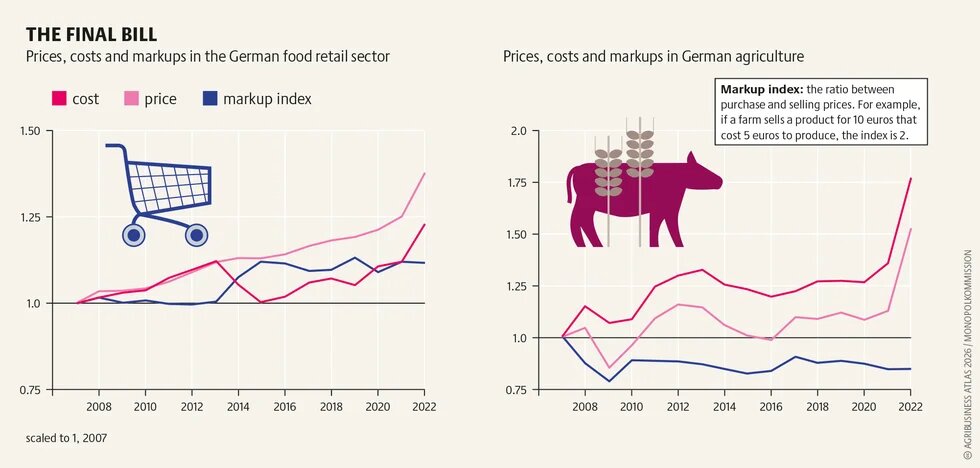
Prices paid to farmers for agricultural products fell sharply after deregulation in the early 1990s. Today, corporations often buy farm produce at prices below the cost of production without passing these lower prices on to consumers, pointing to a severe imbalance in how value is distributed across the food supply chain. The 2025-2026 price crisis in the European milk sector illustrates this dynamic. Milk output has surged due to the intensification of production, leading to overproduction. Milk prices have been falling for months, leaving thousands of producers unable to cover their costs.
Pairing market deregulation with area-based direct payments as compensation has failed to give farmers a viable livelihood, let alone enable them to produce healthy food using sustainable practices. Farmers are pushed to compete and produce at the lowest possible prices, externalising hidden social and environmental costs of this model of food production. Agricultural policy measures to ensure environmental and social conditionality have been ineffective in addressing the negative effects of the industrial intensification driven by a race to the bottom on price.
Peasant farmers' organisations are calling for policies to secure fair prices through market regulation grounded in the principles of food sovereignty and agroecology. The approach to regulate agricultural markets is nothing new. The unique nature of agriculture has been shaped by government intervention since ancient times. In the EU, market regulation was at the heart of the creation of the Common Agricultural Policy (CAP) and central to the founding principles of the EU itself. Despite the gradual weakening of agricultural market regulation, the EU still has a wide range of instruments at its disposal that could be used or improved to ensure fair prices.
One example is the European Directive on Unfair Trading Practices. It aims to address stark imbalances between small and large operators in the food supply chain. Its implementation in Spain through the Food Chain Act offers a useful case in point. The law obliges each link in the food supply chain to buy and sell at prices that cover production costs, beginning with producers. They have the right to anonymously report sales of their produce below production costs. These costs are co-defined by the producers themselves on a case-by-case basis. The ban has proven effective and helped raise the prices farmers receive.
However, national action alone is not enough. The EU also needs coordinated policies to regulate the common market and avoid unfair competition between countries. For this reason, peasant farmers' organisations are now calling for a ban on buying below production costs to be included in the directive and applied across Europe.
Similarly, the Common Market Organisation (CMO) within the CAP is the EU's main framework for regulating agricultural markets. It has the potential to stabilise farm incomes, support sustainable production systems, and strengthen the resilience of European food systems. A range of instruments could help achieve these goals, including public intervention stocks, supply management mechanisms, and minimum purchase prices. For instance, public stockholding schemes can stabilise prices by buying products when prices fall below a certain level and releasing them during periods of shortages, thereby reducing extreme price fluctuations. The recent EU decision to make written contracts between farmers and processors or retailers mandatory is a first step in the right direction.
In short, Europe's ability to meet environmental, social, and geopolitical challenges depends on whether those who produce our food and shape our landscapes are paid fairly. In an increasingly unpredictable global context, price and income stability must be secured through market regulation rooted in food sovereignty and agroecology. This will require a fundamental shift in EU agricultural policy.
A handful of corporations dominate our food system, setting prices, profiting from crises, and driving relentless pressure on the environment, farmers, and consumers alike. The Agribusiness Atlas 2026 traces how this concentration of power took hold, and charts the political pathways toward a fairer food system built around the common good.
