

Agribusiness Atlas 2026
Our food system is exacting a heavy toll on the climate. Green hydrogen for fertilisers, agrofuels, and carbon farming are all touted as ways to reduce or offset emissions. Yet rather than delivering climate neutrality, these technical fixes often create new problems.

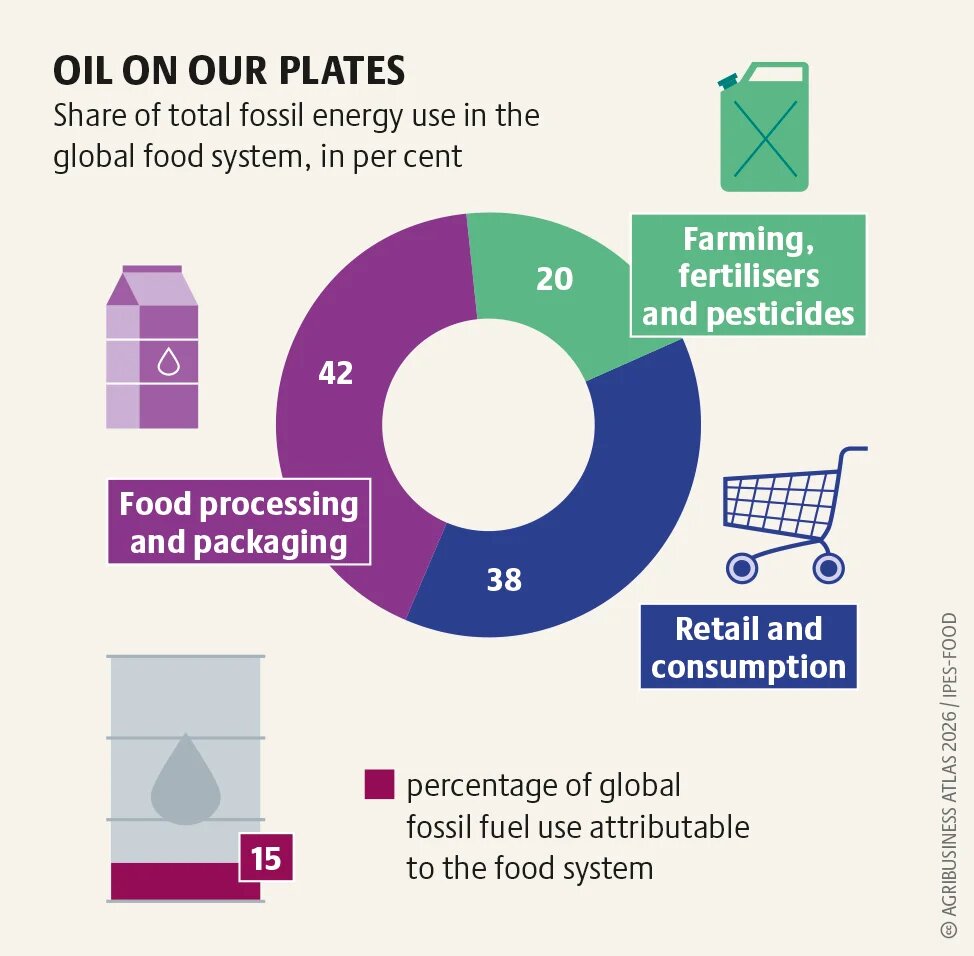
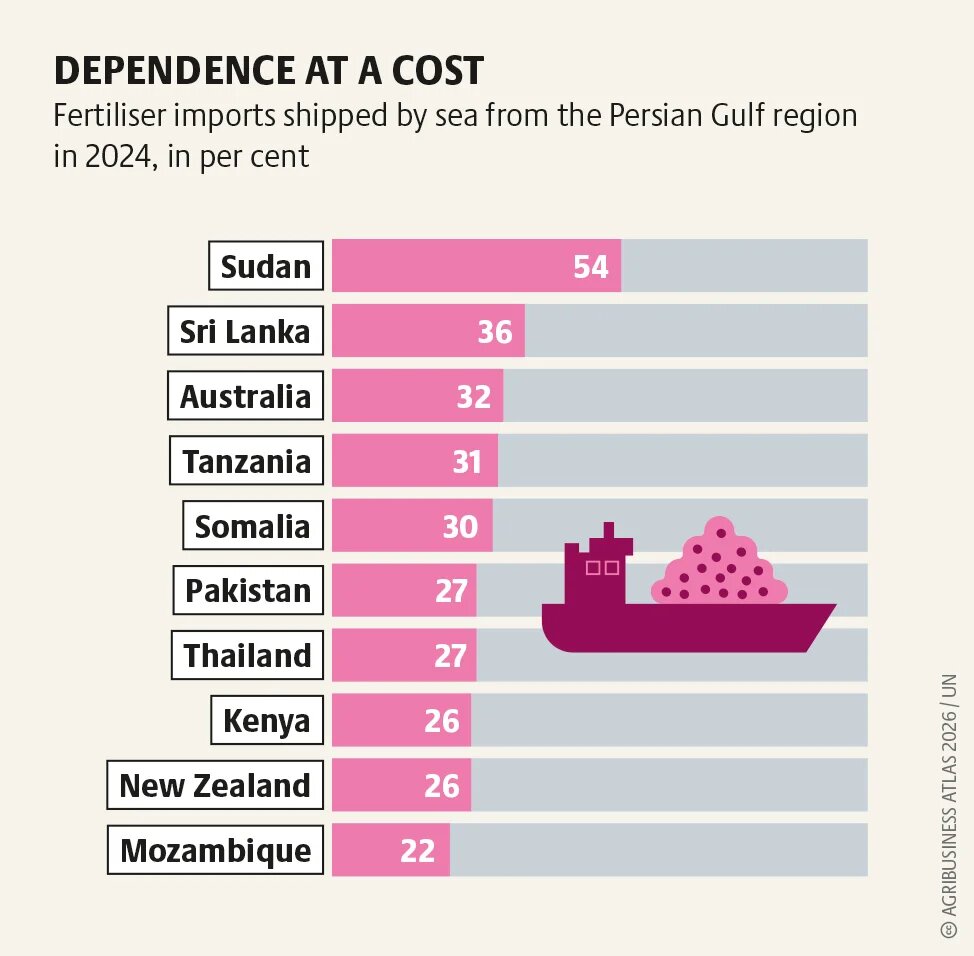
Farmers already feel the full force of the climate crisis through extreme weather events like droughts and floods. At the same time, farming drives that crisis: globally, food systems account for roughly a third of greenhouse gas emissions, including carbon dioxide (CO?). They also consume around 15 per cent of the world's fossil energy. The current war in the Middle East exposes, once again, the degree to which the agrifood sector remains dependent on fossil fuels, to produce fertilisers and pesticides, to power farm machinery, as well as to process, store, transport, and cook food. In recent years, agricultural and industrial corporations have pushed a range of decarbonisation strategies, promoting measures intended to reduce greenhouse gas emissions. However, many of these approaches carry risks and generate new social and environmental impacts.
Corporations such as Norwegian fertiliser giant Yara and German agrochemical producer BASF promise a green transition while continuing to profit heavily from fertiliser and ammonia production. Synthetic nitrogen fertilisers pose a major challenge for climate action: in recent years, their lifecycle emissions, from production through to application, have exceeded those of global aviation. Yara and others have announced that they will switch from fossil-based hydrogen derived from natural gas to green hydrogen, aiming to decarbonise production over the coming decades. In theory, green hydrogen could cut emissions by nearly 40 per cent; the remaining 60 per cent would persist. Once fertiliser is applied, soil microorganisms convert excess nitrogen into nitrous oxide, a greenhouse gas released into the atmosphere. This process occurs regardless of how the fertiliser is produced. Beyond this, the strain on soils and waterways remains a serious concern, even if green hydrogen were deployed at the scale corporations promise.
Another challenge lies in energy supply. Renewable electricity generation within the European Union (EU) falls well short of what would be required. Most green hydrogen would have to be imported from solar- and wind-abundant regions in Africa or South America, creating new dependencies. While corporations in the Global North reduce their reliance on fossil fuels, resource extraction in the Global South continues, fishing communities lose access to water, and pastoralists are pushed off their land.
Countries like Germany are vigorously promoting this agenda. Through its hydrogen diplomacy, the government forges energy partnerships with countries such as Colombia and Kenya. European climate funds and export credit guarantees are being deployed to sweeten the commercial case for hydrogen trade. The main beneficiaries are large agribusiness and industrial corporations.
Other sectors also pursue decarbonisation by drawing on agriculture. In transport, a sector with persistent emissions, agrofuels are meant to reduce the carbon footprint. Yet growing energy crops demand vast tracts of additional farmland and often relies on monocultures. This fuels land conflicts worldwide and frequently displaces food production.
Agrofuels used in the EU already require nearly 10 million hectares, the equivalent of 10 per cent of the EU's arable land. The current fossil fuel energy crisis is bringing agrofuels back onto the agenda, allegedly as a more affordable alternative to imported fossil fuels. Several countries in Asia, including Vietnam and Indonesia, have increased their use of agrofuels since the beginning of the US-Israel war against Iran. But agrofuels come with their own dependencies: they rely on industrial monoculture farming and, in the EU, advanced agrofuels cost 79 per cent more than charging an electric vehicle.
A model called carbon farming has also gained traction in recent years. Under this model, farmers and landowners are expected to modify their land-use practices to sequester carbon in soils or through tree plantations, then sell the stored carbon as carbon credits. Major corporations such as Unilever can buy their way out of addressing their emissions without making their production truly sustainable. Carbon credit schemes are frequently linked to reports of human rights abuses and land grabbing. In Tanzania, for example, the German car manufacturer Volkswagen is developing a carbon farming project that many members of the Indigenous Maasai community oppose, arguing that it severely restricts their traditional grazing practices. The contested area spans nearly one million hectares, larger than the entire island of Cyprus. Volkswagen aims to use carbon credits to shrink its carbon footprint. At its peak, the corporation and the cars it sells emitted more greenhouse gases annually than Australia.
The conclusion is clear: at a moment when war, energy shocks, and rising food prices are exposing the fragility of industrial agriculture, the response cannot be more of the same. When climate action relies primarily on technical fixes, it risks deepening dependence on large agribusinesses and costly technologies accessible only to large-scale industrial farms. Genuine decarbonisation in agriculture demands a fundamental transformation of our food system, one that puts the climate, ecosystems, and social justice first.

A handful of corporations dominate our food system, setting prices, profiting from crises, and driving relentless pressure on the environment, farmers, and consumers alike. The Agribusiness Atlas 2026 traces how this concentration of power took hold, and charts the political pathways toward a fairer food system built around the common good.
