

Agribusiness Atlas 2026
A handful of corporations now shape what kind of fish and seafood reach dinner plates worldwide. The industry has grown more concentrated and industrialised, from Norwegian salmon farms to global supply chains. Aquaculture has surged, yet wild stocks remain under pressure as fleets push further offshore. The shift is changing who profits and at what cost to consumers and the environment.

One of the world's largest seafood corporations traces its origins in processing wild-caught fish to late 19th-century Japan. After Maruha and Nichiro merged in 2007, the corporation became the Maruha Nichiro Group and later expanded into tuna farming and seafood distribution. In early 2026, it rebranded as Umios and now operates on every continent except Antarctica.
This example shows that, like many global industries, the seafood sector has come to be dominated by a small number of large corporations. The consolidation is driven by acquisitions of competitors and by corporations expanding across borders, sectors, and supply chains.
Many of today's leading seafood corporations began as wild-catch processors in Japan or salmon farming businesses in Norway. Salmon production remains concentrated in a handful of countries, including Canada, Chile, Denmark, Norway, and the United Kingdom. In 2023, just 15 salmon corporations accounted for two-thirds of harvest volumes, and consolidation has continued since, with deals such as Mowi's 655 million US dollar investment in Nova Sea.
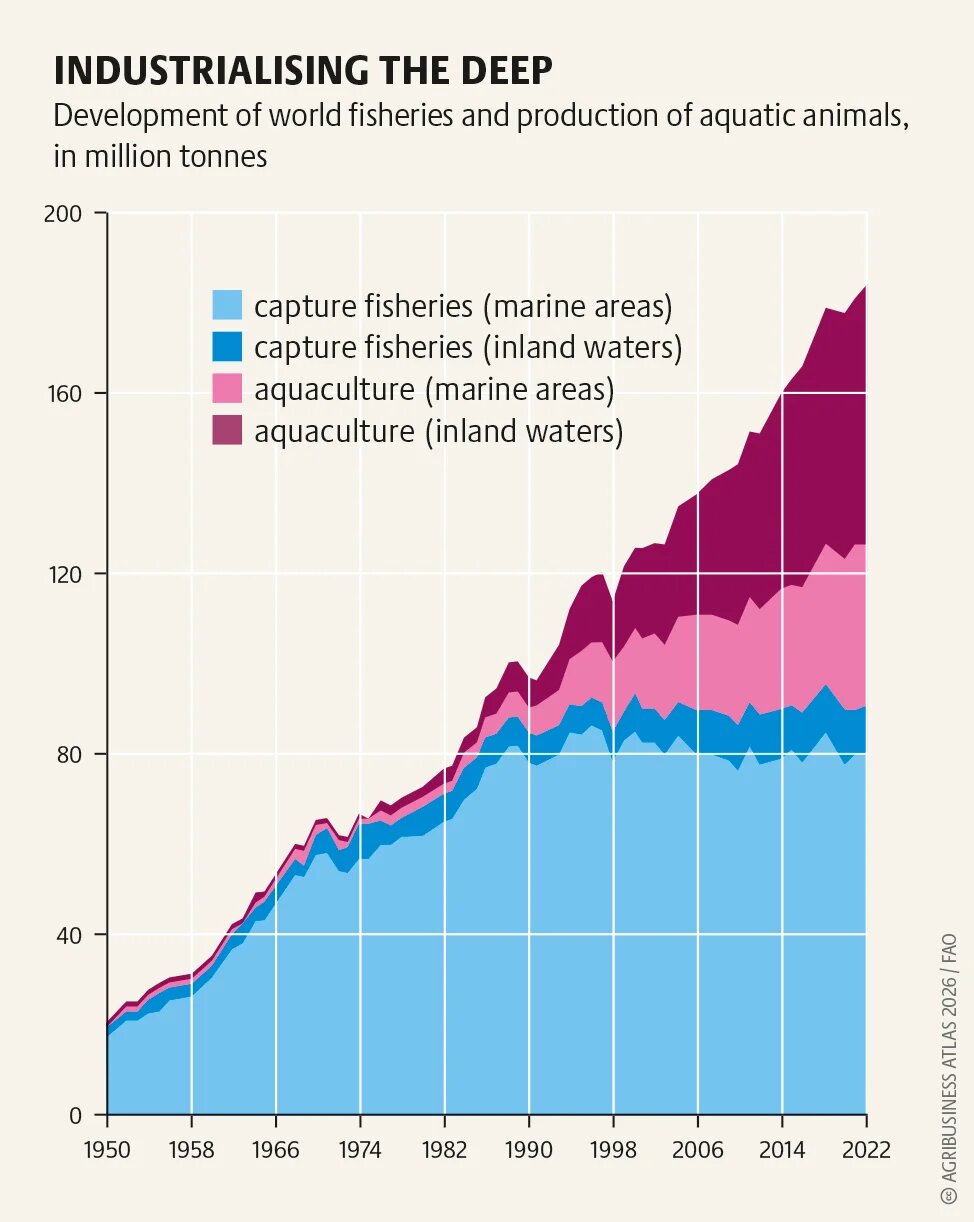
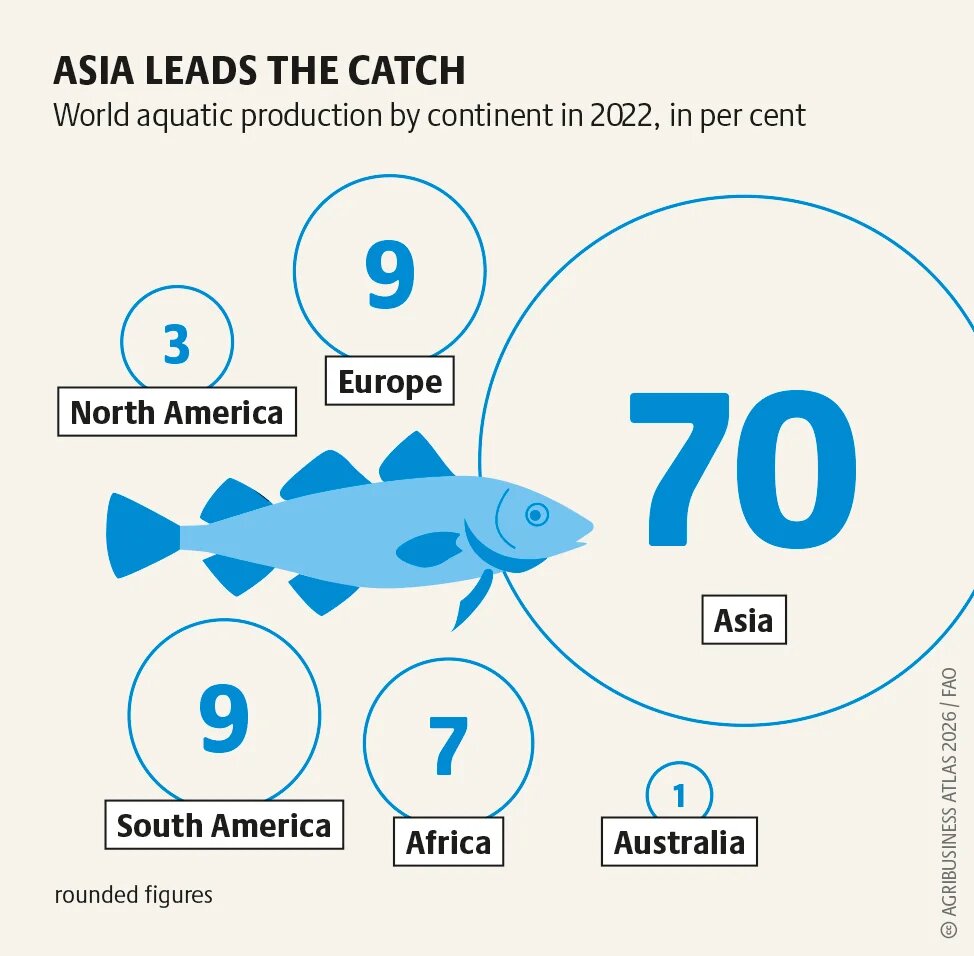
Since the 1990s, aquaculture production has more than quadrupled, while wild fish catches have remained largely unchanged. By 2022, aquaculture had surpassed capture fisheries in the production of aquatic animals. Some of the species frequently utilised in aquaculture production include carp, oysters, shrimp, and tilapia. Growth has been strongest in Asia, particularly in China. Most production takes place inland, and marine operations produce about 37 per cent of global output by weight.
In theory, the rise of aquaculture could reduce demand for wild-caught fish. In practice, it has not. Instead, corporations have continued to expand aquaculture alongside wild fisheries in pursuit of growth. Overfishing continues to deplete wild stocks, and large corporations have adapted by changing how and where they fish moving further offshore, operating at greater depths, and targeting smaller, previously ignored species. These shifts favour larger players with the financial and technological resources to adapt, contributing to further industry consolidation.
Even larger corporations from other sectors especially global meat processors are moving into the seafood sector at a rapidly increasing pace worldwide. JBS has acquired the Australian salmon producer Huon Aquaculture, and the Charoen Pokphand Group has expanded across the shrimp supply chain, from feed mills and hatcheries to farms and processing plants.
In a highly concentrated market, a shrinking number of corporations now decide what ends up on people's plates and how it is produced. The growing market power of a handful of players has also pushed up retail prices. Prison sentences for price-fixing are rare, but the former chief executive officer of Bumble Bee Foods was jailed for 40 months in the United States for his lead role in a canned tuna price-fixing scheme. Just three players controlled 78 per cent of US canned tuna sales in 2015, when the collusion was detected. Six leading Norwegian salmon farming corporations have also been accused of fixing prices by sharing information to manipulate spot markets.
Corporations also raise prices through strategies that attract less regulatory scrutiny, such as steering consumers towards more profitable products. For example, Mowi is working to transform farmed Atlantic salmon from an undifferentiated commodity into a branded product that commands higher prices. It has even hired a former Coca-Cola executive to reshape consumer habits much as Tyson Foods has done with chicken.
Consolidation has driven the expansion of industrial aquaculture, which relies on high stocking densities and genetically uniform varieties. This often results in heavy use of antibiotics and anti-fouling chemicals, nutrient-rich waste, and farmed fish escaping into the wild, where they can harm natural populations.
Fish and seafood are important sources of nutrition for much of the world's population. Although high-value segments such as farmed salmon and canned tuna are dominated by multinational corporations, others such as carp farming remain in the hands of small and medium-sized producers. Smaller operations and shorter supply chains often support food security, create jobs, sustain incomes, and make communities more resilient to disruption. Yet government policies, infrastructure, and subsidies continue to favour large-scale operations, reinforcing the trend towards consolidation.
A handful of corporations dominate our food system, setting prices, profiting from crises, and driving relentless pressure on the environment, farmers, and consumers alike. The Agribusiness Atlas 2026 traces how this concentration of power took hold, and charts the political pathways toward a fairer food system built around the common good.
