

Agribusiness Atlas 2026
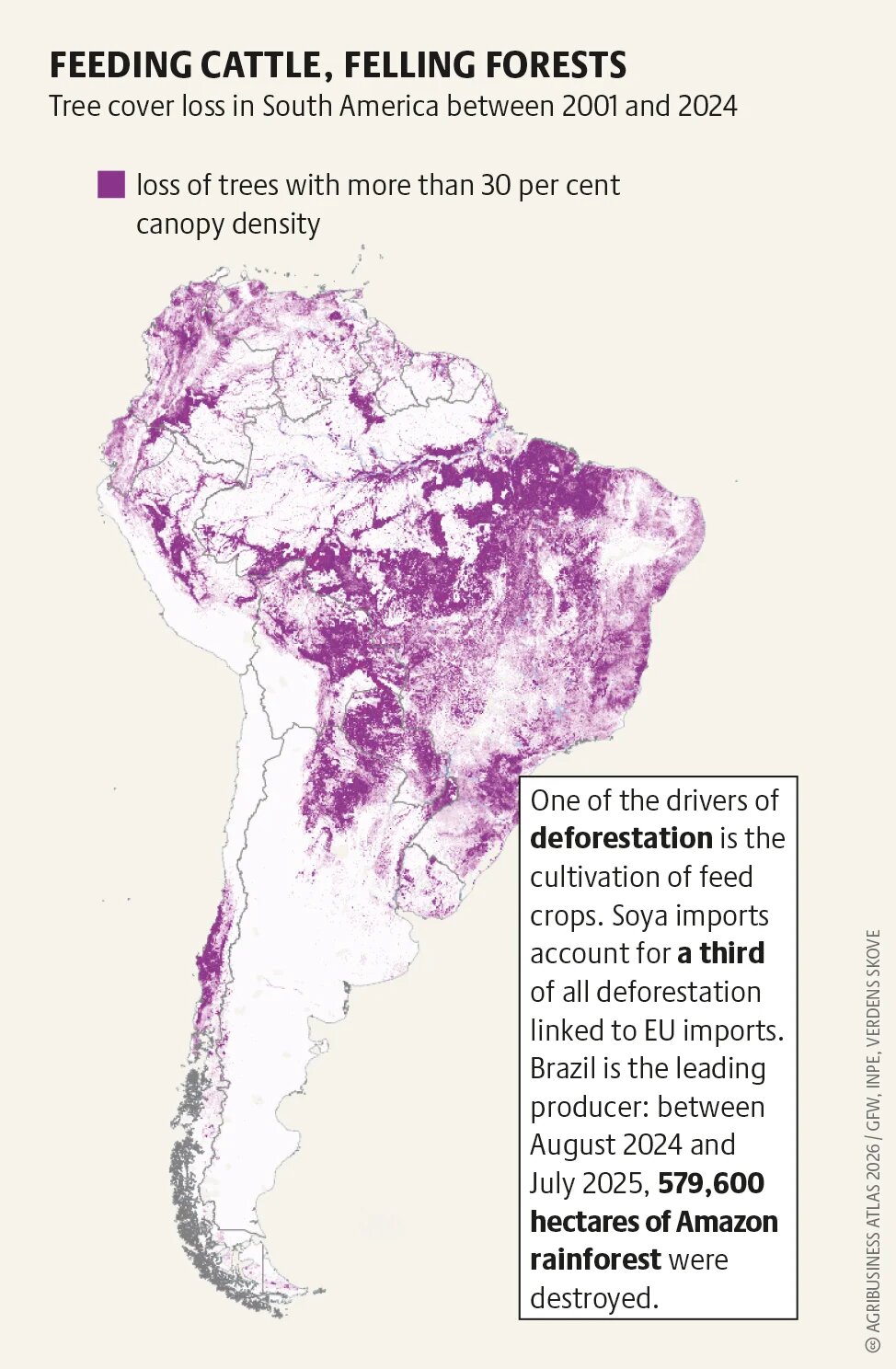
A small number of global players dominate the trade in animal feed, much of which is produced at the expense of rainforest and savannah clearance and the displacement of Indigenous communities. At the end of these supply chains, soya from corporations such as Cargill ends up in feed troughs on farms across Europe.

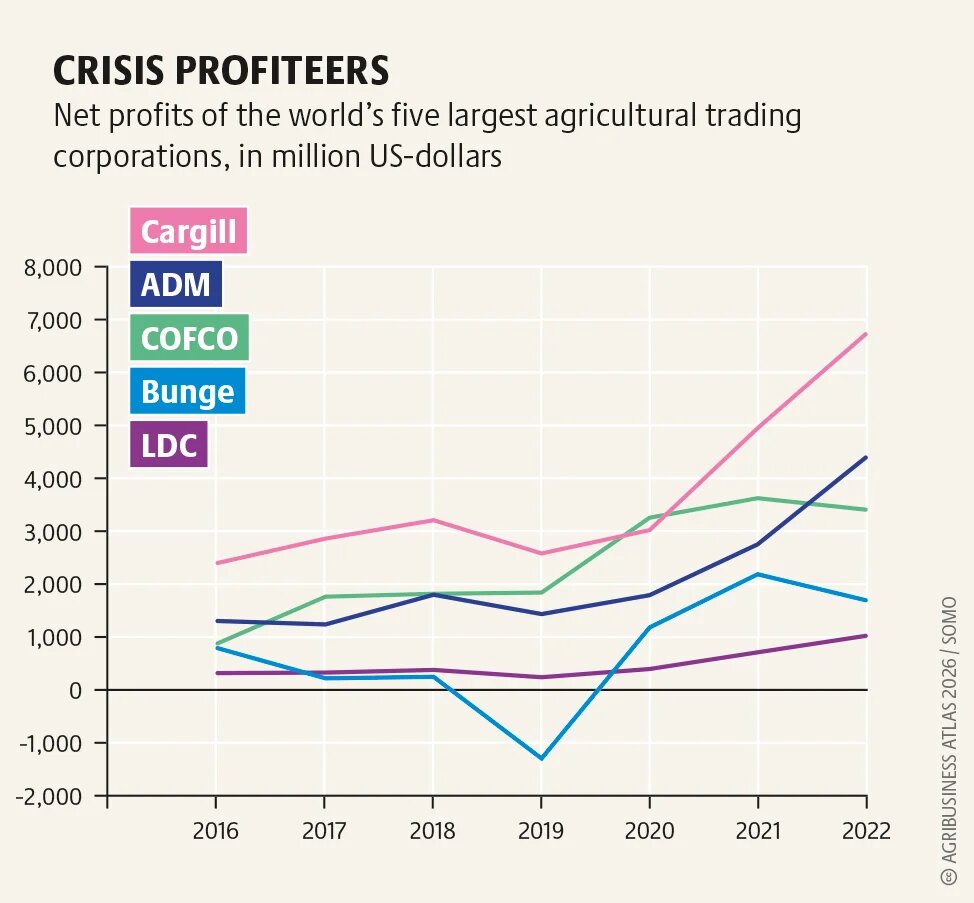
Soya has become the world's most sought-after agricultural commodity, generating export revenues of around 80 billion US dollars in 2024. Between 1968 and 2018, the global area under soya cultivation more than quadrupled, while production volumes increased more than eightfold. A key driver of this expansion is the rising demand for animal products: more than 75 per cent of all soya grown worldwide ends up as protein feed for pigs, poultry, and cattle. Global trade in soya and other feed crops such as maize and wheat is controlled by a handful of dominant corporations: Archer Daniels Midland (ADM), Bunge and Cargill from the United States, COFCO from China, and Louis Dreyfus Company (LDC) from the Netherlands.
This oligopoly is known as the Big Five. It benefits most when prices rise for example when agricultural markets are shaken by geopolitical crises. During the COVID-19 pandemic and following the start of Russia's full-scale war of aggression against Ukraine, the Big Five achieved record profits. Concentration in the agricultural trading sector is intensifying further. In 2025, Bunge completed a merger with the Canadian corporation Viterra. As early as 2022, the two corporations together controlled more than 20 per cent of soya exports and almost 25 per cent of maize exports from Brazil, a key global market. Competition experts warn that growing market power means lower incomes for producers, higher prices for consumers, and an overall increase in market instability.
According to studies, fewer than 3 per cent of all soya beans worldwide are produced in line with sustainability standards. Major agricultural traders repeatedly face criticism over deforestation and human rights violations. This applies in particular to Cargill – the largest privately held corporation in the United States, which reported revenues of 160 billion US dollars in 2024. Since 2003, Cargill has operated its own port in Santarém, in the Brazilian state of Pará. From there, the corporation exerts control over the trade in soya from the Brazilian Amazon and the Cerrado savannah. In 2006, the Brazilian government introduced a moratorium aimed at preventing corporations such as Cargill from sourcing soya grown on deforested land in the Amazon. Investigations show, however, that Cargill continued to trade in soya linked to the burning of the Amazon rainforest at least until 2020. In January 2026, the Brazilian Association of Vegetable Oil Industries, including the corporations Bunge and Cargill, announced its withdrawal from the soya moratorium Ð a dramatic setback for forest protection.
For years, Indigenous communities including the Munduruku have accused the corporation of disregarding ancestral land rights. One of the most controversial projects is the planned Ferrogrão railway, backed by Cargill and other major corporations. The nearly 1,000-kilometre transport corridor for soya and maize threatens to cut through 16 Indigenous territories and facilitate land grabbing. Investigations have also revealed dire working conditions within Cargill's operations. In 2023, a Brazilian court ordered the corporation to pay compensation after it was proven to have sourced cocoa from plantations where child labour was used.
The market power of large agricultural trading corporations must be curbed. This is necessary to protect Indigenous communities from displacement, farmers and workers from exploitation, consumers from high prices, and the environment from destruction. To achieve this, mergers must first be subjected to rigorous scrutiny, taking their social and environmental impacts into account. Second, effective sanctions are needed when corporations abuse their market power to dictate prices and distort competition. Third, greater transparency is essential: What quantities of commodities do major agricultural traders hold in storage, and where? Access to this information would enable governments to draw on these reserves in times of crisis in order to mitigate food shortages and price shocks. This objective should take precedence over corporate profits and returns for investors.
Greater transparency is also needed along the long journey that soya beans and other feed crops undertake from seed to final consumption. An important step in this direction is the EU's regulation on deforestation-free products. It is intended to ensure that corporations, as well as their suppliers and subcontractors, have not committed human rights violations during production and have not used land on which forests were damaged or cleared after 2020. Finally, policymakers can reduce demand for soya and other feed crops through targeted support programmes. These could help farms keep fewer animals and make greater use of domestically grown protein crops, while also making plant-based diets more attractive to consumers.
A handful of corporations dominate our food system, setting prices, profiting from crises, and driving relentless pressure on the environment, farmers, and consumers alike. The Agribusiness Atlas 2026 traces how this concentration of power took hold, and charts the political pathways toward a fairer food system built around the common good.
