

Water Atlas 2025
Industrial and scientific activities are pushing into previously undisturbed marine zones, extracting metals from the seabed and trialling large-scale interventions in ocean chemistry in the name of climate mitigation. Interventions such as deep-sea mining and marine geoengineering entail ecological risks whose long-term consequences remain uncertain.

Covering over 65 percent of Earthユs surface, the deep ocean is no longer beyond human reach. Once perceived as remote and inhospitable, it is now viewed as both a treasure trove of resources and a testing ground for climate interventions. As industrial and scientific interests extend further offshore, two developments have come to the fore: deep-sea mining and marine geoengineering. While deep-sea mining seeks to extract mineral deposits from the seabed, marine geoengineering aims to alter ocean chemistry to remove the greenhouse gas carbon dioxide (CO2) from the atmosphere. Though different in purpose, both rest on the same assumption: that ocean systems can be engineered to serve human ends. Yet this expanding reach into the deep carries risks to marine life, ecosystems, and the future of our planet.
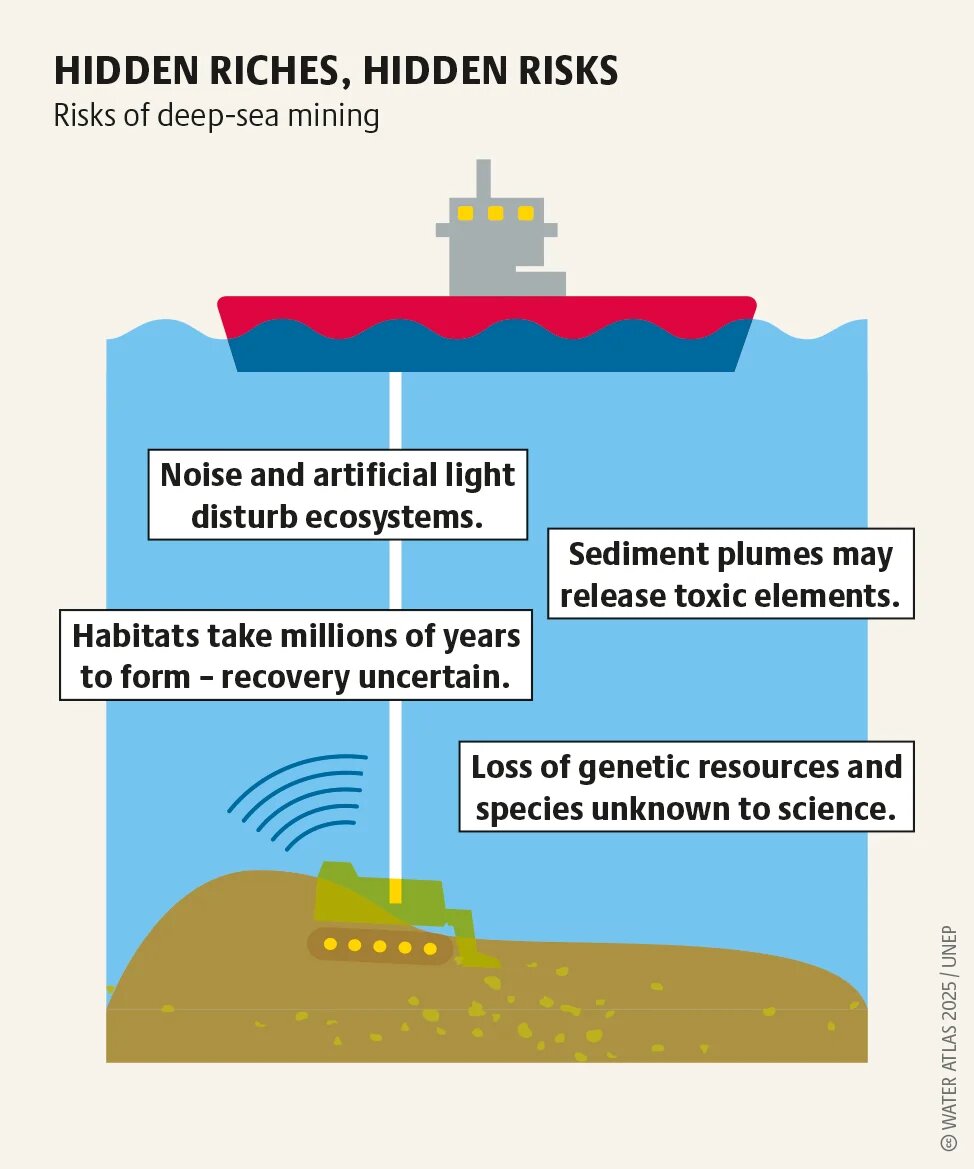
Deep-sea mining involves extracting minerals such as cobalt, copper, gold, manganese, nickel, silver, and rare earth elements from the ocean floor. These resources accumulate in polymetallic nodules scattered across abyssal plains, cobalt-rich crusts on seamounts, and massive sulphide deposits near hydrothermal vents. Attention is currently concentrated on the Clarion-Clipperton Zone (CCZ) in the Pacific Ocean, where an estimated 21.1 billion dry tonnes of polymetallic nodules lie. Stretching across 6 million square kilometres from Mexico to Hawaii, the CCZ is home to an estimated 6,000 to 8,000 species, around 90 percent of which have not yet been described by science. Deep-sea ecosystems may take decades to recover from mining damage, given the slow growth rates and reproductive cycles of marine life. Dredging the seafloor creates sediment plumes that can suffocate life and disrupt nutrient cycles. Acoustic disturbance from mining operations may impact deep-sea species that rely on vibrations or pressure changes. With over 60 percent of the deep-sea DNA sequence variants still undescribed, the full consequences remain unknown.
Governance for deep-sea mining falls primarily to the International Seabed Authority (ISA), established under the United Nations (UN) Convention on the Law of the Sea. The ISA has issued 17 exploration contracts covering approximately 1 million square kilometres. Yet many scientists and conservationists argue that current frameworks are outdated, underdeveloped, and weakly enforced, particularly in terms of environmental protection. Meanwhile, opposition to deep-sea mining is growing worldwide. To date, 40 countries have called for a moratorium or complete ban. They are backed by a broad coalition of lawmakers, Indigenous communities, civil society groups, leading corporations, financial institutions, and more than 930 scientists and policymakers from over 70 countries.
A similar pattern is emerging in marine geoengineering, which also lacks a comprehensive international regulatory regime despite a recent surge in open-water experiments. While over 50 countries are parties to the London Protocol, few have enacted national legislation on ocean geoengineering. The Protocol already effectively prohibits ocean fertilisation as a form of one marine geoengineering technique, but many other approaches are now being developed and trialled.
Marine geoengineering involves large-scale interventions in ocean systems allegedly aimed at mitigating the climate crisis. Two leading methods include ocean fertilisation – adding large quantities of nutrients like iron to stimulate phytoplankton growth – and ocean alkalinity enhancement, which seeks to increase the ocean's capacity to absorb carbon dioxide.
These large-scale interventions could trigger chain reactions difficult to predict or control. Phytoplankton blooms may disrupt food chains or produce harmful algal growth. Altering ocean chemistry could affect species adapted to highly stable conditions.
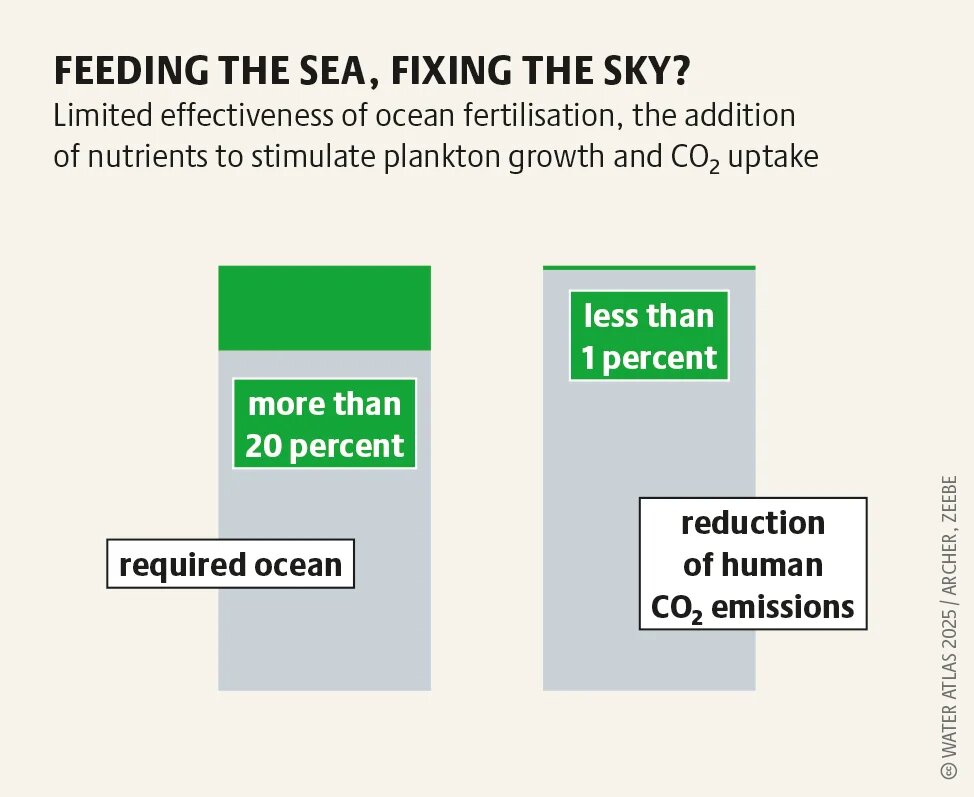
Scientists warn that some geoengineering approaches may acidify coastal waters. In 2012, a rogue ocean fertilisation experiment released 100 tonnes of iron sulphate off the west coast of Canada, triggering a bloom over 10,000 square kilometres. Geoengineering may also accelerate eutrophication, the over-enrichment of seawater with nutrients. If algae and phytoplankton are fertilised, they may grow excessively. As they die, bacteria decompose the biomass on the seafloor, consuming oxygen. This creates dead zones with oxygen levels too low for most marine life. Over 700 dead zones were reported globally by 2019, compared to about ten in 1960.
Both deep-sea mining and marine geoengineering seek profit through new technologies or the sale of carbon offsets that prolong fossil fuel use. Both pose profound and unpredictable risks to the deep ocean. Whether digging for minerals or manipulating marine chemistry, humanity is exerting unprecedented pressure on ocean ecosystems. These developments mark a new era: the deep sea is no longer out of sight and must not be out of mind. In solving crises on land and in the atmosphere, we must not create new ones in the ocean. Deep-sea mining and marine geoengineering test our capacity for foresight and precaution in the final frontier.

