Water Atlas 2025
In many countries, coal companies are not only the main emitters of carbon dioxide – they are also the biggest water users. By importing fossil fuels, the world’s wealthiest countries contribute to water shortages in producing countries.

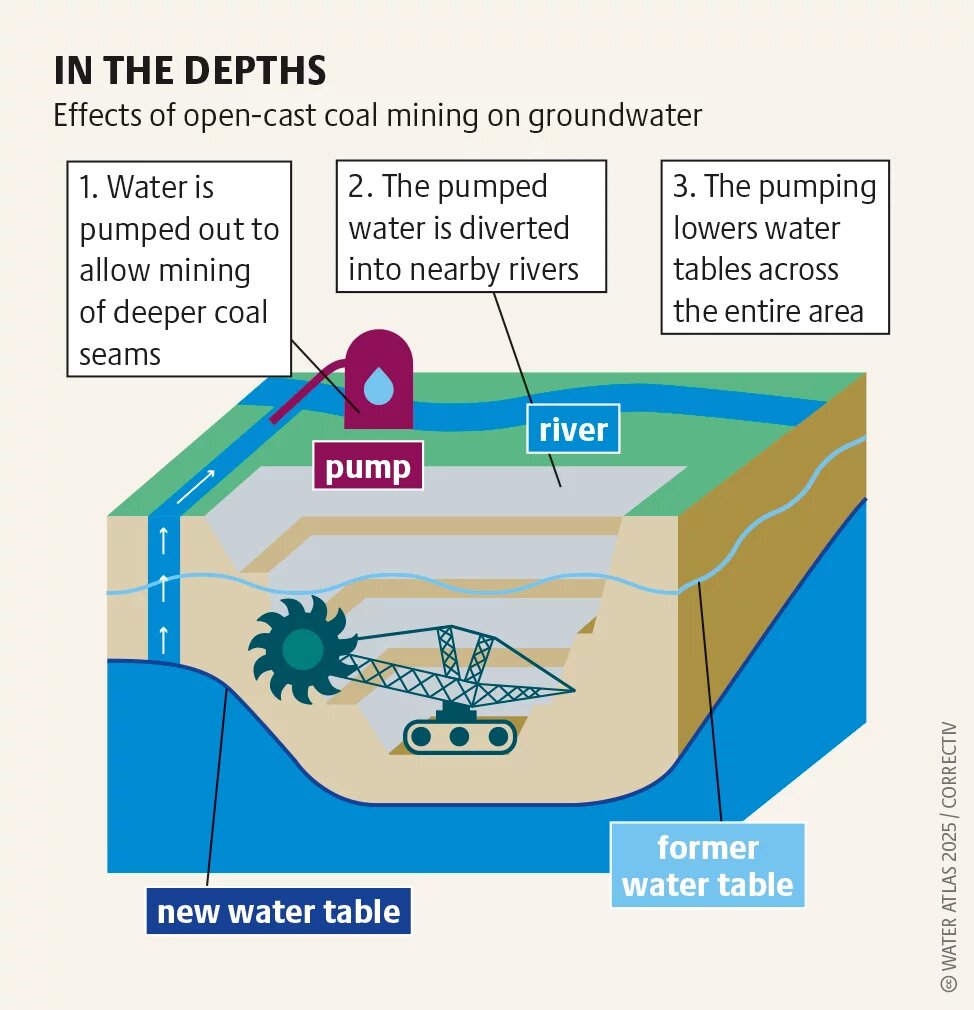
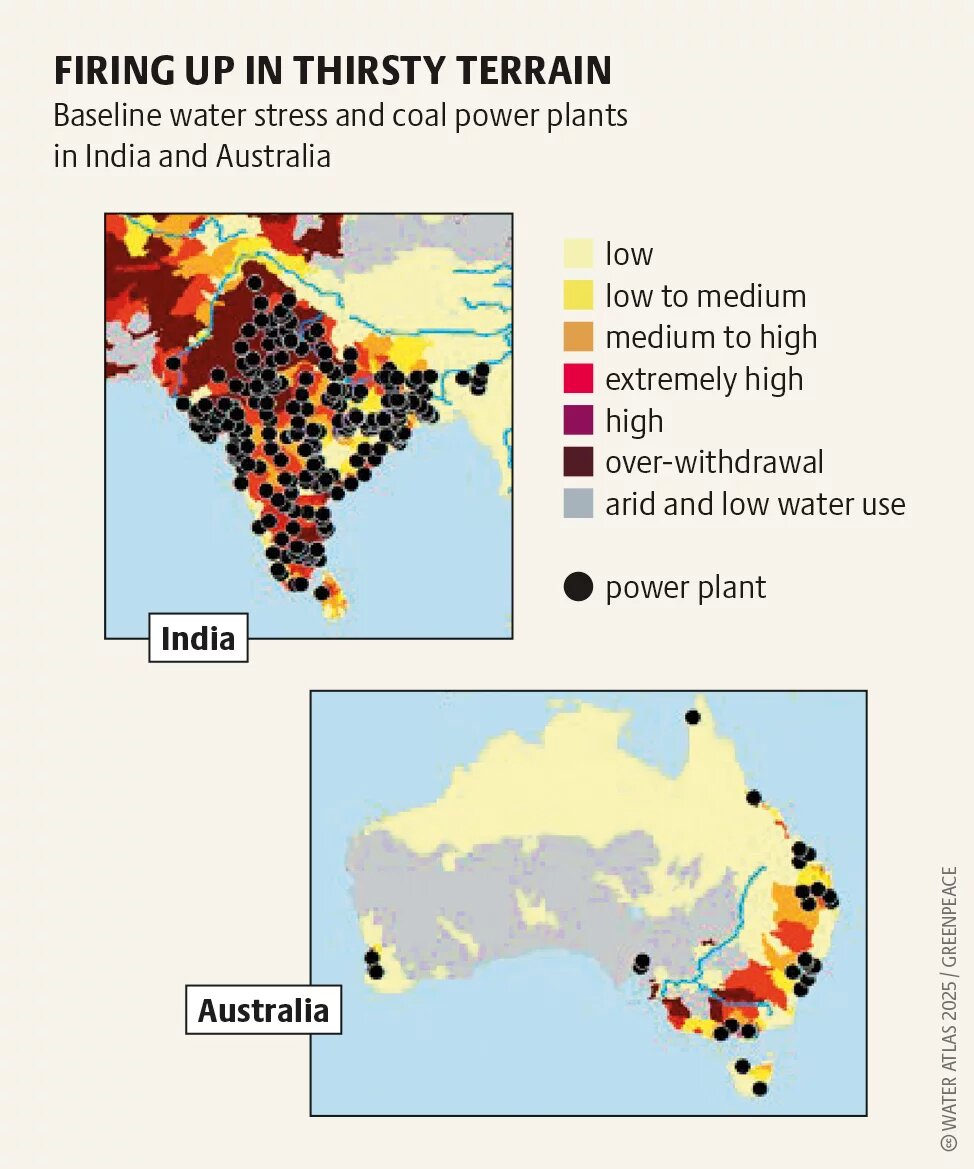
Fossil fuels cause immense damage to the climate. Coal is the biggest driver of the climate crisis: mining and burning it is responsible for more than 30 percent of global warming. Coal mining also has a major impact on the regional water balance. Large quantities of groundwater must be pumped out to expose the deeper layers of rock where coal is found. Coal-fired power stations also need large amounts of cooling water. A 500-megawatt power station with a continuous cooling system requires a flow of water that would fill an Olympic swimming pool every three minutes.
Mining leaves behind consequences that must be dealt with for many generations to come. Sufficient financial resources must be set aside to cover the costs of doing so. In some countries such as Germany, in accordance with the so-called polluter pays principle, the mining companies are obliged to make provisions for mitigation and monitoring activities, but not all the follow-up costs are factored into the price. In particular, the burdens and costs of long-term consequences such as surface-water pollution and damage from rising groundwater have scarcely been analysed or quantified. There is no guarantee that the funds set aside for post-closure mine monitoring will still be available if, for example, the mining company goes bankrupt. And in many countries, the principle does not apply.
To generate energy, many countries continue to import coal from various producing countries, including the United States, Australia, South Africa, Poland, and Colombia. Colombia mined around 84 million tonnes of coal every year between 2012 and 2022. In northern Colombia, numerous rivers have been diverted and dams constructed to permit coal mining. In mining regions such as the La Guajira semi-desert, water shortages are a major contributor to the high local infant mortality. Economically stronger countries import large amounts from Colombia. Germany, for example, imports some 5 million tonnes of coal yearly from Colombia, and is thus responsible for the consumption of at least 5.5 million cubic metres of water there.
Coal is not the only fossil fuel depleting global water resources. In late 2024, two damaged oil tankers in the Strait of Kerch, between the Black Sea and the Sea of Azov, attracted widespread attention. The ships were carrying around 9,000 tonnes of heavy fuel oil. The subsequent oil spill led to the death of dolphins and the contamination of more than 40 kilometres of beach. It is difficult to estimate the number of birds that had their plumage stuck together by the oil slick, seals whose fur was fouled, or fish whose gills were clogged. Such oil disasters also result in oil entering the marine food chain and damaging the ecosystem over the long term.
Accidents and lax regulations are not the only reasons oil causes water shortages and pollution. This is seen in Canada’s synthetic crude oil production: between 2 and 4.5 units of water are required to produce one unit of oil. The industry is permitted to extract around 349 million cubic metres of water a year from the Athabasca River – about the same volume needed to supply a city of 2 million people. Another problem is the contaminated wastewater discharged by oil refineries. This contains numerous pollutants that end up in rivers and lakes, where they damage ecosystems. Studies show that this wastewater harms both water quality and biodiversity.
Energy companies promote natural gas as a cleaner alternative to coal and oil. But the numbers tell a different story. As a fuel, gas is responsible for one-fifth of global carbon dioxide emissions. Fracking, a technique to extract both fossil gas and oil, involves injecting a mixture of water, sand, and chemicals into deep rock layers using high amounts of pressure. This procedure creates fine cracks and releases the trapped fossil fuels. Groundwater may be contaminated by drilling, storage of chemicals used in fracking, methane release, chemical flowback, and the seepage of contaminated reservoir water. The fracking process itself requires large amounts of water as well. According to the German Environment Ministry, around 170,000 cubic metres of water are needed for a well with six drill strings required to fully develop a gas-bearing reservoir.
A comprehensive and equitable phase-out from coal, oil, and gas is necessary to protect global water resources and the climate. This requires rapid and far-reaching renewable energy expansion and reduced energy consumption. Policies must prevent fossil fuel companies from shirking the follow-up costs of their activities and evading responsibility for perpetual liabilities of fuel extraction.